
An EICR for a private rented property in England is valid for up to five years, but the date that actually governs when you need a new one is the “next inspection date” printed on the report itself. That date can be shorter than five years if the inspector’s judgement calls for it, and if the report comes back unsatisfactory, remedial work has to be sorted, typically within 28 days, before the property can be considered compliant.
TL;DR:
- The next inspection date listed on the EICR report, not the five-year maximum, determines when a new inspection is required in England.
- Inspections may be scheduled shorter than five years if the inspector cites risks like aged wiring, damp environments, or high usage, and this overrides generic timeframes.
- A change of tenancy does not automatically invalidate a valid EICR, provided it is still within its period and previous remedial work is complete.
- An unsatisfactory or expired EICR must be addressed promptly, with remedial work completed within 28 days and a new certificate issued before the next tenant moves in.
- Landlords should track property-specific inspection dates, proactively plan renewals, and avoid letting certificates lapse to stay compliant and prevent penalties.
Table of Contents
- What an EICR covers and why the next inspection date matters
- Landlord duties in England under the 2020 regulations
- Common validity periods and how an inspector’s judgement changes them
- Does a change of tenancy invalidate a valid EICR?
- What happens if an EICR is unsatisfactory or expired: codes, remedial timelines and enforcement
- When to get an earlier inspection: red flags and practical triggers
- How to arrange renewal: step-by-step practical checklist for landlords
- Validity differences for EICRs in different parts of the UK
- Impact of property type or usage on EICR validity periods
- Regulatory updates or changes affecting EICR validity over time
- Clarification on what constitutes a valid EICR report format or documentation standards
- What landlords consistently get wrong about EICR validity
- CityPat’s EICR services and how to get support
- Sources
- FAQ
What an EICR covers and why the next inspection date matters
An Electrical Installation Condition Report (EICR) is an assessment of the fixed wiring in a property: the consumer unit, cabling, socket outlets, light fittings and any fixed appliances wired into the system. It does not cover portable appliances like kettles or lamps, which fall under separate PAT testing.
A proper EICR comes as three parts: a condition report summarising the overall state of the installation, schedules of test results showing the measurements taken at each circuit, and an inspection schedule confirming what was physically checked. Buried in that paperwork is the single line that matters most for compliance: the recommended date for the next inspection. Landlords sometimes fixate on the five-year figure quoted everywhere online, but the Gov is clear that inspections must happen at intervals of no more than five years, and it is the date the electrician actually records that you are legally required to follow.
Landlord duties in England under the 2020 regulations
The Electrical Safety Standards in the Private Rented Sector (England) Regulations 2020 set out exactly what private landlords must do. Fixed electrical installations must be inspected and tested by a qualified person at intervals of no more than five years, and the resulting report has to reach the right people within specific windows.
- Supply a copy of the current EICR to existing tenants within 28 days of the inspection.
- Give new tenants a copy before they move in.
- Provide a copy to the local housing authority within seven days of a written request.
- Retain records until the next inspection is due, then keep the latest report on file.
- Arrange any remedial or further investigative work identified in the report and get written confirmation once it is done.
Local housing authorities enforce these duties and can issue remedial notices or financial penalties where a landlord fails to comply, so treating the paperwork as a formality rather than a legal record is a genuine risk.
Common validity periods and how an inspector’s judgement changes them
Five years is the commonly cited figure for private rented housing in England, but it is not universal. Owner-occupied homes commonly see a ten-year recommendation, while higher-risk environments, such as properties with a swimming pool, a caravan park connection, or premises with heavy public footfall, sometimes get a one-year interval.
- Private rented residential: generally up to five years, per the gov.uk guidance.
- Owner-occupied housing: often recommended at a longer interval, commonly around ten years.
- High-risk or heavily used installations: sometimes as short as about one year, depending on inspector judgement.
BS 7671 (Regulation 653.4) requires the inspecting electrician to record a reasoned explanation whenever they recommend an interval shorter than the standard maximum, according to NICEIC guidance on BS 7671. That explanation usually points to the installation’s age, its environment, evidence of past deterioration, or how intensively the property is used.
Whatever the inspector writes down as the next inspection date overrides any generic rule of thumb. If your EICR says three years because of a damp basement flat or an ageing consumer unit, three years is what you follow, not five.
Does a change of tenancy invalidate a valid EICR?
No. A change of tenant does not automatically require a new EICR, provided the existing report is still within its stated period, was marked satisfactory, and any remedial work it flagged has already been carried out, as confirmed by NRLA guidance on tenancy changes.
- Give the incoming tenant a copy of the most recent valid EICR before they move in.
- Do a quick visual check between lettings, looking at the consumer unit, visible socket condition and any signs of scorching or damage.
- Book a full re-inspection early if the visual check raises concerns, even though the certificate technically has time left to run.
The NRLA has also flagged that some EICRs are wrongly worded to say they are “valid until change of tenancy,” which is not correct: the only date that counts is the specific next inspection date the electrician records.
What happens if an EICR is unsatisfactory or expired: codes, remedial timelines and enforcement
An EICR grades any issues it finds using codes. C1 means danger present and requires immediate action. C2 means potentially dangerous. C3 is an improvement recommendation rather than a fault. FI means further investigation is needed. Under the current A4:2026 reporting rules, any C1 or C2 observation makes the whole report unsatisfactory, as set out in guidance on EICR outcomes and coding.
- An unsatisfactory report means remedial work must be arranged, usually within 28 days or sooner if the report specifies.
- Once the work is done, keep the original EICR alongside the remedial paperwork, such as a Minor Electrical Installation Works Certificate or a fresh EIC for any altered circuit.
- Local authorities can serve remedial notices and impose civil penalties on landlords who ignore an unsatisfactory report or let a certificate lapse.
An expired EICR, one where the next inspection date has passed without a new inspection being booked, puts a landlord in breach of the 2020 regulations regardless of how the previous report was graded.
When to get an earlier inspection: red flags and practical triggers
Waiting for the next inspection date on the certificate is fine most of the time, but certain events should push you to book sooner regardless of what the paperwork says.
- Flood or fire damage to any part of the property, even if the affected area seems minor.
- Tenants reporting electric shocks, burning smells, or scorch marks near sockets or the consumer unit.
- Circuit breakers tripping repeatedly with no obvious cause.
- Major refurbishment work, an extension, or a rewire of part of the property.
- Installation of an EV charger or other significant new fixed load.
Do a visual check between tenancies as a matter of habit, and again after any of the events above, per the gov.uk practical guidance on inter-tenancy checks. Mortgage lenders and buildings insurers increasingly expect a recent EICR as a practical condition of lending or cover, even where the law would allow a longer gap, according to Tradefox’s guide to EICR duration.
Pro Tip: Keep a simple spreadsheet of every property’s next inspection date and set a reminder for two months before it falls due, giving yourself time to book and fix any issues before the deadline bites.
How to arrange renewal: step-by-step practical checklist for landlords
Renewal is straightforward if you plan ahead of the date on the certificate rather than reacting to it.
- Book a qualified electrician registered with a body such as NICEIC or NAPIT and ask to see their registration before the visit.
- Gather previous EICRs, remedial certificates and any records of alterations so the inspector has full history.
- Give tenants reasonable notice of access, and clear the consumer unit and any obstructed sockets beforehand.
- Once remedial work is identified, get it certified separately and file it with the main report.
- Diarise the new next inspection date immediately rather than relying on memory.
| Step | Who is responsible | Typical timing |
|---|---|---|
| Book inspection | Landlord or managing agent | Before the current next inspection date |
| Carry out EICR | Qualified electrician | On the booked date |
| Arrange remedial work | Landlord | Within 28 days of an unsatisfactory report |
| Supply report to tenant | Landlord | Within 28 days (existing tenant) or before move-in (new tenant) |
| Supply report to authority | Landlord | Upon written request |
Building in a buffer before a new tenancy starts avoids the common problem of a certificate expiring mid-let with no time to fix defects.
Validity differences for EICRs in different parts of the UK
England’s five-year maximum interval under the 2020 regulations is specific to private rented properties in England. Scotland has run its own electrical safety regime for private tenancies for longer, requiring periodic inspection as part of the wider repairing standard, and Scottish landlords should check current Scottish Government guidance rather than assume the English rules apply.
Wales introduced its own electrical safety duties for private rented housing, broadly mirroring the five-year approach but sitting under separate Welsh legislation, so a landlord letting property in both England and Wales needs to check which specific statutory instrument covers each address.
Northern Ireland has not adopted the same mandatory EICR regime for private lets as England, and requirements there differ again. The practical point for any landlord with a portfolio spanning more than one UK nation is that the underlying safety principle, get the wiring checked and act on the findings, is consistent, but the legal duty, the trigger dates and the enforcement route are not automatically the same across borders. Always confirm the rules for the specific nation the property sits in rather than applying the England-only framework everywhere.
Impact of property type or usage on EICR validity periods
The five-year maximum in the 2020 regulations applies specifically to specified tenancies in the private rented sector in England. It does not automatically transfer to every type of property a landlord might own.
Commercial premises are not covered by the same regulations, and inspection intervals there are typically set by the inspecting electrician using BS 7671 and the nature of the business, sometimes shorter than five years for premises with heavy equipment use or public access. Houses in multiple occupation fall under the same private rented sector duties as any other let, so the five-year maximum still applies, though inspectors sometimes recommend shorter intervals given higher usage of shared wiring and sockets.
Holiday lets and short-term accommodation sit in a greyer area: if the letting counts as a tenancy under the regulations, the same duties apply, but many holiday lets fall outside that definition, and landlords should treat BS 7671’s general safety principles, and their own insurer’s expectations, as the practical benchmark rather than assuming no rules apply at all. Usage intensity, not just property type, is often the deciding factor an inspector weighs when recommending the next inspection date, which is why two similar flats can end up with different intervals on paper.
Regulatory updates or changes affecting EICR validity over time
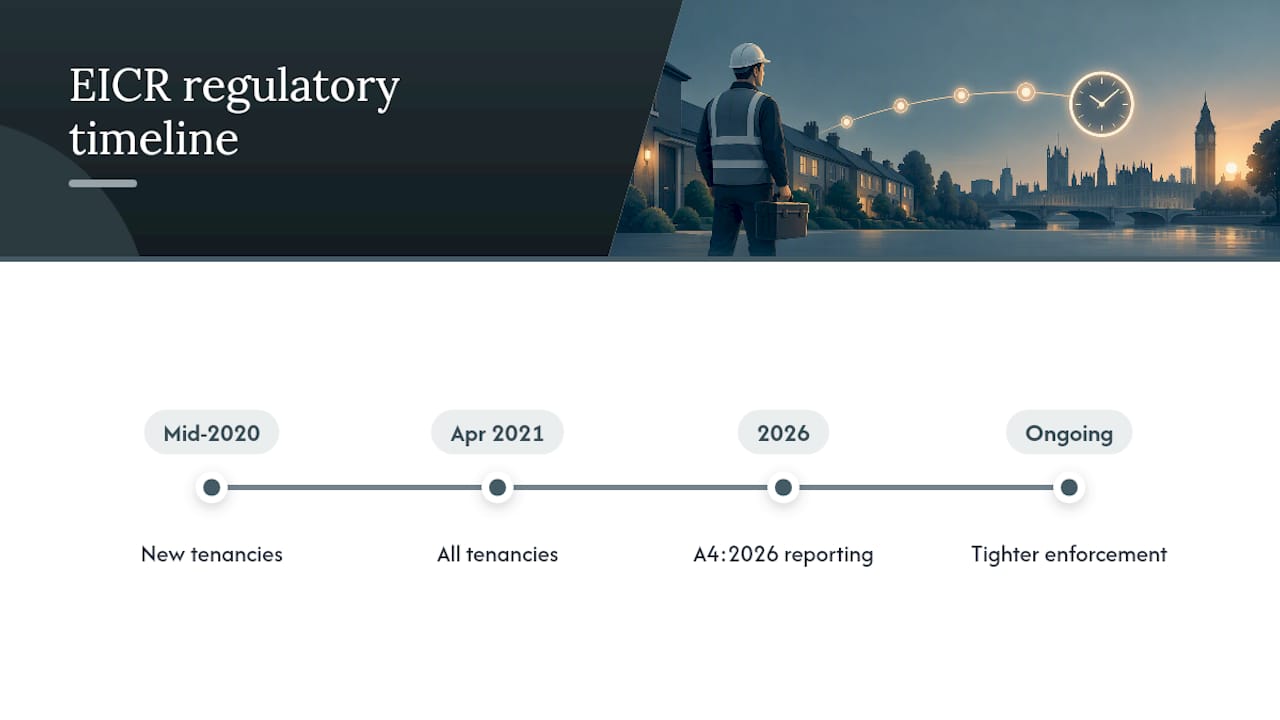
The Electrical Safety Standards in the Private Rented Sector (England) Regulations 2020 came into force covering all private tenancies from April 2021, having applied to new tenancies from mid-2020. This single piece of legislation remains the current legal basis for the five-year maximum interval described throughout this guide.
Reporting standards around EICRs themselves have also moved on. The A4:2026 reporting rules referenced in guidance on EICR outcomes and coding set out how observations are coded and when a report counts as unsatisfactory, and electricians working to current industry model forms follow that version rather than older report layouts. Landlords do not need to track every technical revision themselves, but it is worth confirming that whoever carries out an inspection is working to the current model form and coding standard, since an out-of-date template can cause confusion if a report is later scrutinised by a local authority or an insurer.
The regulatory direction has consistently been towards tighter enforcement rather than looser rules, and landlord bodies including the NRLA continue to press government and trade bodies on points such as incorrect “valid until change of tenancy” wording, which suggests further clarification guidance is likely rather than any relaxation of the five-year maximum.
Clarification on what constitutes a valid EICR report format or documentation standards
A valid EICR is not just a document with the right heading. To count as compliant evidence under the 2020 regulations, it needs to include the three core components: the overall condition report, the schedule of inspections and the schedule of test results, all completed by a qualified person and signed off with their registration details.
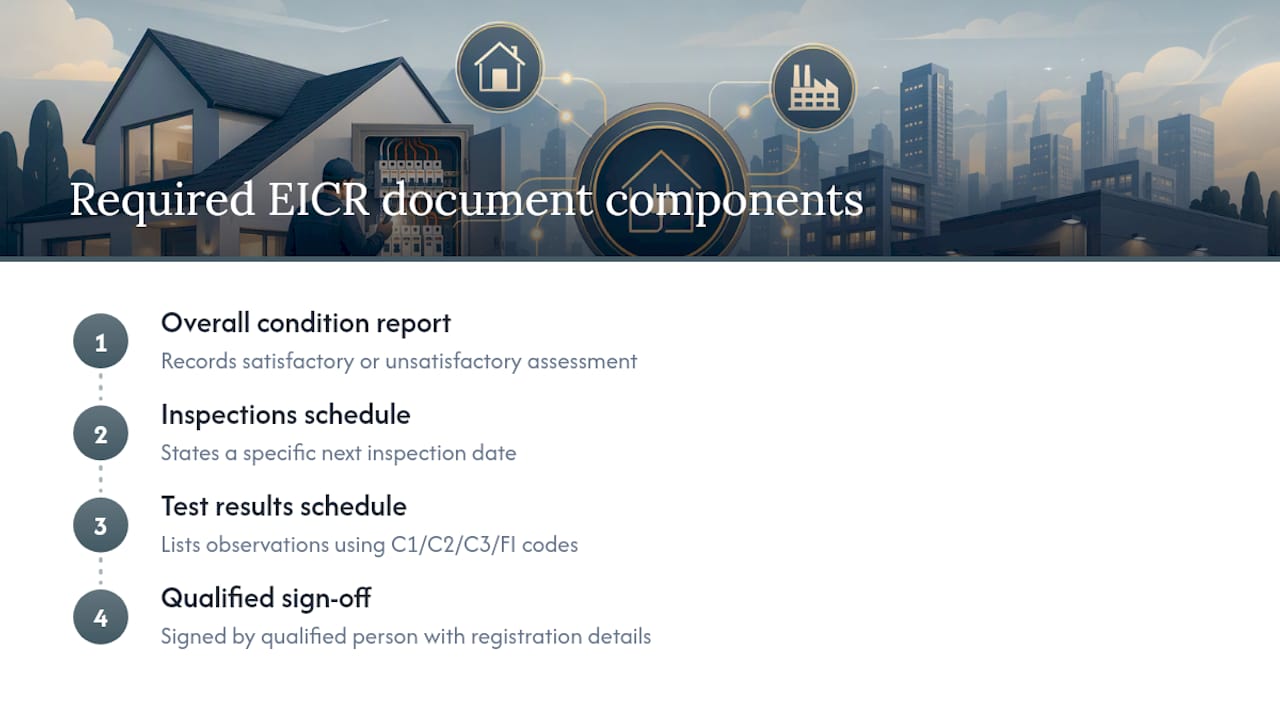
Crucially, it needs a specific, clearly stated next inspection date rather than vague wording. Reports that say a certificate is “valid until change of tenancy” are not correctly worded and have been flagged by landlord bodies as a source of confusion, per NRLA guidance. A properly completed report also records the overall assessment as satisfactory or unsatisfactory, lists any observations using the C1, C2, C3 or FI codes, and, where remedial work has followed, is accompanied by separate certification for that work rather than a note scribbled in the margin.
Digital copies are acceptable as long as they contain the same information as a paper original and can be produced quickly when a tenant or local authority asks for one. Landlords should be wary of any report that skips the schedules, gives only a pass or fail statement with no supporting detail, or fails to name a specific next inspection date, since these are the documents most likely to be challenged if a dispute or an inspection by the local authority ever arises.
What landlords consistently get wrong about EICR validity
The mistake I see most often is landlords treating “five years” as a fixed rule rather than a ceiling. The number on the certificate that actually matters is the specific next inspection date the electrician writes down, and that can be shorter, sometimes considerably so, for older installations or higher-risk properties.
The second mistake is record-keeping that falls apart the moment a tenant changes or a portfolio grows past two or three properties. Landlords managing several addresses often lose track of which certificate covers which property, which is exactly the gap that leads to a lapsed EICR nobody notices until a tenant complaint or a local authority letter arrives.
— Gemma
CityPat’s EICR services and how to get support
Coordinating EICR renewals across several properties usually means chasing several trades, several sets of paperwork and several different expiry dates. CityPat runs EICR and fixed wire testing for landlords and property managers as a single scheduled service, so every property on a portfolio can be tracked from one place rather than reconstructed from old e-mails.

- Book EICR inspections across multiple properties with one point of contact rather than several separate electricians.
- Get remedial work findings followed up and certified as part of the same engagement.
- Keep dated records for every property in one place, ready to hand to a tenant or local authority on request.
- Add related compliance work, such as PAT testing, to the same visit where it makes sense to combine them.
If your next inspection date is approaching, or you are not sure which of your properties are covered and which are not, get a free quote from CityPat and get every certificate back on a schedule you can actually track.
Sources
- Electrical safety standards in the private and social rented sectors guidance
- NICEIC: guidance referencing BS 7671 (regulation 653.4)
- NRLA: Electrical safety — does changing tenants affect an EICR?
FAQ
Is an EICR valid for 3 years or 5 years?
Five years is the statutory maximum for private rented properties in England under the 2020 regulations, but the electrician can set a shorter interval, including three years, if the installation’s condition warrants it. Whatever date is printed as the next inspection date on your specific report is the one you must follow.
Can a landlord be fined for not having an EICR?
Yes. Local housing authorities in England can serve remedial notices and issue financial penalties against landlords who fail to meet their duties under the 2020 regulations, including failing to arrange an inspection or supply the report on request.
What happens if an EICR expires?
An expired EICR, meaning the next inspection date has passed without a new inspection booked, puts the landlord in breach of their statutory duty regardless of the previous report’s grading. A new inspection needs to be arranged promptly, and any remedial work already outstanding should still be completed.
How often is an EICR required in England?
Private rented properties in England need an EICR at intervals of no more than five years, as set out in gov.uk guidance. Some properties are inspected more often when the electrician records a shorter interval, so always check the specific date on your certificate rather than assuming five years applies.
Does changing tenants mean I need a new EICR?
No, a change of tenant does not automatically invalidate a satisfactory, in-date EICR according to NRLA guidance. You still need to give the incoming tenant a copy of the current valid report before they move in, and a quick visual check between lettings is good practice.