
Under the Fire Safety Order, the responsible person must keep fire alarm systems in efficient working order and good repair. In practice that means combining weekly in-house checks with professional servicing every 5 to 7 months, covering every detector and device across the year, and keeping an on-site log book that proves it all happened. Skip any part of that and you’re carrying the legal and insurance risk alone.
TL;DR:
- Fire alarm systems must be maintained through weekly checks and professional servicing every 5 to 7 months, with records kept on-site for inspection.
- Verification of contractor qualifications and clear scope of work are essential to ensure proper maintenance and legal compliance.
- Servicing should include detailed checks of control equipment, detectors, cabling, and zone plan accuracy, with remedial reports issued after each service.
- Falling behind on servicing risks enforcement action, insurance claim denial, and damage to reputation, especially if lapses are discovered after an incident.
- The fire risk assessment determines the specific detector coverage and servicing frequency, which should adapt to building changes and occupancy risks.
Table of Contents
- Legal duties under the fire safety order
- Who holds responsibility and how to vet your engineer
- How often fire alarms need servicing and testing
- What a competent engineer checks during a service
- Records and log book requirements you must satisfy
- Qualifications and training to ask your supplier about
- A practical checklist for weekly and pre-service routines
- How CityPat supports your compliance obligations
- What happens if you fall behind on servicing
- Fitting alarm servicing into your wider fire safety plan
- Servicing requirements across residential, commercial and industrial sites
- Where duty holders should focus their effort first
- Book fire alarm servicing that keeps you compliant
- FAQ
- Sources
Legal duties under the fire safety order
The Regulatory Reform (Fire Safety) Order 2005 places the maintenance duty squarely on the responsible person. Article 17 requires that premises and any fire safety equipment, including the alarm system, be covered by a suitable system of maintenance and kept in an efficient state, in efficient working order and in good repair.
That duty connects directly to your fire risk assessment. The assessment identifies how many detectors you need, where call points go and what response times matter, and the maintenance regime exists to keep that protection working as designed. Gov sets out that suitable maintenance, routine checks and periodic servicing are expected, with records kept in a log book available on site for inspection.
Fire and rescue authorities enforce this order, and they can request your records during an inspection. Missing or incomplete logs are often the first red flag they look for, because they suggest the wider maintenance system has lapsed, not just the paperwork.
Key points to remember:
- The duty to maintain sits with the responsible person, not the installer or manufacturer.
- Risk assessment findings should directly shape your servicing frequency and detector coverage.
- Enforcing authorities can ask for maintenance records at any inspection.
Who holds responsibility and how to vet your engineer
The responsible person, whoever that is in your organisation, cannot hand over legal liability simply by hiring a contractor. Gov.uk guidance on workplace fire safety makes clear that you remain accountable and must satisfy yourself the contractor is competent, then keep evidence that maintenance actually took place.
Before booking anyone, check:
- Relevant certification or scheme membership specific to fire detection and alarm systems.
- Manufacturer-specific training where your system uses a particular panel brand.
- Current public liability insurance and a willingness to provide references.
Get the scope of work, any limitations and isolation arrangements confirmed in writing before the visit, not after.
Pro Tip: Ask any prospective engineer to show you a sample service report before you book, not after. A vague report is as telling as a vague quote.
How often fire alarms need servicing and testing
BS 5839-1:2025 sets the servicing backbone most duty holders in England now follow, and it breaks down into three layers.
- Weekly in-house checks: test a different manual call point each week on rotation and confirm the panel shows normal indicators, recording the result in the log book every time.
- Professional servicing every 5 to 7 months: recent changes to BS 5839-1:2025 introduce this flexible window in place of a fixed six-monthly date, giving you room to coordinate visits around site access or multi-site logistics. Most premises still end up with two professional visits a year, since two 5 to 7 month windows cover roughly twelve months.
- Annual device coverage: every detector and device needs a functional check across the year, not just a sample, and zone plans should be verified during that same period.
Insurers or enforcing authorities can ask for a tighter schedule than the standard allows, and where that happens, the stricter requirement wins.
What a competent engineer checks during a service
A proper service goes well beyond a walk around with a test key. Expect the engineer to work through:
- The control and indicating equipment (CIE), including clock accuracy and a review of the event history log.
- Every manual call point, sounder and detector, whether smoke or heat, along with cabling condition, batteries and back-up power supply.
- Zone plan accuracy against the current layout, interfaces with doors, lifts or access control, and any measures in place to reduce false alarms.
The engineer should finish with a written remedial report flagging anything that needs fixing, rather than a verbal “all fine” on the way out. If a quote or report skips any of these areas, ask why before you sign off.
Records and log book requirements you must satisfy
Your log book needs to hold more than ticks. For weekly checks, record the date, which call point was tested, the panel’s response and who carried it out.
Professional service reports should state:
- The scope of work covered and any limitations agreed beforehand.
- Findings, including faults found and remedial action taken or recommended.
- The engineer’s identity and company, plus the date of the visit.
Keep records for the life of the system where possible, since both enforcement visits and insurance claims rely on being able to show a continuous maintenance history rather than a single recent certificate.
Qualifications and training to ask your supplier about
Look for engineers who hold recognised training specific to fire detection and alarm systems, ideally backed by scheme membership and manufacturer-specific courses for your panel type.
Electrical work on the system, such as wiring repairs, falls under BS 7671 and the Electricity at Work Regulations, so a qualified electrician should handle anything beyond routine alarm servicing. The IET notes that electrical inspection and fire alarm servicing are related but separate disciplines, and scope should be agreed in writing so nothing falls through the gap between the two.
Before booking, ask directly: who carries out isolations, what happens if a fault is found mid-service, and what exactly falls outside their quoted scope.
A practical checklist for weekly and pre-service routines
Keep this close to the log book:
- Assign a named person to test a rotating manual call point each week and check the panel for faults.
- Walk escape routes weekly to confirm they’re clear and signage is intact.
- Before a professional service, confirm site access, pull out current zone plans, and nominate a contact who can explain any recent changes to layout or occupancy.
- Note isolation points and any areas requiring special access arrangements ahead of the engineer’s visit.
- Escalate any fault affecting detection or an escape route immediately, rather than waiting for the next scheduled visit.
A digital logbook such as Gribit can handle scheduling, reminders and record storage if a paper system is becoming hard to manage across multiple sites.
How CityPat supports your compliance obligations
City Appliance Testing Ltd works UK-wide across fire and electrical safety compliance, including fire alarm testing, emergency lighting testing, PAT and EICR services. Coordinating these checks through one supplier cuts down on the number of separate schedules, contacts and paperwork trails a facilities team has to track. That matters most when records, not memory, are what inspectors and insurers actually ask to see.
What happens if you fall behind on servicing
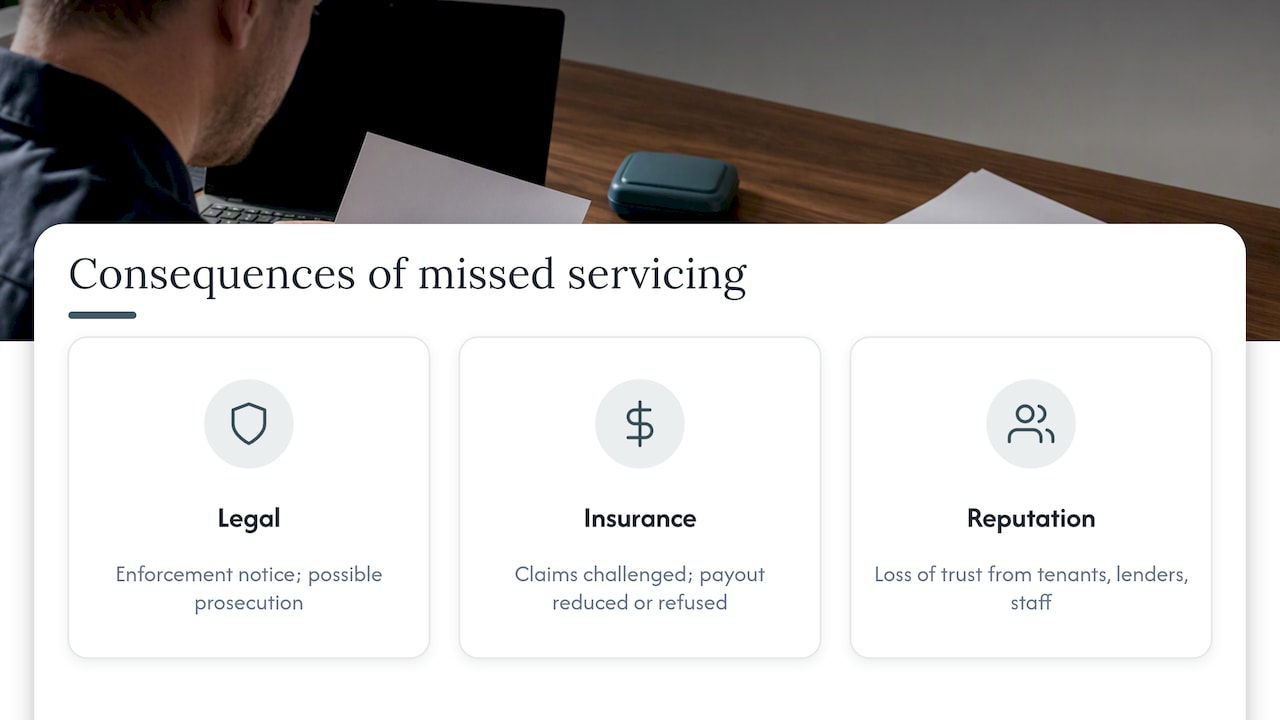
Falling behind on fire alarm servicing creates two separate problems, and either can land on your desk without warning. On the legal side, enforcing authorities acting under the Regulatory Reform (Fire Safety) Order 2005 can issue an enforcement notice requiring improvements, and in serious cases prosecution follows, with the responsible person personally accountable regardless of whether a contractor was meant to be doing the work.
The insurance side is often the sharper shock. Many commercial policies include conditions requiring fire detection systems to be maintained to a recognised standard, and a lapsed service history gives insurers grounds to challenge a claim after a fire, even one unrelated to the alarm fault itself. A business that could have claimed several hundred thousand pounds in fire damage can find the claim reduced or refused entirely because the log book has gaps.
There’s a reputational cost too. Tenants, staff and visitors expect working fire protection, and a known lapse, especially one surfacing after an incident, is hard to recover from with landlords, lenders or insurers who ask pointed questions afterwards.
None of this requires a dramatic failure. A missed service window, an unverified contractor or a log book nobody kept up to date is usually enough to put you in this position, which is exactly why the weekly and periodic routines matter more than any single annual certificate.
Fitting alarm servicing into your wider fire safety plan
Fire alarm servicing works best as one strand of a wider fire safety management system rather than an isolated task ticked off once or twice a year. Your fire risk assessment should drive the servicing frequency and detector coverage you actually need, and that assessment itself needs revisiting whenever the building, occupancy or layout changes significantly.
Alarm servicing also needs to sit alongside emergency lighting checks, fire extinguisher servicing and clear escape route management, since a fault in any one of these can undermine the others. A fully serviced alarm system is far less useful if emergency lighting along the escape route has failed, or if a fire door has been propped open against its intended function.
Staff training matters here too. A system that works perfectly on paper still depends on people knowing what to do when it activates, including who checks the panel, who calls the fire service and who accounts for everyone on-site. Building that into fire drills, rather than treating the alarm as a standalone piece of equipment, is what actually closes the gap between compliance paperwork and a safe evacuation.
Treating these elements as one coordinated plan, documented together, also makes life easier when an inspector or insurer asks to see your overall approach rather than a single certificate.
Servicing requirements across residential, commercial and industrial sites
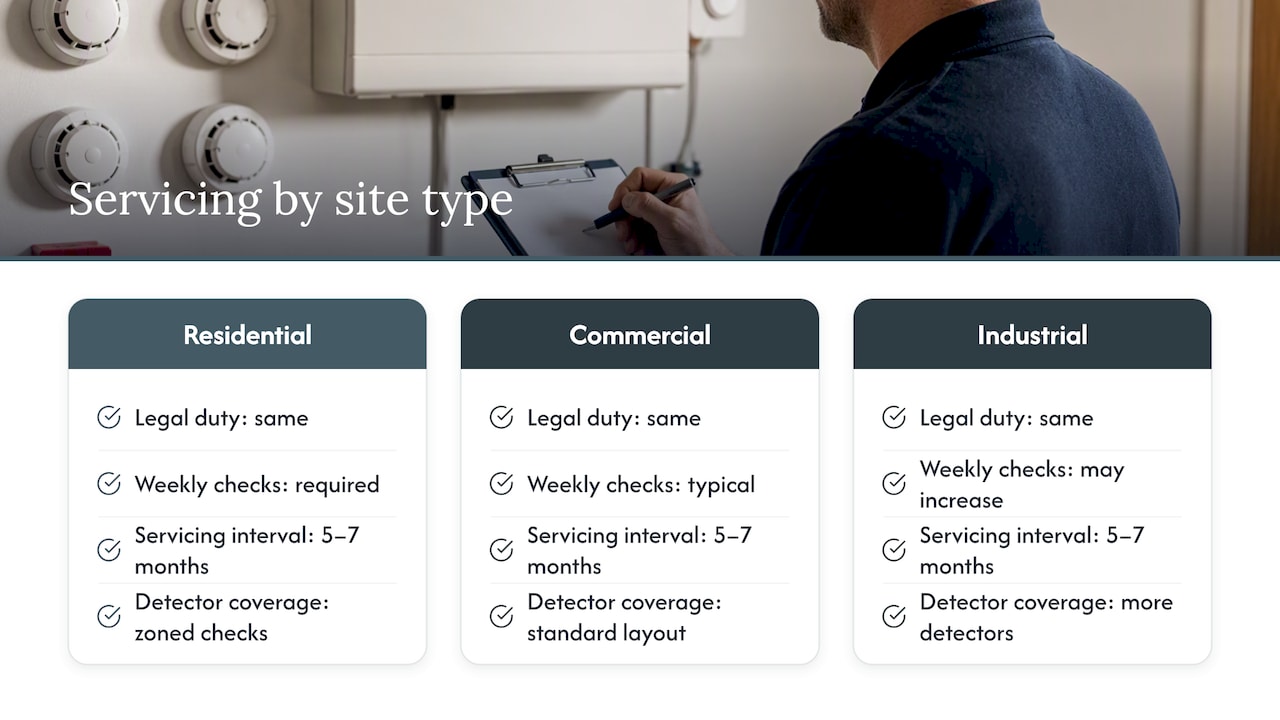
The core legal duty under the Fire Safety Order applies everywhere, but the practical servicing regime shifts depending on occupancy and risk.
Commercial premises such as offices and shops typically follow the BS 5839-1:2025 weekly and 5 to 7 month servicing pattern in full, with the gov.uk guidance for offices and shops serving as the reference point for what a suitable maintenance system looks like for that occupancy type.
Residential blocks, particularly those with communal areas and multiple households, often carry higher scrutiny given sleeping occupants and more complex escape routes, so the frequency of professional servicing and the thoroughness of zone plan verification tend to be treated as non-negotiable rather than flexible.
Industrial sites bring their own variables: higher fire loads, process-related ignition risks or larger floor areas can mean the risk assessment calls for more detectors, more frequent weekly checks, or servicing intervals at the shorter end of the 5 to 7 month window rather than the longer end.
In every case, the fire risk assessment is what should set the final regime for your specific building, not a generic assumption based on occupancy type alone. A landlord managing a single residential block and a facilities manager running an industrial unit will both start from the same legal duty, but the practical detail of detectors, frequency and documentation should look different once the risk assessment has done its job properly.
Where duty holders should focus their effort first
If you take one thing from this, make it contractor verification. A written scope, proof of competence and a proper report protect you more than any single extra check ever will.
Fix detection or escape route faults immediately, not at the next scheduled visit. And keep the log book simple enough that you, or an inspector, can understand it at a glance.
— Gemma
Book fire alarm servicing that keeps you compliant
We handle fire alarm testing alongside emergency lighting checks and fire risk assessments, so your servicing schedule, records and competent engineers sit with one supplier instead of several.
- We coordinate weekly check support, professional servicing and log book evidence across premises.
- We carry out fire risk assessments that set the right detector coverage and frequency for your building.
- Our wider compliance services cover PAT, EICR, emergency lighting and extinguisher servicing where you need them.
Get a free quote and we’ll schedule your next service around your site access, not the other way round.
FAQ
What are the legal requirements for fire alarm maintenance in the UK?
The Regulatory Reform (Fire Safety) Order 2005 requires the responsible person to keep fire alarm systems and equipment under a suitable maintenance system and in efficient working order. This covers England, and the responsible person stays accountable even when a contractor carries out the actual servicing.
What qualifications do I need to service fire alarms?
Engineers should hold training and scheme membership specific to fire detection and alarm systems, often alongside manufacturer-specific courses for the panel in use. Electrical work beyond routine servicing, such as wiring repairs, falls under BS 7671 and typically needs a qualified electrician.
How often do fire alarms need servicing?
BS 5839-1:2025 introduces a flexible professional servicing window of every 5 to 7 months, alongside weekly in-house call point and panel checks. All detectors and devices should receive a functional check across each year.
What are the key changes in the new fire safety regulations for 2026?
BS 5839-1:2025 remains the current standard shaping servicing practice, with its flexible 5 to 7 month servicing window and requirement to verify zone plans annually. There is no separate legal change beyond the continuing duties set out in the Fire Safety Order.
Can I carry out fire alarm checks myself?
Weekly checks, such as testing a rotating manual call point and reviewing panel indicators, are designed to be carried out in-house and recorded in your log book. Professional servicing every 5 to 7 months should be carried out by a competent engineer, since it covers technical checks beyond what in-house staff are trained to assess.