
National law in England does not set an annual PAT test for HMOs, but councils routinely write appliance testing into licence conditions, so a current PAT register is expected in practice. Your first step is to list every landlord-supplied appliance and check whether a dated register exists. If it does not, book a test now. Fixed wiring (EICR) is a separate duty that must also be current.
TL;DR:
- National rules require communal appliances to remain safe but set no PAT interval; check your HMO licence, which may require annual testing.
- The EICR covers fixed wiring separately; inspections are due every five years, and councils can request reports within seven days.
- Prioritize shared kitchen and laundry appliances for annual testing, and test room appliances whenever a tenancy changes and you leave them in place.
- Choose a competent tester who can interpret results, and request a sample register, equipment calibration details, insurance evidence, and a failed item procedure.
- Keep a register listing each appliance’s location, identifier, test result, next due date, and tester; retain a digital copy for council requests.
Table of Contents
- What does PAT testing cover in an HMO?
- How do the 2006 and 2020 regulations shape PAT in an HMO?
- Who is a competent person to carry out PAT testing?
- How often should HMO appliances be tested?
- What does HMO PAT testing cost in England?
- How do you prepare an HMO for PAT testing?
- What records will a council ask for at licence inspection?
- Why use a professional PAT provider for your HMO?
- What goes wrong with appliances in shared houses?
- How do size and appliance count change the scope?
- What is the most important lesson for HMO landlords?
- How can CityPat help with HMO compliance?
- FAQ
- Sources
What does PAT testing cover in an HMO?
PAT, or portable appliance testing, is a combination of visual inspection and, where appropriate, electrical testing of plug-in equipment. HSE explains that user visual checks are essential, and that formal periodic testing catches faults a visual check cannot see, such as a failing earth connection inside a casing. The two work together: a tenant spots a frayed lead, a tester finds the insulation breakdown behind a sound-looking plug.
In a shared house, the scope is the equipment you supply. Typical items include:
- Kettles, toasters and microwaves in the communal kitchen
- Fridges, freezers and washing machines
- Tumble dryers and vacuum cleaners
- Extension leads and multi-way adaptors you provide
- Communal televisions, heaters and fans
- Lamps and small appliances left in furnished bedrooms
Tenant-owned items are generally outside your duty unless you have agreed otherwise in writing, though a tester can include them if you ask.
PAT is not the same as an EICR. An EICR (electrical installation condition report) examines the fixed installation: circuits, sockets, the consumer unit and earthing. PAT covers what plugs into it. A house with immaculate wiring can still have a lethal toaster, and a perfect appliance register tells you nothing about a deteriorating consumer unit. HMO compliance needs both, and councils will ask to see both.
How do the 2006 and 2020 regulations shape PAT in an HMO?
Two sets of regulations sit behind most licence conditions, and it helps to see exactly what each one says and what it leaves unsaid.
The Management of Houses in Multiple Occupation (England) Regulations 2006 require managers to keep communal appliances in safe working order under Regulation 7(2)(f). They also require fixed electrical installations to be inspected and tested at intervals not exceeding five years by a qualified person, with certificates supplied to the local housing authority within 7 days of a written request, as set out in the regulations as made. Neither text names an annual PAT test.
The Electrical Safety Standards in the Private Rented Sector (England) Regulations 2020 add a second layer for private landlords. Fixed wiring must be inspected at intervals no greater than five years, the report goes to tenants within 28 days, and the local authority can ask for it within seven days. The government’s published guidance explains how to comply in plain terms, and the full regulation text is available for anyone who wants to check the wording.
Where PAT enters is through licensing. An HMO licence under the Housing Act 2004 can carry conditions about electrical safety documentation, and many councils use that power to require appliance testing or an equivalent inspection. So the position is this:
- National law: keep communal appliances safe, with no set PAT interval.
- Local licence conditions: frequently require PAT evidence, often annually.
- Practical result: a PAT register is the document that proves you met the duty.
Because licences are enforced locally, the wording differs between councils. One may ask for annual PAT on all landlord-supplied items, another for a test at each change of occupancy, a third simply for “evidence of appliance safety”. Check the conditions attached to your own licence before you decide on a schedule, and keep the council’s exact phrasing alongside your register.
Timing matters too. A request from the council for fixed-wiring certificates must be met within 7 days, and tenants need their copy within 28 days. If you only start looking for the paperwork when the letter arrives, that window closes quickly. Holding everything in one folder, digital if possible, removes the scramble.
Who is a competent person to carry out PAT testing?
HSE’s position is that user checks can be done by trained staff, but a combined inspection and test needs a competent person with suitable equipment and the ability to interpret the results. HSE’s guidance HSG107 frames this in two broad levels: simple pass/fail testers suitable for low-risk checks, and more sophisticated instruments where technical knowledge is needed to read the readings. The law does not insist on a qualified electrician, but it does insist that the tester knows what they are doing.
For an HMO, the second level is usually the sensible choice. Shared kitchens run hard, appliances get moved, and a borderline reading on an old fridge needs a judgement call rather than a green light on a handheld unit.
Councils and insurers tend to favour recognised training, such as City & Guilds, and testers who can show their credentials. Before you appoint someone, ask for:
- A sample register showing the fields they record
- Their qualifications and the calibration date of their test equipment
- Evidence of public liability insurance
- A written policy on what happens to failed items, including whether they remove or label them
- Timescales for delivering the full report
Pro Tip: Ask the tester to show you a failed-item label and explain what they do next. A tester who has a clear remediation routine has done this properly before.
Doing visual checks yourself is worthwhile between formal tests. A quick look at leads, plugs and casings at each inspection visit costs nothing and often catches the problem before it becomes a failure.
How often should HMO appliances be tested?
Testing frequency depends on the equipment, its environment and your licence or local standards. Testing frequency is a matter of practice rather than a national rule, so treat it as a sensible default and let your licence override it.
HSE gives a risk-based baseline in its guidance on electrically powered equipment. Its suggested intervals vary by equipment type, and equipment used by the public, or hand-held items that are moved and flexed constantly, sit at the shorter end.
A shared HMO kitchen may involve frequent handling, movement, spills and heat. Consider these conditions when setting testing intervals, alongside HSE’s suggested intervals and your licence requirements.
To turn this into a schedule for a multi-let building:
- Test communal kitchen equipment and shared laundry appliances first, every year
- Include every extension lead you supply, and replace any that are visibly damaged rather than retesting them
- Add a test whenever a room changes hands and you leave appliances in it
- Review the interval after any fault, repair or tenant complaint, and shorten it for that item
- Align the PAT date with your EICR and licence renewal dates so one visit can cover several tasks
Any appliance that fails should come out of use immediately. Record the failure, the action taken and the date it was repaired or replaced, then retest before it goes back.
What does HMO PAT testing cost in England?
Prices are set by the tester, and published rates vary, so treat any figure you read as a starting point for comparing quotes rather than a fixed tariff. We do not publish a standard price list, and quotes depend on the details of your property. What you will meet most often are three shapes:
- Per-item pricing: a rate for each appliance, usually falling as volume rises. This suits small and medium HMOs.
- Day rates: a flat charge for a tester’s time, which works out cheaper for large houses or blocks with hundreds of items.
- Minimum call-out fee: a floor applied when the item count is low, so a tiny job can cost more per appliance than a big one.
Several things move the total. The number of appliances is the biggest driver. Access matters too: if the tester has to return because rooms were locked, you will pay for that. The level of documentation counts as well, since a fully itemised, labelled register takes longer to produce than a bare pass certificate.
When you compare quotes, check what each one actually includes:
- Whether the register is itemised, with location and next-test date for every appliance
- Whether the tester’s name, qualifications and contact details appear on the paperwork
- How failed items are treated and whether remedial work is charged separately
- Whether re-testing after repair is included or billed again
- Whether labels are applied to each tested item
Budgeting is simpler if you separate small, medium and large houses: a small HMO may have kitchen items and leads, a medium one may add laundry appliances and furnished rooms, and a large one may require an extended site visit. Ask each provider to price your house from an inventory rather than quote off a generic scale.
Combining visits saves money and disruption. If your EICR is due in the same period, ask for PAT and fixed wiring to be done together. One access arrangement, one tenant notice and one set of paperwork is far less effort than two separate visits.
How do you prepare an HMO for PAT testing?
Preparation can make the visit smoother and reduce delays. Work through these steps before the tester arrives:
- Inventory your appliances. Walk every room and the communal areas and list each item you supply, with its location.
- Label and record. Give each item a unique identifier so it matches a line in the register later.
- Separate tenant property. Note which items belong to tenants and will not be tested unless you have agreed it.
- Give notice in writing. Tell tenants the date, the time window and what the visit involves, and ask for written permission for access to individual rooms.
- Ask tenants to prepare. They should leave your appliances accessible, unplug or move personal items, and make sure doors are unlocked or a key holder is available.
- Appoint a contact. One person should be reachable on the day to open rooms and answer queries.
- Agree the paperwork. Ask the tester for a sample register format and a date for receiving the full report.
A short notice might read: “We will be carrying out safety testing of the electrical appliances we supply on [date] between [time] and [time]. Please make sure the appliances provided in your room are accessible and that any personal items are unplugged and moved out of the way. Please let us know if you cannot be present.” Adapt the wording to your tenancy terms and keep a copy of what you sent.
Pro Tip: Do a trial walk-through before the visit and photograph each labelled appliance in place. If a room is locked on the day, the photos show the tester what to expect and speed up a rebooking.
During the visit, make sure testing conditions are safe: clear access, nothing unplugged mid-use that could cause harm, and no appliance returned to service until it has passed. Afterwards, confirm when the register will arrive and check it against your inventory so nothing has been missed.
What records will a council ask for at licence inspection?
Officers inspecting an HMO look for evidence, not intentions. A usable PAT register contains, for every appliance:
- A description of the item
- A unique identifier or label reference
- Its location in the property
- The test date and the result
- The next test due date
- The tester’s name and contact details
On timing, a council can ask for fixed-wiring certificates under the 2006 regulations and must receive them within 7 days of a written request, while under the 2020 regulations tenants are due the EICR within 28 days. Treat appliance paperwork the same way: if you can hand over the register within a week, you will rarely have a problem.
Keep a digital copy as well as paper, with a version history so you can show earlier tests and what changed. A register you can export to a spreadsheet or PDF in a minute is far better than a folder in a landlord’s loft. Retention periods are not fixed by the regulations we cite here, so keep records at least for the life of the licence and through any renewal, and longer if your insurer or council asks.
Why use a professional PAT provider for your HMO?
For landlords who want one clean audit trail, a professional service solves the three things councils care about: documentation, competence and schedule.
- We provide documentation to support your compliance records
- We can combine PAT with EICR or other compliance checks, so one visit covers more and your schedule stays auditable
- We offer nationwide scheduling and coordinated reporting, which helps multi-site landlords avoid missed deadlines
This is the simplest way to turn a licence condition into a repeatable annual routine.
What goes wrong with appliances in shared houses?
Shared houses age equipment faster than single-family homes, and the faults PAT catches follow a pattern. Damaged flexes are the commonest: cables trapped under furniture, pulled from the wall by the lead, or chafed against a hot surface. Plugs crack or loosen their terminals when they are yanked out constantly, and a loose connection heats up quietly before it fails.
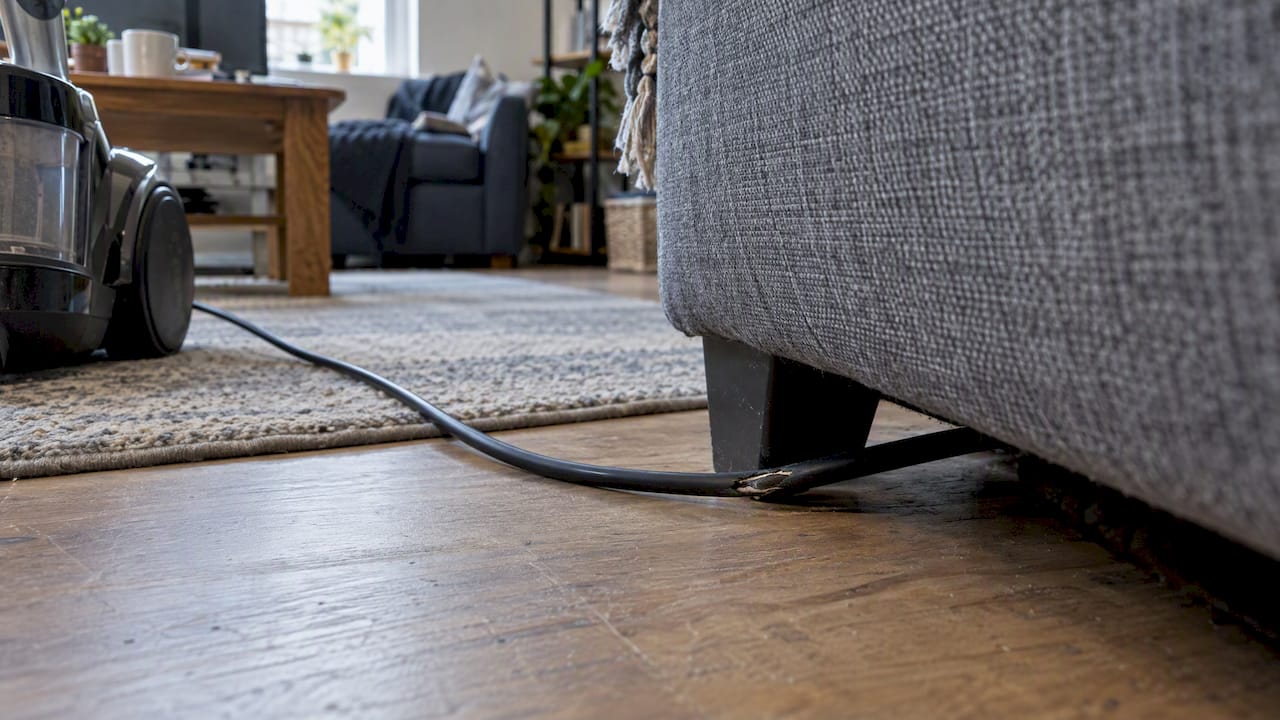
Earth faults matter on metal-cased items such as toasters, kettles and washing machines, because a break in the earth path can leave the casing live without any visible sign. Internal insulation breakdown shows up as leakage that only a test reveals. Overloaded extension leads and daisy-chained adaptors are a fire risk in rooms where tenants plug in laptops, heaters and chargers at once.
Heat and moisture add to the problem in kitchens and laundries: steam, spilt liquids and grease degrade seals and insulation. Heaters and fans left running, then covered, are another source of overheating. Regular testing, combined with visual checks between visits, catches these before they injure someone or start a fire.
How do size and appliance count change the scope?
The bigger the house, the more the job is about logistics. An HMO with a shared kitchen might be a short visit with a modest number of items. A large block with fully furnished rooms, multiple kitchens and laundries can involve many appliances, and the schedule shifts accordingly.
Large properties usually move to day-rate pricing and need access planned room by room, because one locked door can hold up the whole visit. Splitting the work into zones, such as communal areas on one day and bedrooms on another, can reduce disruption. Appliance count also affects the register: the more items, the more important unique labels and a clear naming scheme become.
If you manage several houses, group them into one booking round where you can. A single appointment cycle with a consistent register format makes compliance far easier to track than a patchwork of separate visits at different times of year.
What is the most important lesson for HMO landlords?
Councils inspect records, so the single habit worth building is keeping them current and easy to hand over. Tie your PAT dates to tenancy turnover and to your EICR cycle, so nothing quietly lapses between inspections. A tidy register you can produce promptly does more for your licence than any amount of good intentions.
— Gemma
How can CityPat help with HMO compliance?
We carry out PAT testing, EICR and fixed-wire inspections and related compliance services across the UK. When you book, we can combine PAT with an EICR to save you time and cost. Start with our PAT testing service and tell us how many properties and appliances you manage.
If you are also planning wider checks on a building, such as a roof or exterior survey, a drone inspection report can sit alongside your electrical visit, and you can book our EICR and fixed wire testing at the same time.
FAQ
Do I need insurance to PAT test?
You are not required by law to hold insurance to test appliances you supply, but a professional tester should carry public liability insurance and you should ask for proof. Your own landlord policy may also specify that electrical safety checks are carried out and documented.
Can a landlord be fined for no EICR?
Yes. Under the 2020 regulations a local authority can act where a private landlord fails to hold a valid fixed-wiring report, and the regulations as made set out the duty. Check the current penalty position with your council or the government guidance before relying on any figure.
What do landlords legally have to provide?
You must keep communal appliances in safe working order, keep fixed wiring inspected at no more than five-year intervals, and supply reports to tenants and the council within the set timescales, as the 2006 regulations require. Licence conditions can add further requirements, such as appliance testing evidence.
Do people in an HMO pay rent?
Yes. Tenants in an HMO pay rent, either individually under separate agreements or jointly under one tenancy, and the landlord’s safety duties apply whichever arrangement is used. The structure of the rent does not change your obligations on appliances or wiring.