
An emergency lighting certificate is the signed evidence that your system’s design, installation, and ongoing testing meet BS 5266-1, the code of practice enforcement officers check against. If you cannot find one, or the on-site logbook next to it, that’s the job for this week, not next quarter. Book a competent contractor to inspect the system and get monthly and annual testing scheduled immediately.
TL;DR:
- Most buildings lack the necessary records, such as a complete certificate with photometric data and a test logbook, required for fire safety inspections.
- The appropriate certificate type depends on the building’s history, with a completion certificate for new systems and an existing site compliance certificate for older or undocumented systems.
- All certificates must reference BS 5266-1 and related standards, including photometric design evidence and ongoing verification through regular testing.
- Monthly short tests and an annual full-duration discharge test are legally mandated, with tests ideally scheduled during low-occupancy periods.
- Certification costs vary based on building size and documentation needs, but retaining electronic copies and regular testing routines are essential to stay inspection-ready.
Table of Contents
- What types of emergency lighting certificate exist?
- What does the law actually require in England?
- How often should emergency lighting be tested?
- Who is qualified to test and sign off a certificate?
- What must a valid certificate contain?
- How do you get and keep a certificate in place?
- CityPat’s perspective on keeping certificates audit-ready
- Book emergency lighting testing that keeps your certificate current
- Sources
- FAQ
What types of emergency lighting certificate exist?
Three distinct certificates cover different moments in a building’s life, and knowing which one applies saves you asking a contractor for the wrong paperwork.
- Completion certificate: issued when a system is newly installed or substantially modified. A smaller version exists for installations of up to 25 self-contained luminaires, where the contractor confirms photometric evidence and a logbook have been handed over.
- Existing site compliance certificate: used where a building has an older system, or where documentation has gone missing over time, to bring records up to date without a full reinstallation.
- Periodic inspection and testing certificate: the annual verification document confirming the system still performs to standard, referenced against NICEIC’s electronic certificate templates.
A landlord taking over an older office block with no paperwork typically needs an existing site compliance certificate first, followed by periodic certificates going forward. A new-build fit-out gets a completion certificate at handover, then slots into the same annual cycle.
What does the law actually require in England?
Under the Regulatory Reform (Fire Safety) Order and the Fire Safety England regulations, the Responsible Person for a building carries direct legal duties to maintain fire safety systems, including emergency lighting, and to keep records suitable for inspection. That duty doesn’t disappear because a letting agent or facilities contractor handles day-to-day maintenance; the legal responsibility sits with whoever controls the premises.
BS 5266-1 is the primary code of practice enforcement officers reference, with two supporting standards named directly on most certificates:
- BS EN 1838 covers the photometric performance emergency lighting must achieve, such as minimum illuminance along escape routes.
- BS EN 50172 sets out the testing regime, including test frequency and duration.
A certificate that cites these standards by name and demonstrates conformity to them is what a fire officer expects to see during an inspection. One that simply states “tested and satisfactory” without reference to the standards gives an inspector nothing to verify against, which is often treated as no evidence at all.
How often should emergency lighting be tested?
Yes, monthly testing is a legal expectation, not a recommendation you can skip when things get busy. BS EN 50172 sets the testing regime, and the practical schedule breaks down like this:
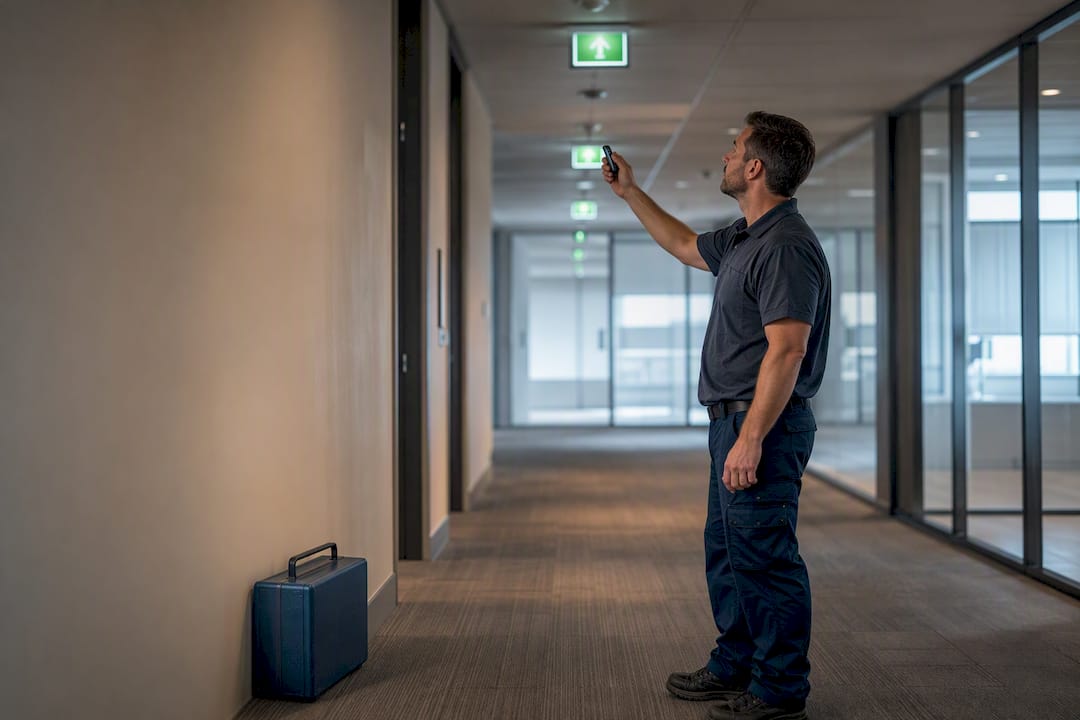
- Monthly short functional test: switch each luminaire to emergency mode briefly, confirm it operates, and log the date, results, and any faults in the on-site logbook.
- Annual full-duration discharge test: run the entire system on battery power for its full rated duration, typically three hours, to confirm it performs when mains power actually fails.
- Photometric performance verification: confirm light output still meets the original design figures, a requirement that recent standard updates have made more explicit and detailed than in older editions.
The annual discharge test has a genuine operational catch: it leaves your building without working emergency lighting for the recharge period afterwards, which can run to many hours depending on battery capacity. Practitioners generally advise scheduling it overnight or over a weekend when the building is unoccupied.
Pro Tip: Batch your annual test with any planned power shutdown or maintenance closure. You get the full-duration data you need without ever leaving occupied areas without emergency cover.
Who is qualified to test and sign off a certificate?
Not every electrician who touches a distribution board is automatically competent to certify emergency lighting, and this is where a surprising number of buildings fall down on paperwork despite having perfectly functional lights.
- Registered contractors: electricians registered with bodies such as NICEIC are the most common route, since registration involves assessment against current wiring and emergency lighting standards.
- In-house competent staff: larger organisations sometimes train facilities staff to competence level, but this requires demonstrable knowledge of BS 5266-1 test procedures and photometric interpretation, not just general electrical experience.
- Photometric interpretation matters as much as test technique: someone can run a discharge test correctly and still fail to spot that illuminance levels have degraded below BS EN 1838 minimums.
The contractor certifies the technical work; the Responsible Person still owns the legal duty to commission that work and keep the resulting records. Handing a contractor the job doesn’t hand them your liability.
What must a valid certificate contain?
A single signature on a template is not enough. A certificate that will actually hold up during an inspection needs several supporting pieces assembled together, and enforcement officers routinely expect all of them, not just the top sheet.
- Signed declarations covering design, installation, and verification stages, each attributable to a named competent person.
- Photometric design evidence, either ICEL 1001 tables or calculations performed per BS 5266-1 and CIBSE LG12, showing the system was designed to meet minimum light levels.
- An on-site test logbook, retained continuously and available for inspection, not stored in an inbox somewhere.
- Model completion certificates for small installations explicitly require the contractor to confirm this evidence has actually been handed over, according to guidance on completion certificate templates, which also notes that a certificate lacking photometric data is often deemed insufficient on its own.
A certificate without a logbook or photometric backup is, in practice, weak evidence. Enforcement officers expect the assembled package, not an isolated form.
How do you get and keep a certificate in place?
Getting compliant, and staying compliant, follows a fairly linear sequence rather than a single event.
- Audit what you already have. Check whether design evidence and a logbook exist, or whether you’re starting from an existing site compliance certificate instead.
- Commission a photometric survey if design evidence is missing or clearly outdated against current room layouts.
- Engage a competent contractor to complete or verify the installation and issue the relevant certificate, referencing BS 5266-1, BS EN 1838, and BS EN 50172.
- Set up the testing routine: monthly short tests, an annual full-duration test scheduled for low-occupancy hours, and periodic photometric checks.
- Retain everything centrally, ideally as both a physical logbook on site and an electronic backup.
Costs scale mainly with installation size and how much photometric survey work is needed. A small office with 15 luminaires and existing design data costs far less to certify than a large mixed-use building starting from scratch.
Pro Tip: Ask your contractor for electronic certificate copies at handover. A misplaced paper certificate is one of the most common reasons buildings fail inspections despite the system itself working fine.
CityPat’s perspective on keeping certificates audit-ready
Most compliance failures we see aren’t broken emergency lights. They’re missing paperwork for systems that work perfectly well. A logbook left in someone’s old office, a completion certificate with no photometric data attached, a periodic test that happened but was never written down. City Appliance Testing Ltd works across UK businesses on exactly this gap: the difference between a system that functions and one that can prove it functions when an inspector asks. Clients get certificates and logbooks that stand up to scrutiny, not just lights that switch on.
— Gemma
Book emergency lighting testing that keeps your certificate current
Compared to chasing a contractor every time your annual test comes due, or discovering your logbook has gone missing right when an inspector calls, having one provider handle the whole cycle removes the guesswork. Citypat’s emergency lighting testing service covers monthly and annual testing, photometric checks, and the certificate paperwork that ties it all together.
A typical booking starts with a site visit to assess your existing system and documentation, followed by testing against BS 5266-1, BS EN 1838, and BS EN 50172, and finishes with a signed certificate plus electronic logbook copies you can produce instantly during any inspection. Many clients pair this with EICR testing or a wider look at safety compliance services to cover electrical and fire safety together. If your certificate has lapsed, or you’ve never had one, get a free quote and get a testing schedule in place before it becomes an inspector’s problem rather than yours.
Sources
- NICEIC Emergency Lighting Electronic Certificates
- LG12: Emergency lighting (2022) | CIBSE
- Emergency Lighting Installation UK | Elec-Mate
- EMERGENCY LIGHTING COMPLETION CERTIFICATE (model template / guidance)
- Gov
FAQ
Do you need a certificate for emergency lighting?
Yes. A certificate, backed by photometric design data and a test logbook, is the evidence a Responsible Person needs to show a system meets BS 5266-1 and related standards during a fire safety inspection.
What are the legal requirements for emergency lighting in England?
The Regulatory Reform (Fire Safety) Order and the Fire Safety England regulations place a legal duty on the Responsible Person to maintain the system and keep inspection-ready records, with BS 5266-1 as the technical benchmark.
How much does an emergency lighting certificate cost?
Cost depends mainly on installation size and whether a photometric survey is needed alongside testing; a small office with existing design data costs considerably less than a large building starting without documentation.
Is it a legal requirement to test emergency lighting monthly?
Yes. BS EN 50172 sets monthly short functional tests as the standard testing regime, alongside an annual full-duration discharge test, and both results belong in the on-site logbook.