
There is no single legally mandated PAT interval in England. The Electricity at Work Regulations 1989 require you to maintain electrical equipment in a safe condition, but frequency itself is left to a risk assessment. HSE and the IET both recommend starting intervals ranging from 3 months to 60 months depending on environment and appliance class, then adjusting them using your own test history. City Appliance Testing Ltd builds schedules around exactly this principle rather than a blanket annual visit.
TL;DR:
- The starting intervals for PAT testing vary widely, from 3 to 60 months, depending on environmental risks and appliance class, and are adjusted through test history.
- Class I appliances require earth continuity tests and typically have shorter intervals than Class II, which rely on insulation and can be tested less frequently.
- Landlords in England are not universally required to PAT test appliances, but social landlords must have equipment tested at least every five years, with separate rules applying in Scotland.
- Maintaining detailed records of tests, labels with due dates, and using test history to extend intervals are critical for compliance and defending your schedule.
- A competent tester needs proper training and calibrated equipment, and working with a risk-based program tailored to actual equipment and usage reduces unnecessary tests and liabilities.
Table of Contents
- PAT testing intervals UK: quick reference by environment and class
- How do you set and adjust PAT testing frequency?
- What are the PAT testing rules for landlords in England?
- Records, labelling and using test history to defend your schedule
- Who’s competent to carry out PAT testing?
- Practitioner view: how test history should drive your schedule
- How City Appliance Testing Ltd builds a risk-based PAT programme
- Where to check the legal detail yourself
- Sources
- FAQ
PAT testing intervals UK: quick reference by environment and class
Most confusion around PAT testing frequency comes from treating a starting point as a fixed rule. HSE’s guidance in INDG236 and the wider HSG107 publication both describe “initial intervals”: sensible first schedules based on how equipment is used and where, not statutory deadlines carved in stone.
An initial interval assumes you know nothing yet about how a particular appliance behaves in your particular environment. A kettle in a quiet office and a drill on a building site face wildly different stresses, so they start on wildly different clocks. Once you’ve tested an item two or three times and it keeps passing cleanly, the IET Code of Practice allows a competent person to stretch that interval out, provided the reasoning is documented.
Here’s how the starting points typically break down, drawing on HSE’s illustrative tables and practical industry matrices from sources such as Megger:
Class matters as much as environment. Class I appliances have an earth connection and need an earth continuity test, so they carry more risk if a fault develops unnoticed. Class II appliances, marked with the double-square symbol, rely on insulation rather than earthing, which is one reason IT equipment and modern double-insulated tools sit at the long end of the interval scale.
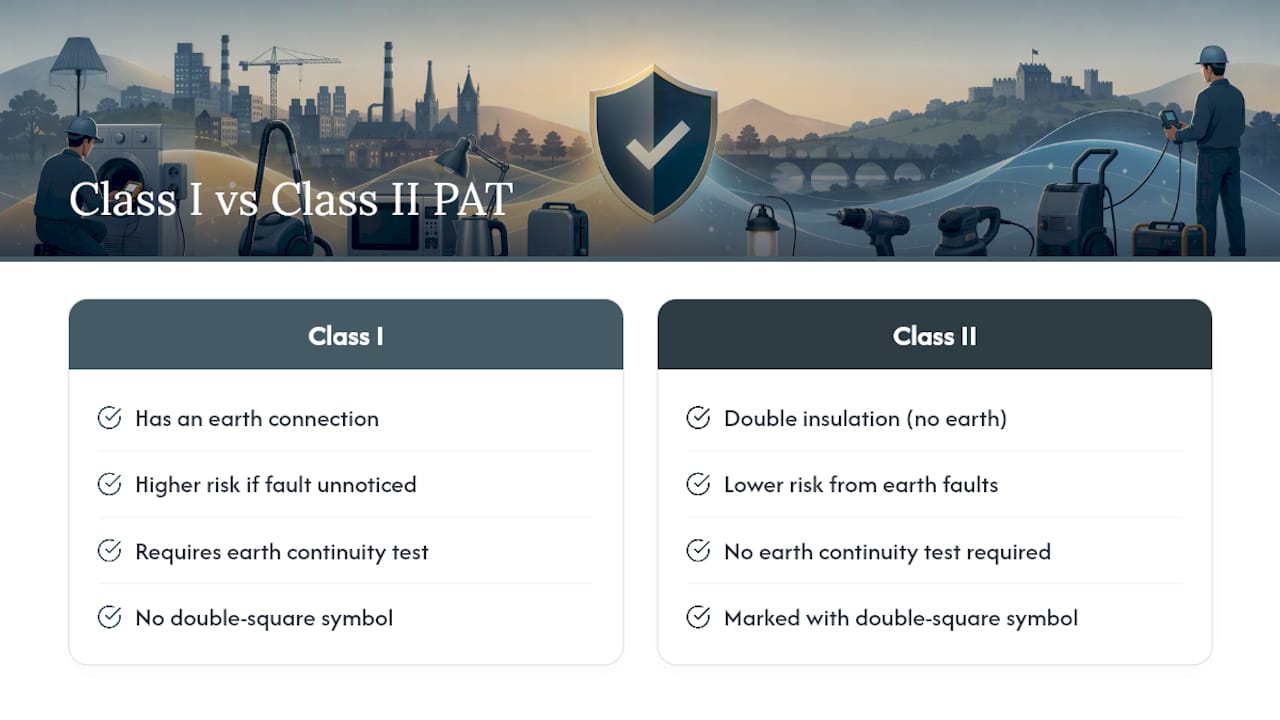
A construction firm running the same power tools for a decade won’t test them the same way an office tests its printers. That’s the entire point of an initial interval: it’s a sensible opening bid, not a fixed sentence.
How do you set and adjust PAT testing frequency?
Setting a defensible schedule is a process, not a guess. Five steps get most organisations from zero to an audit-ready programme.
- Classify your equipment and environment. Group appliances by class (I or II), type (handheld, stationary, IT), and who uses them, staff, tenants, or the public, since public-facing equipment generally warrants shorter intervals.
- Set initial intervals using IET/HSE defaults. Pull straight from the ranges above rather than inventing your own figures. This gives you a documented, defensible starting position from day one.
- Run user checks and formal visual inspections between formal tests. A user check takes seconds: look for cracked plugs, frayed cable, scorch marks. Log the outcome, even if it’s just a tick and a date.
- Review test history and fault trends. If an item has passed cleanly across two or three cycles, extend its interval. If a category of equipment keeps failing or a particular site shows more faults, shorten it. HSE’s own estate review found that after years of clean user checks and visual inspections, some equipment no longer needed routine formal testing at all.
- Document the rationale and set a review date. Write down why an interval changed, not just that it changed, and build in triggers for immediate re-testing after any incident, repair, or relocation.
Pro Tip: Batch equipment by its shortest likely interval, not its type. Grouping a mixed batch of tools by “workshop kit” instead of by risk means the one item needing quarterly checks gets lost among things that only need testing every two years.
A simple compliance framework like the one outlined by Rapid Test Cup reinforces the same principle: monitoring trends over time beats a fixed calendar entry every time.
What are the PAT testing rules for landlords in England?
Landlord obligations vary more than most people expect, and getting this wrong is one of the most common compliance gaps we see. Private landlords in England are not universally required to PAT test appliances they provide to tenants. There’s no blanket statute forcing an annual or biennial test on a rented toaster or washing machine.
Social landlords face a different picture. A 2025 amendment introduced a requirement for social landlords in England to have provided electrical equipment inspected and tested at least every five years. Scotland goes further for all landlords: the Repairing Standard already requires PAT testing before a let begins and at least every five years after that, regardless of landlord type.
Practical guidance for landlords in England, whether the five-year rule applies to you or not:
- Test all provided appliances before a new tenancy starts, even if no formal requirement compels it.
- Work to a documented 2 to 5 year schedule for ongoing checks on items you supply.
- Keep dated records and photographs of labels; insurers and letting agents increasingly ask for them.
- Check devolved nation rules separately if you let property outside England, since Scotland and Wales don’t mirror England’s position exactly.
A five-year gap sounds generous until you picture a tenant plugging a faulty kettle into a socket you haven’t inspected since the last change of occupancy. Landlord-specific guides such as Totalskills’ overview set out the tenancy-change trigger clearly, and it’s worth building into your own paperwork even where the law doesn’t force your hand.
Records, labelling and using test history to defend your schedule
Every appliance test should generate a record with six fields: equipment type, location, test date, tester’s name, pass/fail result, and any remedial action taken. Skipping any one of these weakens your position if an insurer or HSE inspector ever asks to see your history.
- Keep records for the working life of the appliance, not just the current interval.
- Retain fail records even after an item is repaired or scrapped, since the pattern matters more than any single result.
- Label every tested item with the date and next-due interval, visible without opening a cabinet.
- Quarantine or remove failed equipment immediately, don’t leave it “for the next round”.
Good records are what let you extend an interval with confidence rather than guesswork. Three clean passes on the same appliance is evidence; a blank logbook is a liability.
Who’s competent to carry out PAT testing?
A competent person needs proper training, calibrated test equipment, and the ability to interpret results, not just operate a tester. That distinction catches out businesses that buy a cheap tester and assume a member of staff can run the whole programme unsupervised.
User checks and simple visual inspections can be done by any sensible employee without formal training. Formal PAT testing, involving earth continuity, insulation resistance, and load tests, needs someone who understands what a borderline result actually means. This matters most for earthed Class I equipment, anything used by the public, and hire items passed between multiple users.
When choosing a contractor, look for:
- Evidence of relevant training and calibrated test equipment with current calibration certificates.
- A clear reporting format that lists every appliance, its result, and any remedial action.
- Willingness to explain why they’ve set a given interval, not just deliver a certificate.
- UK-wide coverage if you operate across multiple sites, which is suitable for organisations managing PAT, scheduling, and record-keeping across several locations.
Pro Tip: Ask any prospective PAT contractor to show you a fail rate from a previous client’s history. A competent tester should be able to talk fluently about trends, not just hand over a stack of green stickers.
Practitioner view: how test history should drive your schedule
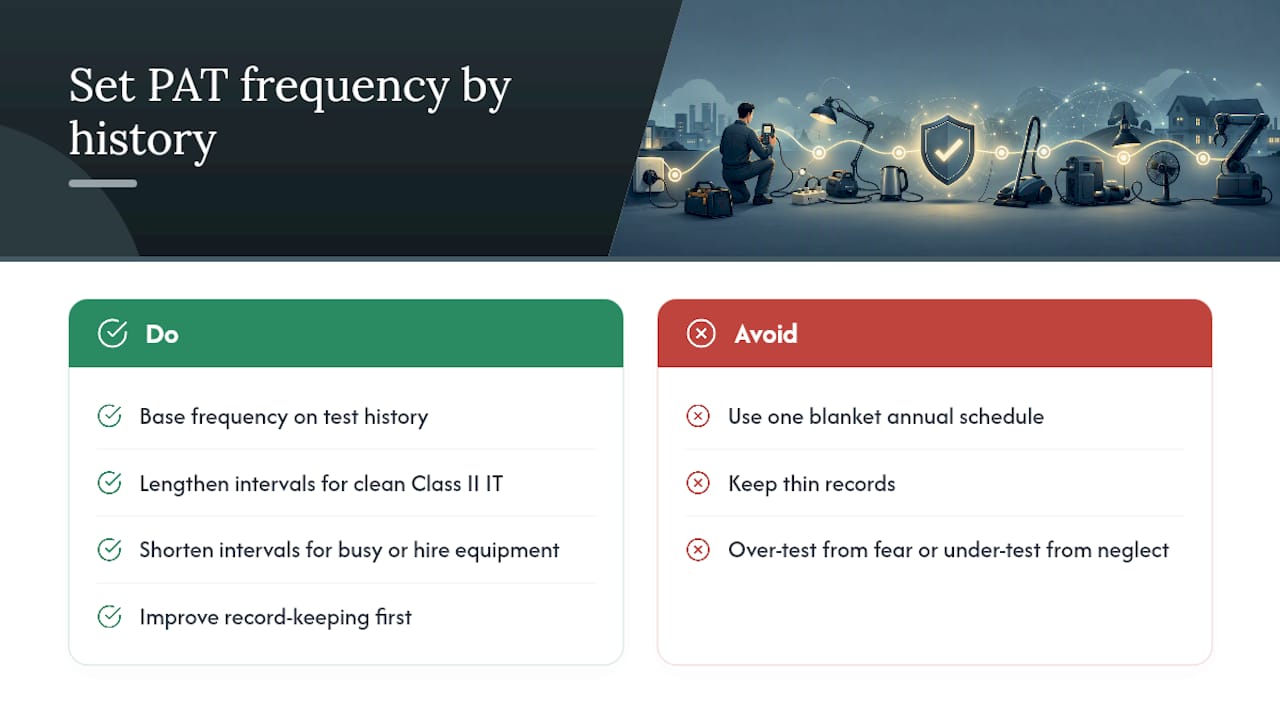
Working with clients across offices, schools and construction sites shows the same pattern again and again: businesses either over-test out of fear or under-test out of neglect. Offices with a genuinely clean history on Class II IT kit can often move to the longer end of the interval range without any increase in risk. Equipment on a busy production line or a hire fleet, by contrast, often needs shortening from the textbook default because real-world wear outpaces the generic guidance.
The most common mistake isn’t testing too rarely, it’s applying one blanket annual schedule to everything regardless of class or use, and keeping records too thin to justify changing it either way. Fix the record-keeping first; the right frequency usually follows on its own.
— Gemma
How City Appliance Testing Ltd builds a risk-based PAT programme
Getting your schedule right shouldn’t mean choosing between overspending on unnecessary tests or under-testing and hoping for the best. A specialist PAT testing provider works from the same HSE and IET starting intervals covered above, then tailors the schedule to actual equipment, environment, and test history rather than defaulting everyone to an annual visit.
A typical engagement starts with a site survey to classify your equipment and environment, moves into a risk-based schedule built on IET/HSE defaults, then runs through testing itself, with a full report and any remedial actions flagged clearly. Businesses managing multiple sites, or juggling PAT alongside EICR fixed wire testing, get one point of contact and one set of records to maintain instead of several. If you’re ready to see where your current schedule sits against a proper risk assessment, book a PAT testing survey and get a schedule built around your actual equipment, not a generic calendar entry.
Where to check the legal detail yourself
For the legal position itself, HSE’s PAT testing FAQ page and the underlying Electricity at Work Regulations 1989 are the two documents worth reading first. For the practical interval tables referenced throughout this guide, go to INDG236 and the IET’s Code of Practice guidance. Landlords letting property outside England should also check devolved nation guidance before assuming England’s rules apply.
Sources
- INDG236: Maintaining portable and transportable electrical equipment
- PAT testing and the parameters affecting the frequency of testing (IET)
FAQ
How often should a PAT test happen?
It depends on equipment class and environment: construction tools often need testing every 3 months, while low-risk office IT equipment can go up to 48 to 60 months, based on HSE and IET starting intervals.
What is the British standard for PAT testing?
There’s no single mandatory British Standard dictating fixed PAT intervals; instead, the IET Code of Practice sets out risk-based initial frequencies that a competent person adjusts using test history.
Is PAT testing still a legal requirement?
PAT testing itself isn’t named in law, but the Electricity at Work Regulations 1989 require you to maintain electrical equipment in a safe condition, and formal testing is often the practical way to prove that duty is met.
What are the HSE requirements for PAT testing?
HSE doesn’t set a fixed testing frequency; it recommends user checks, visual inspections, and testing based on risk, with intervals adjusted as evidence from previous tests builds up.