
110V equipment does need PAT testing. The lower voltage makes it safer to use, but it does not make it exempt from inspection, and the places it is used (building sites, workshops, yards, event set-ups) are hard on cables, plugs and casings. The law does not fix a test interval. You decide one by risk assessment, and for 110V tools in rough conditions that usually means more frequent checks than for an office kettle.
This guide explains what 110V PAT testing involves, why a standard tester can get it wrong, how often to inspect and test, and what to ask an engineer before you book.
TL;DR
- 110V tools, transformers and leads should be inspected and tested like any other portable equipment. Lower voltage reduces shock risk. It does not remove the need for maintenance.
- No law sets an annual PAT test. The HSE says frequency should follow a risk assessment, and for 110V construction equipment it suggests weekly user checks, monthly formal visual inspections and combined inspection and testing every three months.
- The test must be done by a competent person using equipment that can test 110V items. A standard 230V-only tester is not enough.
- Most 110V failures are damaged cables and loose plugs, which is why the visual inspection matters as much as the electrical test.
- Ask for a written asset register and a test schedule, not only a sticker on each item.
Table of Contents
- Why 110V equipment is used, and why it still needs checking
- What the law says about testing 110V equipment
- The three layers of a sound 110V maintenance regime
- How often should 110V equipment be tested?
- What happens in a 110V PAT test
- The faults we expect to find
- Records: what a good result looks like
- Choosing who tests your 110V equipment
- Our view: treat 110V as a maintenance system, not a sticker
- Booking 110V PAT testing with Citypat
- FAQ
- Sources
Why 110V equipment is used, and why it still needs checking
On construction sites and in similar harsh settings, portable tools usually run from a 110V supply fed by a site transformer. The supply is centre-tapped to earth, so the voltage between any live conductor and earth is limited to 55V. That design is the reason 110V is the industry standard for site tools: if someone cuts a cable or a tool’s insulation fails, the shock they could receive is far lower than at 230V. The HSE’s guidance on work equipment describes the simple checks that find most faults.
The mistake we see most often is to read “safer” as “no testing needed”. It is the other way round. A 110V tool lives in dust, mud, rain, concrete and the back of vans. Cables get dragged, crushed and nicked. Plugs get dropped. A safe-by-design supply only protects people if the equipment is kept in good order, and the harsh environment is exactly why inspections need to be frequent, disciplined and recorded.
Typical 110V items that belong in a PAT regime include:
- Drills, grinders, saws, sanders and breakers
- Site transformers and the leads that run from them
- Extension leads and cable reels (including the 16A and 32A industrial plugs and sockets)
- Work lights and floodlights
- Heaters, mixers and pumps
- Welfare equipment on 110V circuits in site cabins
Battery tools are often chosen first where the work allows. The battery pack is not the concern here, but the charger is mains-powered, so chargers belong on your test list too.
What the law says about testing 110V equipment
There is no legal requirement for PAT testing as a named activity, and nothing that makes it an annual task. The Electricity at Work Regulations 1989 require employers to keep electrical equipment in a safe condition. How, and how often, is left to you. The HSE is explicit that the law does not state what must be done or how often, and that the level of maintenance should reflect the risk of an item becoming faulty and how it is used (see its guidance for low-risk environments).
Two practical consequences follow:
- You cannot rely on a blanket annual rule. An annual test may be too rare for a breaker used daily on a demolition job, and more than you need for a desk lamp in a site office.
- You do need to show your reasoning. If there is an incident or an insurance claim, a risk assessment, a schedule and records are what demonstrate you took reasonable steps. If you want the wider picture for employers and landlords, we cover it in our guide to PAT testing regulations in England.
The HSE also says there is no law requiring a qualified electrician to do the tests. What is required is that the person is competent, meaning they have the skills, knowledge and experience to inspect and test safely and to interpret the results. For 110V work that includes knowing how the equipment behaves and how to configure the tester.
The three layers of a sound 110V maintenance regime
PAT testing is one part of maintenance, not a replacement for it. The HSE’s guidance on maintaining portable equipment describes a system of user checks, formal visual inspections and combined inspection and testing. Applied to 110V kit:
1. User checks
The person using the tool looks at it before use. Is the cable sheath intact? Is the plug cracked, and is the cable gripped where it enters the plug? Are there burn marks, a damaged casing, or signs the tool has been dropped or wet? The HSE advises switching off and unplugging before any checks. A tool that fails a user check is taken out of use and tagged, not used “just for this job”.
2. Formal visual inspections
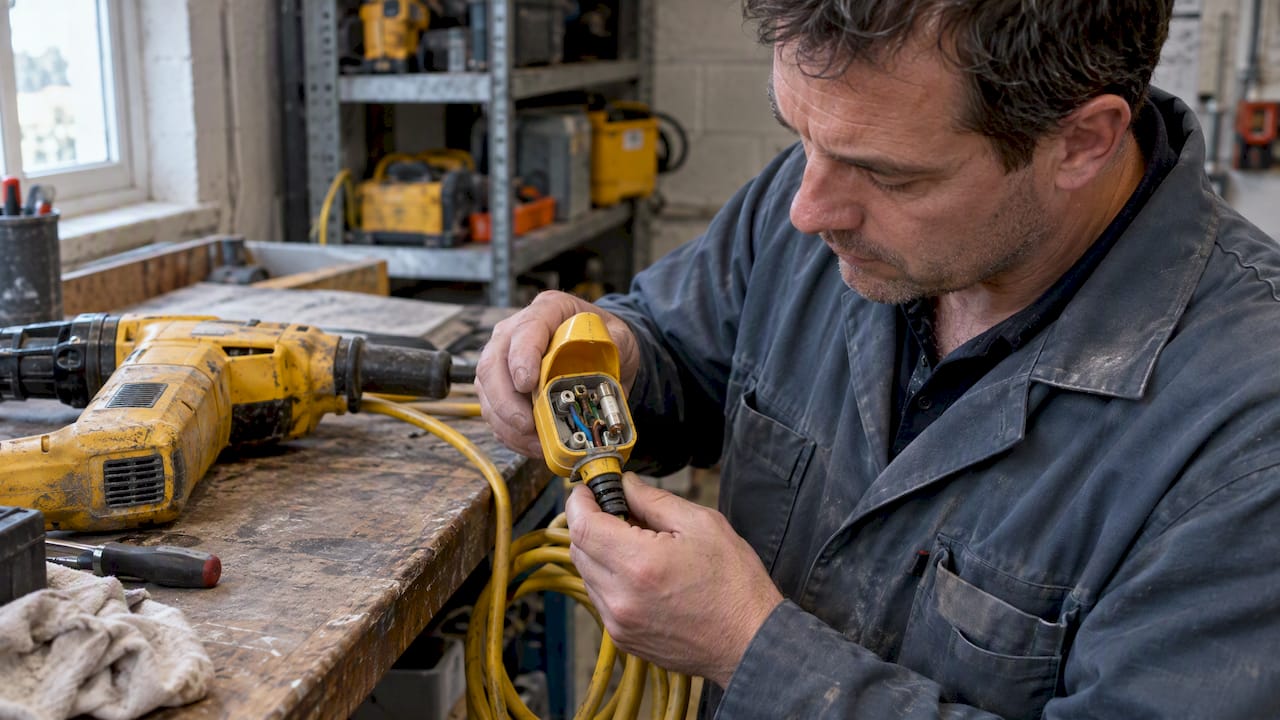
A competent person looks more closely: opens the plug where safe to do so, checks the fuse is the right rating, checks the cable is not joined with tape, and looks at the casing, guards and switches. On rough sites this is where most faults are caught.
3. Combined inspection and testing
This is the PAT test itself: a visual inspection followed by electrical tests on the item, recorded against its unique ID. The intervals come from your risk assessment. Testing alone cannot guarantee safety, because a pass only shows the item was safe at the moment of testing.
How often should 110V equipment be tested?
For construction, the HSE’s published suggestion is a useful starting point. It is a guide, not a legal minimum, and your own risk assessment can justify something different.
| Check | Suggested frequency for 110V construction equipment | Who does it |
|---|---|---|
| User check | Before use, and visual checks weekly | The operator |
| Formal visual inspection | Monthly | A competent person |
| Combined inspection and testing | Every 3 months | A competent person with suitable test equipment |
These intervals are taken from the HSE’s PAT FAQ. Compare that with a low-risk environment such as an office, where the HSE says equipment may need only occasional formal checks. The difference is the point: 110V site kit is tested more often because it is used harder, not because the voltage is dangerous in itself.
Factors that should push your interval shorter:
- Equipment moved between sites or hired out
- Wet, dusty or corrosive working conditions
- Heavy-duty tools used daily
- A history of failures in a particular item type
- Equipment used by many different people
Factors that allow it to lengthen, with evidence: stable fixed-location use, low failure rates over several test cycles, and good user-check discipline. Record the reasoning when you change an interval.
What happens in a 110V PAT test
A competent engineer starts with the visual inspection. If the item fails there, no electrical test is needed: it is failed and removed from use. For items that pass, the typical electrical tests are:
- Earth continuity, confirming the protective conductor is intact where the item is Class I.
- Insulation resistance, or a leakage current measurement as an alternative.
- Functional checks, confirming the item operates as it should.
The Seaward PAT guidance, which reflects the IET Code of Practice, notes that the test equipment has to be capable of the voltage in question and set up properly. A standard 230V tester will not do the job. Using the wrong configuration risks inaccurate readings or damage to the appliance.
Tools with electronic speed control
Some modern 110V power tools contain electronic speed control or similar circuitry. A 500V DC insulation test can damage these. Experienced engineers use protective conductor current or leakage measurements instead, which are gentler on sensitive electronics. If an engineer tells you they run the same test on everything, ask how they treat electronic tools.
Transformers and reels
A site transformer has a 230V input side and a 110V output side, so the engineer needs to know which they are testing. Cable reels should be tested fully unwound, because a coiled reel can hide faults and can overheat in use. These are ordinary parts of a site test, but they are the places a generalist tester can slip.
The faults we expect to find
Practitioners agree that the most common 110V failure is not a failed internal component. It is cable and plug damage from rugged use. A cut outer sheath, a loose plug, an exposed inner core or a cracked housing fails the item regardless of what the electrical test says. That is why formal visual inspection is the priority, and why a tester who rushes straight to the machine and ignores the cable is not giving you much.
Common findings on 110V kit:
- Outer sheath cut or crushed, often near the plug or the tool entry
- Cable not gripped by the plug’s cord clamp
- Taped repairs and joints
- Cracked or melted industrial plugs and sockets
- Missing or damaged guards
- Incorrect fuses in plugs that take them
- Signs of water ingress in housings
- Tools that have been dropped and have loose or broken internal parts
Each of these is cheap to fix early. A replacement lead costs far less than a tool failure on a live job, or the time lost when an incident is investigated.
Records: what a good result looks like
A passed sticker is useful on the job, but it is not the real deliverable. A professional service should leave you with:
- An asset register listing every item, its ID, location and type
- Test results per item, with pass or fail and any repair notes
- A schedule showing when each group of items is next due
- Clear flags on failed items, with what needs to change
This paperwork is what you show after an incident, an insurance query or a client audit. On multi-site contractors it also stops items from being missed when tools move from one site to another. A pass label only says the item was safe when tested, so the records and the discipline between tests carry the real weight.
Choosing who tests your 110V equipment
Because the law asks for competence rather than a particular certificate, it is worth asking a few direct questions before you book:
| Question | What a good answer sounds like |
|---|---|
| Can you test 110V equipment, including transformers and reels? | Yes, and they describe their equipment and how they configure it |
| How do you handle electronic speed-control tools? | They use leakage or protective conductor current measurements rather than a high-voltage insulation test where needed |
| What do I get at the end? | An asset register, itemised results and a next-due schedule |
| Can you work out of hours or around our programme? | They plan testing so it does not stop the job |
| How do you set the interval? | They talk about your risk assessment, not just “annually” |
A tester who cannot answer these plainly is a risk, whatever the price. If you manage a mix of 110V and 230V equipment, there is a real convenience in having one provider test all of it so the register is complete.
Our view: treat 110V as a maintenance system, not a sticker
We test portable equipment for businesses, landlords and organisations across the UK, and our view of 110V work is simple. The voltage is a good safety decision, but it can lull people into skipping the discipline that keeps it safe.
Three things matter most in practice:
- Risk-based intervals, written down. A monthly formal inspection and quarterly testing may suit a busy site. A lightly used 110V set in a depot may suit something longer. Either is defensible if you can explain it.
- Visual first. We would rather an engineer spend an extra minute on a cable than speed through a machine test. Damaged plugs and sheaths are where the faults are.
- Documentation that survives an audit. Clear records and scheduling, so inspection dates are not missed, are as valuable as the test itself. This matters most for clients with several sites, where we aim to coordinate testing so it causes the least disruption.
Many of our clients also need related checks: fixed wiring, emergency lighting, fire alarms and extinguishers. Having one provider coordinate these makes missed dates less likely, which is the main reason compliance slips.
— Gemma
Booking 110V PAT testing with Citypat
If you have 110V tools, transformers or leads alongside ordinary 230V equipment, we can test both in one visit and give you a single register and schedule. Our PAT testing service covers businesses, landlords and organisations, including multi-site operators. Tell us what equipment you have and how it is used, and we will plan testing around your working pattern. For the fixed installation behind your supply, see our EICR and fixed wire testing. We do not publish prices, so contact us for a quote based on your equipment.
If you also let property, our guide to HMO PAT testing explains why licence terms, rather than a general rule, often set the schedule there.
FAQ
Does 110V equipment need PAT testing?
Yes. Lower voltage reduces the shock risk, but cables, plugs and casings still wear out, and site conditions speed that up. The HSE expects equipment to be maintained to prevent danger, and for 110V construction equipment it suggests regular user checks, formal inspections and combined inspection and testing.
Is there a legal requirement to test 110V tools every year?
No. The law requires equipment to be maintained safely but does not set a test interval. The IET’s guidance also notes there is no specific legal requirement for annual inspection or testing. Your risk assessment sets the frequency, and for hard-working site tools it will often be shorter than a year.
Can a standard PAT tester test 110V equipment?
Not a 230V-only unit. The tester must be capable of 110V equipment and configured correctly, otherwise readings can be wrong or the appliance damaged. Ask your engineer what equipment they use and how they handle tools with electronic speed control.
Does an electrician have to do the test?
No. The person must be competent: skilled, knowledgeable and experienced enough to test safely and interpret results. That can be a trained PAT engineer, as long as they understand 110V systems.
Do chargers for battery tools need testing?
Yes. The charger runs from the mains and is a portable appliance, so it belongs in your register even if the tool it powers is battery-operated.
Sources
- HSE: PAT (portable appliance testing), answers to popular questions
- HSE: Work using electrically powered equipment
- HSE: Maintaining portable electric equipment in low-risk environments
- HSE: Maintaining portable electrical equipment (HSG107)
- Seaward: Portable Appliance Testing guidance
- IET: PAT testing of equipment having high protective conductor leakage current