
Most businesses pay between £120 and £250 for an annual full-duration emergency lighting test on a small site, rising to £300 to £600 or more for larger premises, according to current market pricing. Contracted monthly visits typically run £40 to £90 per attendance, though in-house monthly checks can cost nothing at all. The figure that catches most people out is remedial work: faulty batteries or replacement luminaires are priced separately and can push the final bill well past the test fee itself.
TL;DR:
- Tiny premises may pay nearly the same minimum attendance fee as larger sites, while testing 25 to 50 luminaires typically costs £250 to £450.
- Competent in house staff can log monthly function tests, but a qualified electrician usually performs the annual discharge, lasting one or three hours.
- Ask for an itemized quote that separates attendance, per fitting rates, VAT, and remedial labor; batteries and replacement luminaires are rarely included.
- Combining annual testing with PAT or EICR visits can spread the attendance fee across services and reduce separate contractor callouts for each job.
Table of Contents
- Typical cost bands: what testers currently charge in England
- What affects the total cost of an emergency lighting test
- What a proper quote should include (and what it usually excludes)
- How tests are done and who can perform them
- Practical ways to reduce your ongoing emergency-lighting costs
- CityPat perspective: pricing tests fairly and keeping costs predictable
- Get an itemised quote or a bundled compliance visit
- FAQ
- Sources
Typical cost bands: what testers currently charge in England
Prices scale with the number of luminaires and the complexity of the site, but the bands are fairly consistent across England. A small shop or office with a handful of emergency fittings typically pays £120 to £250 for the annual full-duration test. A mid-size site with around 25 to 50 luminaires tends to land in the £250 to £450 range, and a larger building with roughly 100 fittings, such as a multi-storey office block, commonly falls into the £300 to £600 band.
Contracted monthly visits add up quickly if you choose that route rather than handling function checks in-house, which can save considerable ongoing costs.
- Many contractors apply a minimum attendance fee, which can dominate the bill on very small premises regardless of luminaire count.
Most contracts also carry a minimum site attendance fee, so a tiny premises with only three or four emergency lights may still pay close to the same call-out charge as a slightly larger one. VAT is added on top of quoted figures unless a supplier states otherwise, so always check whether a quote is VAT-inclusive before comparing two suppliers side by side.
What affects the total cost of an emergency lighting test
Quotes vary for practical reasons, and understanding them helps you ask sharper questions when comparing suppliers.
- Number of luminaires: most testers charge per fitting on top of a base attendance fee, so a site with 80 lights costs more to test than one with 15.
- System type: self-contained emergency fittings are quicker to check individually, whereas central battery or inverter systems need specialist testing of the central unit as well as each outlet, which adds time.
- Access difficulty: fittings mounted at height, in plant rooms or behind locked doors may need scaffolding, a mobile platform or an out-of-hours visit, all of which add cost.
- Missing records: a site with no logbook or previous test history takes longer to survey because the engineer has to map the system from scratch.
- Bundling: combining the emergency lighting test with another scheduled compliance visit, such as a fire alarm service or PAT round, spreads the attendance fee across more than one job.
Pro Tip: Ask your supplier for a per-luminaire rate rather than a single lump sum, so you can estimate costs accurately if you add or remove fittings later.
What a proper quote should include (and what it usually excludes)
A clear quote separates the routine test from anything unexpected it uncovers. Before signing off, check the paperwork sets out:
- Attendance or call-out fee, charged regardless of how many fittings are on site.
- Per-luminaire test rate, so the total scales predictably with your fitting count.
- VAT, stated clearly as included or added on top.
- Labour rate for remedial work, quoted separately from the test itself, since battery and luminaire replacement is rarely included in the base price.
- Deliverables, meaning a signed certificate, a logbook entry, a written remedial report where faults are found, and a note of the next due date.
A quote that bundles everything into one number without breaking out remedials is harder to challenge if the final invoice comes in higher than expected.
How tests are done and who can perform them
Emergency lighting testing follows two distinct routines, and they are not interchangeable. The monthly function test is a brief simulated mains failure, usually just long enough to confirm each light switches on and operates correctly. It’s straightforward enough that competent in-house staff can carry it out and log it themselves, provided the result goes into the site logbook.
The annual test is different: it’s a full-duration discharge, running the system for its full rated period, typically one or three hours depending on the system’s design. Because this drains the batteries completely and can reveal faults that only show up under sustained load, it’s normally carried out by a qualified electrician or specialist contractor rather than in-house staff.
- Monthly function test: short switch test, in-house staff, logged in the site logbook.
- Annual full-duration test: complete discharge test, usually contracted out, results recorded on a formal certificate.
This testing schedule reflects BS 5266-1:2025, the code of practice for emergency lighting of premises, and sits alongside duties under the Regulatory Reform (Fire Safety) Order 2005, which requires that escape routes needing artificial illumination have adequate event fire safety that is maintained and tested. Certificates and logbook entries matter beyond compliance: they’re often the first thing an insurer or fire officer asks to see after an incident.
Practical ways to reduce your ongoing emergency-lighting costs
Cutting cost without cutting corners comes down to a handful of sensible habits.
- Carry out monthly function tests with your own competent staff instead of paying a contractor for a monthly visit.
- Bundle the annual full-duration test with other scheduled compliance work, such as PAT testing or an EICR, so the attendance fee is shared across jobs.
- Ask for an itemised quote upfront and budget separately for likely remedial work rather than being surprised by it later.
- Replace ageing fluorescent emergency fittings with LED luminaires in phases, since LED units hold charge longer and fail less often, which reduces remedial spikes at each annual test.
- Schedule non-urgent replacements for a planned maintenance window rather than paying for an emergency call-out.
Pro Tip: Keep a simple spreadsheet of fitting age and last replacement date. It makes phased LED upgrades far easier to plan and budget for.
CityPat perspective: pricing tests fairly and keeping costs predictable
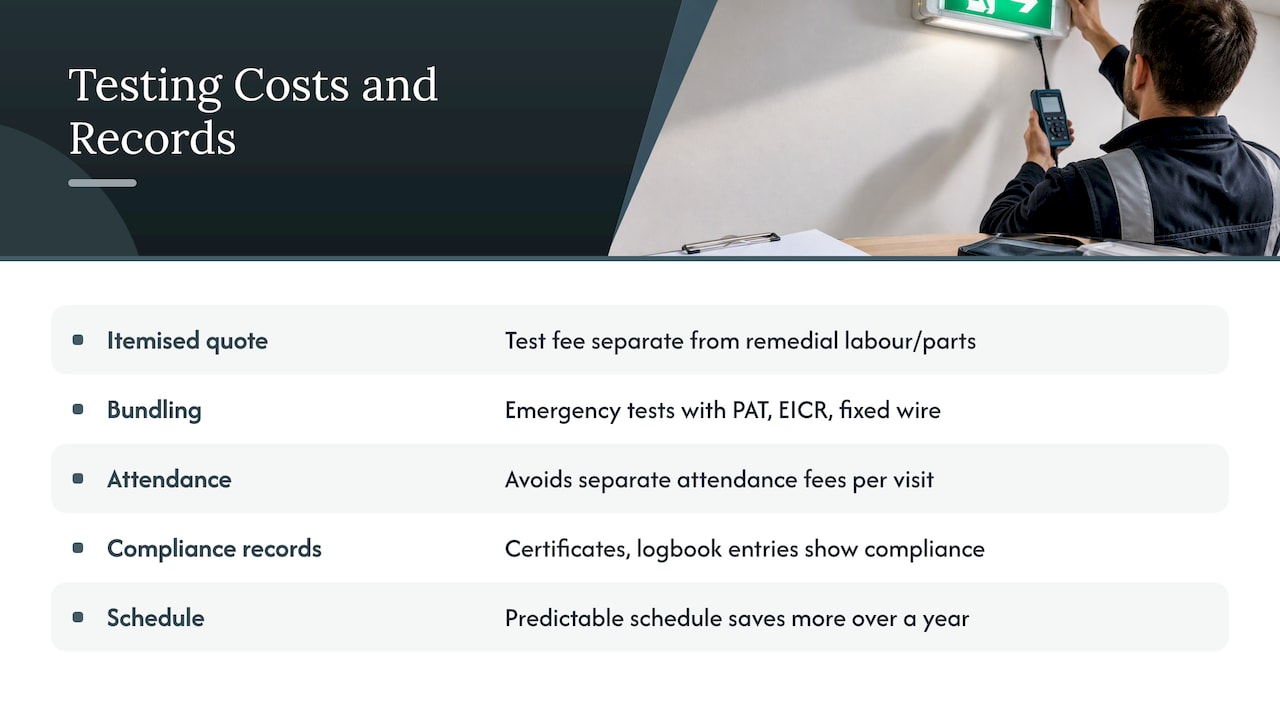
We think the biggest cost complaint we hear from clients isn’t the test fee itself, it’s not knowing what the final invoice will look like. That’s why we issue itemised quotes that separate the test fee from any remedial labour or parts, so nothing arrives as a surprise.
We offer emergency lighting testing across England, and we often bundle it with PAT testing or EICR and fixed wire testing so clients avoid paying separate attendance fees for each visit. Tests typically include documentation such as certificates and logbook entries that demonstrate compliance to landlords, insurers, or fire officers. We find that a predictable, well-documented schedule saves clients more over a year than chasing the cheapest single quote.
— Gemma
Get an itemised quote or a bundled compliance visit
We handle the booking, the testing and the paperwork, so you can request one visit that covers emergency lighting alongside PAT, EICR or fire extinguisher servicing rather than arranging three separate call-outs.
| What you get | Detail |
|---|---|
| Itemised quote | Test fee and remedial costs listed separately |
| Bundling option | Combine with PAT, EICR or extinguisher servicing |
| Documentation | Certificate and logbook entry on completion |
Request a no-obligation emergency lighting testing quote for your site and find out whether bundling with another service lowers your overall cost.
FAQ
What qualifications do I need to test emergency lighting?
Monthly function tests can be carried out by competent in-house staff who understand how to simulate a mains failure and record the result correctly. The annual full-duration test is normally carried out by a qualified electrician or specialist contractor familiar with BS 5266-1:2025, since it involves a complete battery discharge.
How much does it cost to install emergency lighting in the UK?
Installation costs depend on the number of luminaires, the system type and the building’s wiring, and prices aren’t published as a fixed rate. For an accurate figure, request a site-specific quote rather than relying on a generic estimate.
Can I test my own emergency lighting?
You can carry out the brief monthly function test yourself as a competent person, provided you log the result in your site logbook. The annual full-duration test is more involved and is typically carried out by a contractor because it drains the system fully and can reveal faults needing specialist repair.
Is emergency lighting testing a legal requirement?
Yes. The Fire Safety Order requires that escape routes needing artificial illumination have adequate emergency lighting, and responsible persons must ensure it’s routinely tested and maintained. Records of testing are expected as evidence of compliance.
Sources
- Emergency Lighting Testing Cost 2026 | RiskFire
- BS 5266-1:2025 – Emergency lighting of premises – BSI Knowledge
- A guide for persons with duties under the Regulatory Reform (Fire Safety) Order 2005