

An emergency lighting logbook is the running record of every test, fault and repair on your escape lighting. In England it is the proof a fire and rescue officer, insurer or new manager looks at first. Record each monthly test, each annual full-duration test, every fault and the date it was put right, and keep the book where the responsible person can find it. We test and certify emergency lighting for businesses and landlords, and the pattern is simple: lighting that works but is not written down is very hard to defend.
TL;DR
- The logbook records monthly and annual test results, faults found and the action taken, and can show enforcing authorities that the system is maintained to BS 5266-1 (NSI).
- Test monthly with a short functional check, and once a year run a full rated-duration discharge test, normally three hours.
- Every entry needs a date, the tester, which fittings were covered, pass or fail per fitting, and, for any fault, the date reported and the date fixed.
- The 2025 revision of BS 5266-1 adds a five-year photometric check, so your logbook should have somewhere to hold those readings.
- Staff can do the monthly test; the annual test belongs with a competent contractor.
Table of Contents
- What an emergency lighting logbook is for
- What the standard says about records
- What to put in the logbook
- How often to test
- Who can do the testing
- What changed with BS 5266-1:2025
- Paper, spreadsheet or digital
- Common logbook mistakes
- Landlords and multi-site operators
- How we help
- Our view
- FAQ
- Sources
What an emergency lighting logbook is for
Emergency lighting is the lighting that comes on when the mains fails, so people can get out safely. Every unit has a battery, and batteries fade without anyone noticing. The only way to know a fitting will work on the night is to test it and write down the result.
The logbook does three jobs:
- It proves maintenance. The NSI, a UK security and fire industry certification body, describes the logbook as proof to enforcing authorities such as the Fire and Rescue Service that the system is maintained in line with BS 5266-1 (NSI). BS 5266-1 is the British Standard code of practice for emergency lighting.
- It shows who is responsible. BAFE, the fire safety certification scheme, says the functional operation of the system is the responsibility of the user, meaning the person appointed responsible for the premises (BAFE). That is the employer, landlord or managing agent. You can hand the work to a contractor, but the record-keeping stays your concern.
- It shows patterns. A fitting that fails every quarter, or a fault left open for months, is visible only on paper. The same page that protects you in an inspection tells you where to spend money.
If you own a private house, none of this applies. For shops, offices, workshops, hotels, schools and the shared areas of blocks of flats, it does.
What the standard says about records
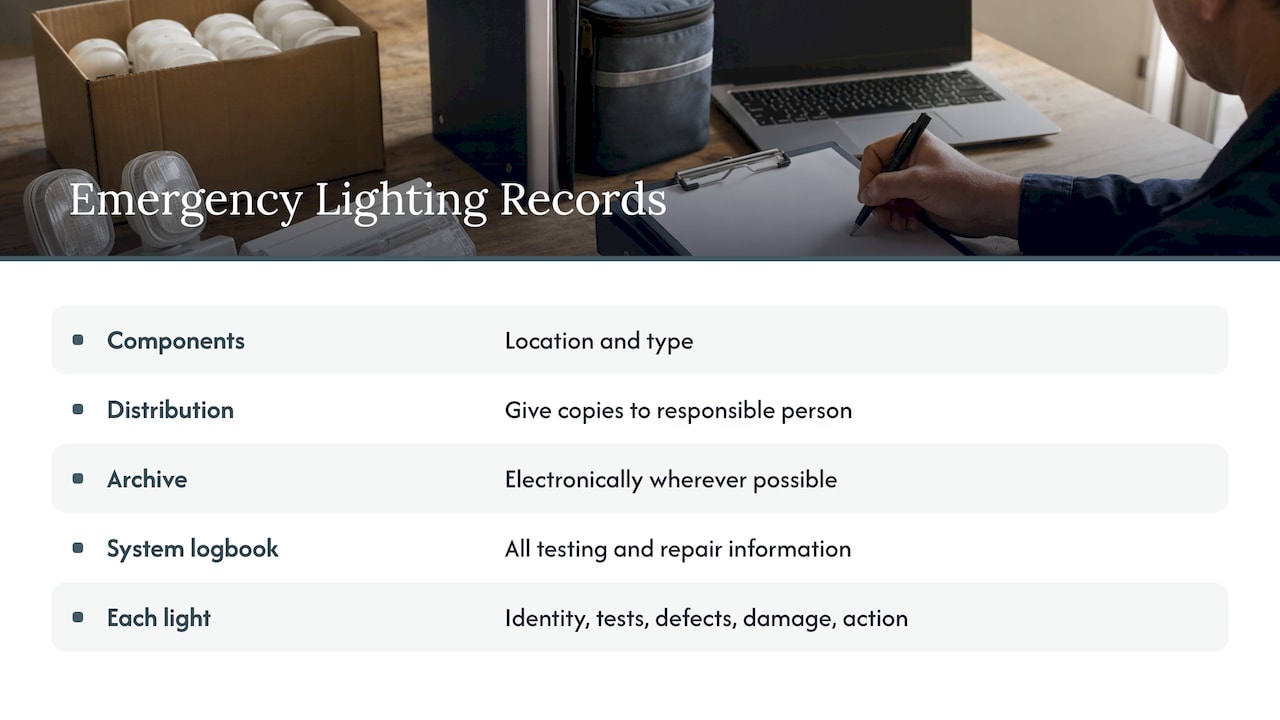
BS 5266-1:2016 says records of the emergency lighting system should be kept, including the location and type of components. Copies should go to the responsible person, and records should be archived electronically wherever possible (BS 5266-1 code of practice text). The standard also asks for all testing and repair information to be recorded in a logbook (BAFE).
The Fire Protection Association adds a practical point: give each light a location identity, so a failure can be tied to one specific fitting, and log tests, defects, damage and remedial action for each light (FPA). “Light failed on first floor” is not a record. “Fitting 1F-07, corridor outside kitchen, did not illuminate” is.
What to put in the logbook
Here is a layout that covers what the fire and rescue service logbooks and the standard ask for. Think of it as three parts.
Part 1: System details
Set this up once and update it when anything changes.
- The responsible person and the nominated competent person.
- The type of system and its rated duration (one hour, two hours or three hours).
- A plan or schedule showing every emergency light and exit sign, each with its own reference number.
- Where the test key switches are.
- Installer details and the completion certificate, if you have them.
BS 5266-1 requires records of the location and type of components such as luminaires, test devices and central power units (BS 5266-1 code of practice text). If you have no plan, drawing one is the best first job. Our guide to emergency lighting lux levels in England explains what light output the design should achieve.
Part 2: Monthly tests
For every monthly test, record:
- the date;
- who carried it out;
- whether it was a visual inspection or a full functional test, and whether staff or an engineer did it, as East Sussex Fire and Rescue Service asks (ESFRS logbook);
- which fittings or zones were covered;
- pass or fail for each fitting;
- any fault, with its reference.
Avon Fire and Rescue Service’s logbook describes the monthly test as switching each luminaire and exit sign on from its battery by simulating a mains failure, and asks for daily visual checks of any central power supply indicators (Avon FRS logbook). Do not write “all OK” without saying how you tested. And do not forget to record that the supply was restored afterwards. A light left in test mode keeps draining its battery.
Part 3: Annual tests, faults and changes
For the annual test, record:
- the date and the engineer or company;
- the duration tested and whether every fitting held for its full rated duration;
- the result per fitting;
- any batteries, lamps or fittings replaced;
- the certificate number, so the logbook and the certificate point to each other.
For every fault, record what was wrong, the date it was reported, the action taken and the date it was rectified. Essex Fire and Rescue Service asks for exactly this: checks, tests, faults, remedial action and the date each fault is rectified (Essex FRS logbook). Avon asks for the date the fault was reported to be indicated alongside remedial action (Avon FRS logbook).
Also log alterations. If you partition a room, add a mezzanine or move a fire exit, the lighting design may no longer cover the space. Note the change and ask for the lighting to be reviewed.
A simple example entry
| Date | Test type | Done by | Fittings covered | Result | Fault and action | Fixed on |
|---|---|---|---|---|---|---|
| First week of the month | Monthly functional (key switch) | Site manager | All 24 fittings, ground and first floor | 23 pass, 1 fail | 1F-07 did not light, battery suspected, engineer called | Date the battery was replaced |
The last column is the one people skip. A fault with no “fixed on” date looks like a fault nobody dealt with.
How often to test
BS 5266-1 recommends checking functional operation at least every month and running a full rated-duration test on each luminaire at least once a year (BAFE).
Monthly: a short “flick” test. The Fire Protection Association explains that this simulates a mains failure using a fish key, a small key that operates the test switch, and that a record must be kept including any faults, which are reported to the responsible person for remedial action. It also advises using the key rather than switching off the mains lighting, which could be hazardous to other occupants (FPA).
Annually: a full-duration discharge test. The FPA says the normal lighting circuit is switched off and the emergency lights are left on for three hours in line with BS 5266-1, with every luminaire staying lit throughout (FPA). Your system’s rated duration is set by its design, so check the figure in your logbook.

The standard suggests precautions during a full test, such as testing while the building is empty or testing alternate luminaires so a charged one always sits beside the unit under test. If a light fails, a competent person should repair it, and alternative safety arrangements such as extra patrols, torches or limits on building use should apply until it is retested satisfactorily (BS 5266-1 code of practice text). Write those interim measures in the logbook too.
Who can do the testing
According to the NSI, monthly functional testing can be done by the user with a test key, while the annual full-duration test, normally three hours, should be carried out only by a competent emergency lighting contractor (NSI).
BS 5266-1 defines a competent person as someone with relevant current training and experience, the right tools, equipment and information, and the ability to carry out the task (BS 5266-1 code of practice text). In practice:
- Monthly: nominate one named member of staff, train them on the key switch and the logbook, and name a deputy for holidays. Essex Fire and Rescue Service asks for a nominated competent person with enough information and training, and for tests at times of minimum risk (Essex FRS logbook).
- Annually: use an engineer who will leave you a dated certificate and fitting-by-fitting results to file with the logbook. BAFE notes that using a third-party certificated organisation demonstrates ongoing due diligence (BAFE). Our page on emergency lighting certificate types explains what the paperwork should look like.
What changed with BS 5266-1:2025
BSI published a fully revised BS 5266-1 in late 2025, widening its scope from escape lighting to local area and standby lighting (BSI). The ECA, the electrical contractors’ trade association, reports the update alongside revisions to BS EN 1838 and BS EN 50172. Among the changes are verification of photometric performance every five years, new lux levels across the full width of escape routes, dual-circuit wiring for high-risk areas, and clearer handover documentation (ECA).
Photometric verification means measuring the actual light on escape routes with a calibrated meter, rather than assuming the design still holds. For your logbook this means:
- a section for the handover or commissioning measurements;
- a place to record each five-year measurement with date, engineer and result;
- a note in the system details of any change to the layout that could alter coverage.
If your system was installed before the update, you do not need to rewrite the logbook. Add the new section and ask your contractor to include photometric readings at the next suitable annual visit. Our page on emergency lighting test cost explains what typically sits inside a test and what is charged separately.
Paper, spreadsheet or digital
The standard does not demand a particular format. It asks for records that are kept, accessible and, wherever possible, archived electronically (BS 5266-1 code of practice text). So choose on practicality:
- A bound book kept at the main entrance or fire panel works well for one site with one person testing.
- A spreadsheet or shared document suits several sites, as long as nobody can quietly overwrite old entries and every row carries a name and date.
- Scans of the paper book each quarter give you a backup if the book is lost or damaged.
Whatever you choose, an entry should be clear enough that a stranger could reconstruct what was tested and how. If it would not satisfy a fire officer reading it cold, it will not satisfy an insurer either.
Common logbook mistakes
- No method. “Tested, all OK” with no note on whether it was a key test or a visual check.
- Faults without a fitting reference. If you cannot say which light failed, you cannot show it was fixed.
- No fix date. Open faults sit for months and the book itself shows the neglect.
- Supply not confirmed restored. The test leaves lights discharging.
- No link to the annual certificate. Note the certificate number in the annual entry.
- Gaps. Missing months are far more noticeable than a recorded fault with a quick repair.
Landlords and multi-site operators
If you manage the shared areas of a block of flats or several let properties, the logbook is part of your wider fire safety file alongside the fire risk assessment. Our landlord fire safety guide sets out how the duties fit together. If you are expanding your portfolio, the wider checks before a buy to let purchase are worth reading alongside it. Ask the seller for the existing logbooks and certificates for any building you take on.
For retail chains and organisations with many sites, the difficulty is consistency. Use one template, one numbering scheme for fittings and one schedule for monthly tests, so that a manager at site 14 records things the same way as site 2. A similar structure works for the fire alarm, and our fire alarm logbook guide shows it.
How we help
Emergency lighting is one of several fire and electrical checks most sites need, and each has its own dates. We coordinate emergency lighting testing alongside fire alarm testing, fire extinguisher servicing, fire risk assessments, PAT testing and EICRs through one provider, with nationwide support, clear documentation and scheduling designed to minimise disruption and missed inspection dates. For multi-site businesses that means one schedule rather than a different supplier and a different set of paperwork at every location.
If you want the annual test and the records handled together, start with our emergency lighting testing page, or see our fire risk assessment service to check that your lighting matches your assessment.
Our view
A logbook is not paperwork for its own sake. It is the only thing that tells you, on a quiet Tuesday, whether the lights will work when the power goes at 6pm in winter.
Most of the sites we visit are not short of lights. What they lack is a clear plan, numbered fittings and a habit. Give every fitting a number, name one person for the monthly test and one deputy, and write down the fix date as well as the fault date. That discipline costs a few minutes a month.
We would also keep the annual test, the certificate and the logbook together, and tie them to the fire risk assessment, so that one visit answers all three questions: is it working, can you prove it, and does it still match the building? That is why we bring emergency lighting, fire alarm, extinguisher and electrical testing under one schedule for our clients.
Gemma
FAQ
Is an emergency lighting logbook a legal requirement in England?
The Regulatory Reform (Fire Safety) Order 2005 requires the responsible person to keep emergency lighting maintained and working. BS 5266-1 sets out how, including keeping records. Enforcing authorities such as the Fire and Rescue Service use the logbook as proof of that maintenance (NSI).
How long should I keep emergency lighting records?
The standard asks for records to be kept and archived electronically wherever possible, without giving one fixed period (BS 5266-1 code of practice text). A sensible approach is to keep the full history for the life of the installation, so a new manager or inspector can see the pattern of faults and repairs.
Can my own staff do the emergency lighting tests?
Yes for the monthly functional test, using the test key, provided the person is trained and named in the logbook. The annual full-duration test, normally three hours, should be done by a competent emergency lighting contractor (NSI).
What should I do if a light fails the test?
Record the fitting reference, the fault and the date, and get a competent person to repair it. Until it is retested satisfactorily, put alternative safety measures in place, such as extra patrols or torches, and then record the date it was put right (BS 5266-1 code of practice text).
Sources
- Emergency Lighting (BAFE SP203-4) for your workplace, NSI
- Emergency Lighting System Guidance, BAFE
- How often should emergency lighting be tested?, Fire Protection Association
- BS 5266-1:2016 code of practice for emergency lighting
- Fire Safety Log Book, Avon Fire and Rescue Service
- Fire Safety Log Book, Essex Fire and Rescue Service
- Fire Safety Log Book, East Sussex Fire and Rescue Service
- BSI publishes revised standard on emergency lighting systems
- Significant changes to emergency lighting standards, ECA