
Most UK businesses pay a visit charge plus a per-extinguisher fee for a basic annual service, varying by type and supplier. Total cost combines the visit charge and the per-extinguisher price multiplied by the number of units, plus any parts and VAT. For a typical office with several extinguishers, the total cost is modest and depends on extinguisher mix and supplier.
TL;DR:
- Smaller units like water, foam, and powder extinguishers generally cost less to service than more complex CO2 or clean agent types, which require pressure testing and parts replacement.
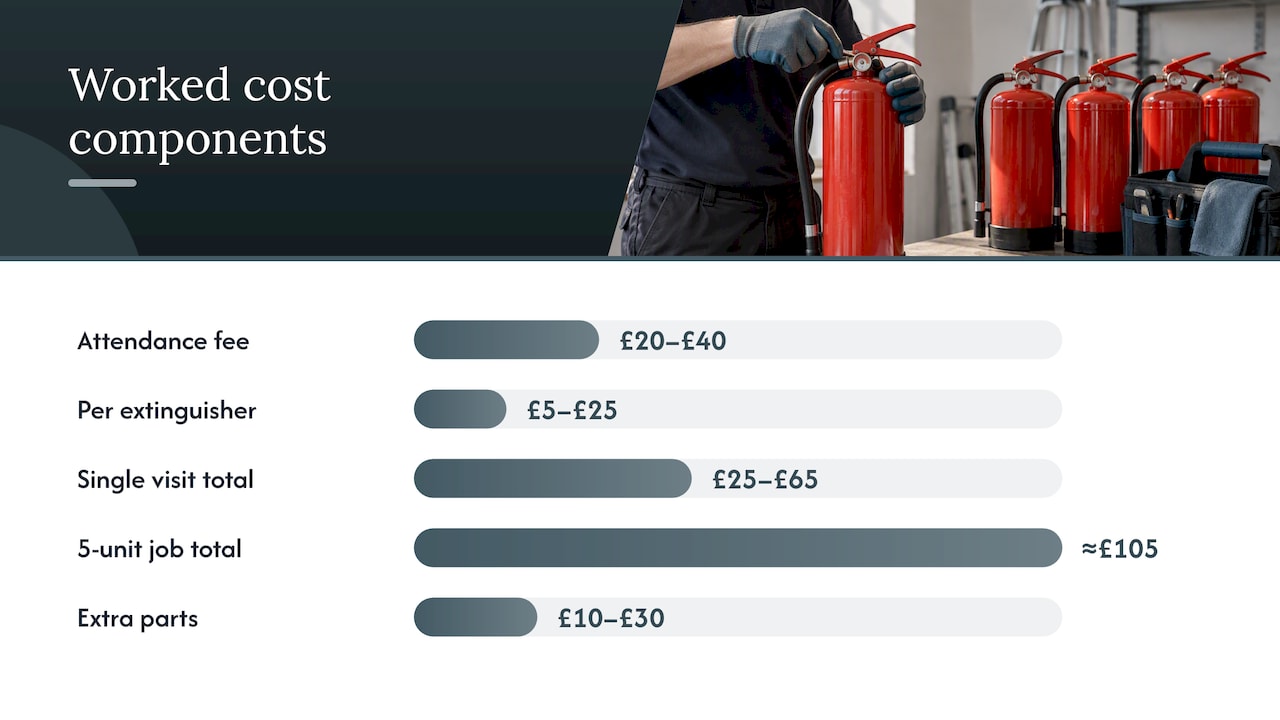
- A typical service quote includes a fixed attendance fee of £20 to £40 plus £5 to £25 per extinguisher, with additional costs for parts such as gauges or valves.
- Annual basic servicing must follow BS 5306-3 standards, covering visual inspections, pressure checks, and record-keeping, while more extensive repairs are priced separately.
- Out-of-hours, inaccessible, or multiple-location jobs increase costs, but bundling compliance tasks can significantly reduce overall expenses.
- Consistent, documented maintenance records and using a single supplier for multiple compliance needs offer better long-term cost control and legal protection.
Table of Contents
- Real UK price bands and worked calculations by scenario
- What a basic annual service covers under BS 5306-3
- Factors that raise or reduce the cost
- Legal requirements, intervals and record-keeping for England
- How to budget, procure and lower long-term costs
- How to verify competence and why it matters
- Geographical cost variations and regional pricing differences
- Comparison of costs between professional service providers
- Cost implications of non-compliance or missed servicing deadlines
- Timeline: from booking a service to completion
- Why the real cost conversation is about routine, not price per unit
- Get a fire safety quote that covers more than extinguishers
- Sources
- FAQ
Real UK price bands and worked calculations by scenario
Pricing varies by extinguisher type, supplier and location, but the shape of a quote is fairly consistent across England. Water, foam and powder extinguishers tend to sit at the lower end of the per-unit range, while CO2 and clean agent extinguishers, which need specialist handling and more expensive replacement parts, usually cost more to service.
- Water, foam and powder extinguishers generally cost less per unit for a basic annual service than CO2 or clean agent types, which tend to be more expensive due to pressure testing and refilling requirements.
- Attendance or call-out fees are an additional fixed cost that can sometimes be combined with other services to reduce the overall charge.
A basic service quote is usually built from two moving parts: a fixed attendance fee and a variable per-extinguisher charge. Add parts (new seals, tamper tags or a replacement gauge) and VAT, and you have the full invoice.
Worked examples make this easier to plan around. A single extinguisher service might cost £20 to £40 attendance plus £5 to £25 for the unit, so roughly £25 to £65 plus VAT for a one-off visit. Five extinguishers of mixed type (say two powder, two CO2 and one clean agent) could total £30 attendance plus around £75 in per-unit fees, bringing the job to about £105 plus VAT before any parts are needed. Add a replacement gauge or valve and the bill can climb by £10 to £30 per part.
When you read a supplier’s quote, look for these line items: attendance or call-out, basic service per extinguisher (usually broken down by type), parts or refill charges, extended service or discharge test fees where relevant, and disposal costs for condemned units. A quote that bundles everything into one number is harder to compare against a competitor’s breakdown, so ask for the itemised version before you sign anything.
What a basic annual service covers under BS 5306-3
A competent basic service follows the checks set out in BS 5306-3, referenced in MGN 276, and should include the following as standard.
- A visual check of the extinguisher body, hose, nozzle and horn for damage or corrosion.
- A pressure or gauge check to confirm the unit is charged correctly.
- Verification that seals, tamper tags and pins are intact and undisturbed.
- Confirmation that the correct signage and location labels are present and legible.
- A weight check on CO2 cylinders, since these do not use a pressure gauge.
- An entry in the service record or logbook noting the date, technician and outcome.
Minor items such as a replacement pin or a new label are usually included in the basic service price. Anything more, a full discharge test, a refill, or a valve replacement, is priced separately because it takes longer and uses parts that vary in cost by extinguisher type. The service record should note the extinguisher’s serial number, the date of service, the next due date and the technician’s name, since this becomes the primary evidence of compliance if a fire authority or insurer asks for it.
Factors that raise or reduce the cost
Several variables push a quote up or down, and understanding them helps you negotiate a fairer price.
- Extinguisher type and age matter: older units may need a refill, a new gauge or a full overhaul rather than a straightforward check.
- The number of extinguishers and how they are spread across a site affects the technician’s time, so a multi-floor building with extinguishers on every landing costs more to service than the same number in one room.
- Access issues, locked plant rooms or extinguishers behind stock, add time and can increase the attendance charge.
- Emergency or out-of-hours call-outs, missing previous records, and disposal of condemned units all add to the final bill.
Pro Tip: Ask your supplier whether a planned annual contract locks in the per-unit price for the year. This usually saves money compared with booking each visit separately.
Planned contracts and bundled visits also reduce cost because the supplier can route multiple jobs into one trip, spreading the attendance fee across more work.
Legal requirements, intervals and record-keeping for England
Fire extinguisher servicing in England follows a set schedule rather than a one-off check. BS 5306-3 sets an annual basic service as the minimum, with an extended service typically required around every 5 years for many water, foam and powder extinguishers, and a full overhaul or hydrostatic test at around 10 years, with CO2 cylinders following their own schedule, as detailed in MGN 276.
- The annual basic service is a legal minimum, not a recommendation, for most commercial premises.
- Extended servicing and overhauls happen less often but cost more per visit because they involve dismantling and testing the unit.
- Monthly visual checks by the Responsible Person, confirming extinguishers are visible, accessible and undamaged, are expected under GOV.UK’s fire risk assessment guidance and catch problems before they become expensive emergency repairs.
Under the Regulatory Reform (Fire Safety) Order 2005, the Responsible Person keeps legal duty for fire safety compliance, including keeping signed service records as the primary evidence used by enforcing authorities and insurers. A missing logbook entry can matter as much as a missed service when an inspector or insurer reviews a claim.
How to budget, procure and lower long-term costs
An annual maintenance contract usually beats booking ad-hoc visits because the per-unit price is fixed for the year and you avoid emergency call-out premiums when something fails a check unexpectedly. A one-off visit suits a business with very few extinguishers or one that has just taken on a new site and needs an initial assessment before committing to a contract.
- Compare contract pricing against the total of two or three ad-hoc visits over a year, since a contract often works out cheaper once you factor in attendance fees.
- Ask whether extinguisher servicing can be combined with PAT testing, fire alarm testing or emergency lighting checks on the same visit to share the attendance fee.
- Request an itemised quote covering attendance, per-extinguisher basic service, parts or refill charges, extended service fees, and disposal costs.
- Confirm the next due date for each extinguisher in writing so nothing slips past its annual or 5-year deadline.
- Ask what happens if a unit fails its check: whether a replacement is quoted on the spot or requires a second visit.
Bundling attendance across multiple compliance tasks is one of the more reliable ways to cut the average cost per visit, since the technician’s travel time gets spread across more billable work.
How to verify competence and why it matters
A technician servicing extinguishers should be trained to BS 5306-3 and have access to manufacturer-specific service information and the right tools for the job. This is the practical definition of a “competent person” under the standard, and it is worth asking any supplier to confirm before you book.
- Ask to see evidence of technician training against BS 5306-3 before the first visit.
- Request a signed service record for every extinguisher, not just a verbal confirmation that “it’s all fine”.
- Check that invoicing is itemised rather than a single lump sum, so you can audit costs year on year.
- Ask whether the supplier can coordinate extinguisher servicing with other compliance tasks on one visit.
Some providers service fire extinguishers alongside PAT testing, EICR and fixed wire testing, fire alarm testing, emergency lighting testing and fire risk assessments, allowing coordination of several compliance deadlines through a single provider rather than juggling separate suppliers for each one.
Geographical cost variations and regional pricing differences
Where you are based in England affects what you pay, mainly because attendance fees reflect travel time and local labour rates rather than the extinguisher itself. Businesses in and around London typically see higher attendance charges than those in the North West or the Midlands, since technician time costs more in areas with higher overheads and denser traffic.
Rural or semi-rural sites can also carry a premium if the nearest competent contractor has to travel a significant distance, even though the actual service work takes the same amount of time everywhere. A business in a town with several established fire safety contractors nearby, Manchester and the wider Greater Manchester area being a good example, tends to benefit from more competitive quoting because suppliers are competing for local work.
Multi-site businesses spanning several regions often find it easier to negotiate a consistent rate across all locations with a single national or regional provider, rather than accepting whatever the local market charges at each site individually. This is one of the more overlooked ways to control cost: asking a supplier who covers multiple areas for one blended rate rather than negotiating separately at each address. It also simplifies record-keeping, since one provider issuing consistent paperwork across sites is easier to audit than several local contractors each using their own format.
Businesses that operate across England, whether that is a single office in Cheshire or several sites spanning Greater Manchester and beyond, should ask prospective suppliers whether their pricing is genuinely consistent nationwide or whether it varies by branch or subcontractor, since inconsistent pricing between sites is a common source of budget surprises at renewal time.
Comparison of costs between professional service providers
Suppliers quote differently for what looks like the same job, and the gap often comes down to what is included rather than raw price. A cheaper headline attendance fee sometimes hides a higher per-unit charge, or excludes parts that a more expensive quote includes as standard.
When comparing providers, ask each one for the same breakdown: attendance fee, per-extinguisher basic service cost by type, parts and refill charges, extended service or discharge test fees, and disposal costs for condemned units. Without this, you are comparing two numbers that may not represent the same scope of work.
Some providers specialise narrowly in fire extinguisher servicing, while others, CityPat among them, offer it alongside PAT testing, EICR and fixed wire testing, fire alarm testing and emergency lighting testing. A narrow specialist may quote a slightly lower per-unit price for extinguishers alone, but a business juggling several compliance deadlines often saves more overall by paying one attendance fee across multiple services rather than several separate call-outs through the year.
The fairest way to compare quotes is to model your annual cost with each provider, not just the price of a single visit. A supplier with a slightly higher per-unit charge but no separate call-out fee for combined services can end up cheaper across twelve months than one with a low headline price and multiple hidden extras.
Cost implications of non-compliance or missed servicing deadlines
Missing a service deadline rarely shows up as a cost immediately, which is exactly why it catches businesses out. The bill arrives later, either as an emergency call-out premium when a fault is finally noticed, as a failed insurance claim after a fire incident, or as enforcement action from a fire authority.
Under the Regulatory Reform (Fire Safety) Order 2005, the Responsible Person retains legal duty for fire safety compliance, and a missing or incomplete service record is treated as primary evidence of a gap in that duty. An extinguisher left unserviced past its due date, or one with no logbook entry at all, can undermine an otherwise sound safety case if an incident occurs.
Insurers also look closely at maintenance records when assessing a claim linked to fire damage. A policy may still pay out, but a business with no evidence of annual servicing is in a considerably weaker position to argue it met its obligations, and insurers have been known to challenge or delay claims on exactly this basis.
There is also a simple financial cost to letting servicing slip: an extinguisher that has sat unchecked for two or three years is far more likely to need a refill, a new valve or full replacement than one serviced annually, turning what would have been a £5 to £25 basic service into a considerably larger repair or replacement bill. Staying on schedule is, in almost every case, cheaper than catching up after the fact.
Timeline: from booking a service to completion
Scheduling a basic annual service is usually straightforward. Most suppliers can offer an appointment within one to two weeks of enquiry, though this can extend during busy periods such as the run-up to the new year when many businesses renew contracts at once.
The visit itself is quick for a small site: a handful of extinguishers typically takes a technician 15 to 30 minutes to check, tag and record. A larger premises with extinguishers spread across several floors can take an hour or more, mainly due to travel time between locations rather than the checks themselves.
Extended servicing, which involves a more thorough check every 5 years for many extinguisher types, takes longer per unit because it includes internal inspection and sometimes a partial discharge. A full overhaul or hydrostatic test, needed at around the 10-year mark, is the most time-consuming, and the extinguisher may need to be taken off-site and temporarily replaced with a loan unit while the work is done.
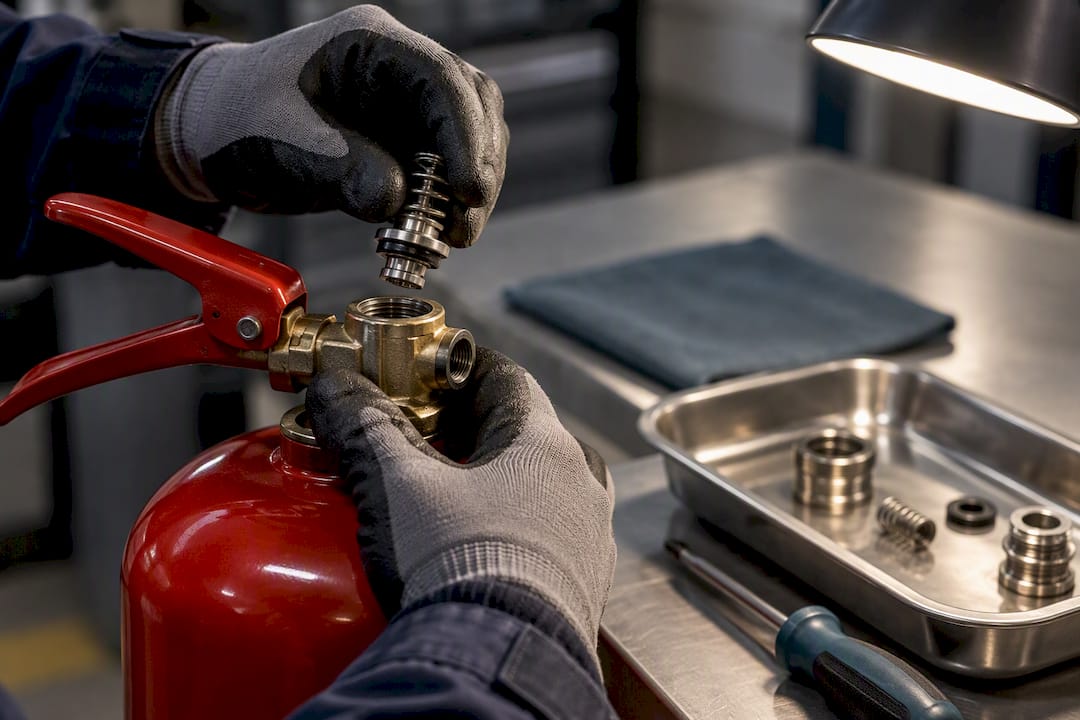
Paperwork should follow within a day or two of the visit: a completed service record for each extinguisher, an updated logbook entry, and an invoice itemising what was done. If any parts were ordered specially, a second short visit may be needed to fit them, which is worth factoring into your schedule if you are working towards a compliance deadline or an insurance renewal date.
Why the real cost conversation is about routine, not price per unit
The most useful thing a small business can do is stop treating fire extinguisher servicing as a single annual expense to minimise and start treating it as one line in a wider compliance routine. The per-unit price differences between suppliers are usually small once you account for VAT and attendance fees, so chasing the cheapest quote rarely saves much and sometimes costs more when it leads to a supplier that skips proper record-keeping.
Conventional budgeting advice focuses heavily on comparing per-extinguisher prices, but the bigger lever is combining visits. A business paying separate attendance fees for extinguishers, PAT testing and fire alarm checks across three different suppliers is very likely spending more overall than one paying a single provider to coordinate all three on one visit.
If you take one thing from this, prioritise the logbook over the price tag. A complete, signed service record protects you far more than a slightly cheaper quote does, and it is the first thing an insurer or fire authority will ask to see.
— Gemma
Get a fire safety quote that covers more than extinguishers
CityPat services fire extinguishers alongside PAT testing, EICR and fixed wire testing, fire alarm testing, emergency lighting testing and fire risk assessments, so you can put several compliance deadlines through one visit instead of several separate call-outs.
Before you request a quote, have the number and type of extinguishers on site, the date of your last service, and any access notes (locked rooms, multi-floor layout) ready. It makes for a faster, more accurate quote and a smoother visit. Read more about the fire extinguisher servicing CityPat offers, or see the full range of compliance services available for bundling.
Sources
- MGN 276 (M+F) amendment 1: Fire protection – maintenance of portable fire extinguishers
- Fire risk assessment: 5-step checklist (GOV.UK)
FAQ
How much does fire extinguisher maintenance cost?
A basic annual service typically costs a visit charge of around £20 to £40 plus VAT plus £5 to £25 per extinguisher, depending on type. A site with several extinguishers of mixed type will usually see a total quote combining these two elements plus any parts needed.
How often do fire extinguishers need to be serviced in the UK?
Under BS 5306-3, referenced in MGN 276, extinguishers need a basic service annually, with extended servicing typically required around every 5 years for many water, foam and powder types and a full overhaul or hydrostatic test at around the 10-year mark. Monthly visual checks by the Responsible Person are also expected between professional services.
What is the price range for fire extinguisher servicing?
Per-extinguisher basic service prices commonly range from around £5 for simpler water or powder units up to £25 for CO2 or clean agent types, with an attendance fee of roughly £20 to £40 plus VAT added on top. The final price depends on the number of extinguishers, their type, and whether any parts or refills are needed.
How much does it cost to have a fire extinguisher checked?
A single extinguisher check, including the attendance fee and basic service, typically costs somewhere between £25 and £65 plus VAT for a one-off visit. Combining the check with servicing for other extinguishers or other compliance tasks on the same visit usually brings the effective cost per unit down.