
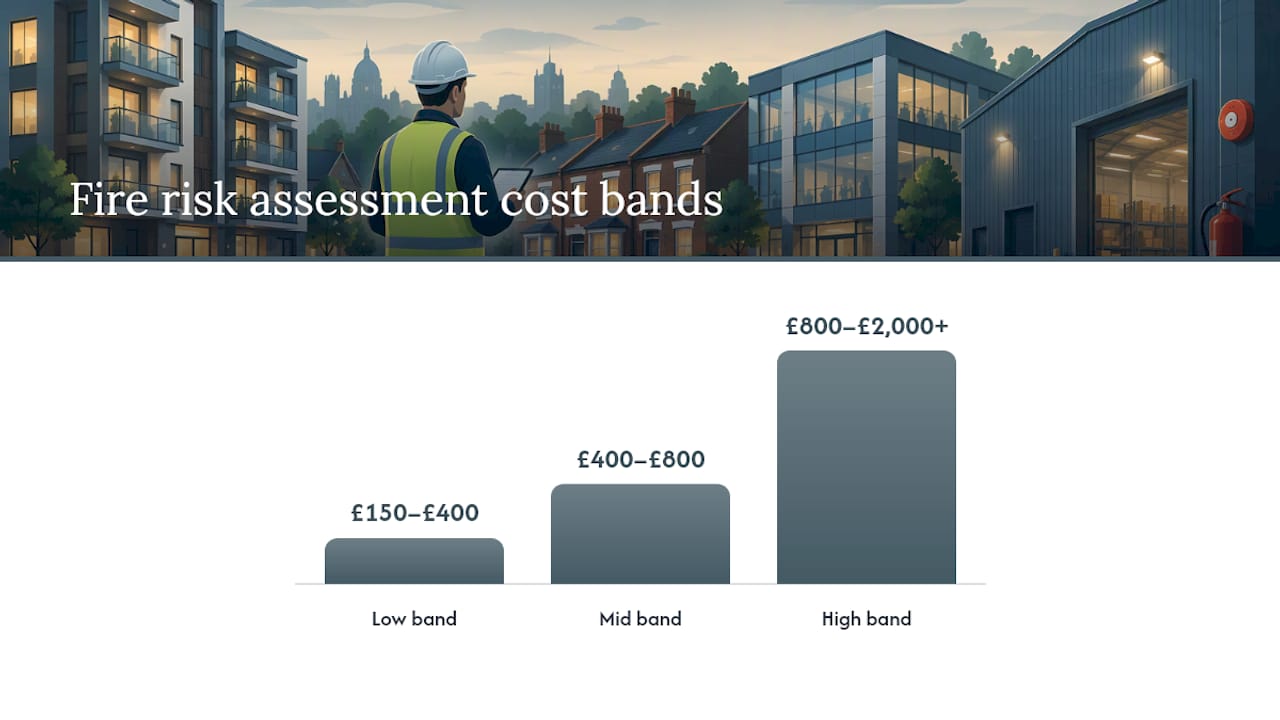
Most fire risk assessments in England have a wide cost range, with price influenced more by risk complexity than floor space. Small offices and shops typically pay £150 to £400; medium commercial premises sit around £400 to £800; large, multi-building or high-risk sites (HMOs, care homes, warehouses) run from £800 up to £2,000 or more. The main reason quotes vary so much is competence and sleeping-risk considerations, not square footage. Read on before you accept the cheapest quote.
TL;DR:
- Cost varies primarily based on site complexity and sleeping risk, with high-risk premises like care homes exceeding £800, while small shops cost around £150 to £400.
- Prices increase in London and the South East by 20-30%, and urgent requests or out-of-hours assessments can add 25-50% to the quotes.
- Larger or more complex buildings with hidden structures, multiple exits, or existing fire systems tend to be much more expensive to assess than simple layouts.
- Choosing a certificated, competent assessor and obtaining a clear scope is more important than the lowest quote, as professional evaluations provide better legal protection.
- Follow-up costs, including re-inspections and remedial work, can range from £100 to several thousand pounds, so budgeting for ongoing compliance is essential.
Table of Contents
- Typical UK cost ranges and what each band covers
- What actually drives the price up or down?
- How much should different property types expect to pay?
- How do you choose a competent assessor and compare quotes properly?
- What follow-up costs should you budget for?
- Why competence matters more than the lowest quote
- How long does a fire risk assessment take from booking to report?
- What extra costs might appear on your final invoice?
- A short note on balancing cost, competence and compliance
- Get a scoped, transparent quote for your fire risk assessment
- Where to check the rules for yourself
- Sources
- FAQ
Typical UK cost ranges and what each band covers
Prices cluster into three broad bands, and each one buys a genuinely different level of survey work. Industry pricing guides put the national range at roughly £200 for the simplest premises up to £1,500 or more for larger, complex sites, with most small and medium premises landing between £300 and £800.
- Low band (£150–£400): A single small shop, café or office unit. Expect a half-day site survey and a concise written report covering the obvious hazards, escape routes and basic fire precautions.
- Mid band (£400–£800): Medium-sized commercial premises, perhaps a multi-floor office or a small hospitality venue. This buys a full-day survey, a more detailed report, and specific, prioritised recommendations rather than generic checklist items.
- High band (£800–£2,000+): Large, multi-building, or high-risk sites such as HMOs, care settings or industrial units. These need multi-day surveys, specialist input on evacuation strategy, and a much more detailed written assessment.
Pro Tip: If a quote sits well below £200 for anything beyond a single small unit, ask exactly what’s excluded. Templated reports that skip sleeping risk or fire strategy checks are common at the bottom of the market.
Location and urgency push prices further. Assessors in London and the South East typically charge 20 to 30% more than the national average, and same-day or out-of-hours requests can add a further 25 to 50% on top. If your premises fall outside these hotspots and you can book a few weeks ahead, you should land comfortably within the mid band for most standard commercial buildings.
What actually drives the price up or down?
Floor area matters less than most people assume. A 200 square metre warehouse with a simple, open layout can cost less to assess than a 100 square metre building riddled with ductwork risers, hidden voids and multiple tenancies. Complexity, not size, is what pushes assessor time up.
The factors that genuinely move the price include:
- Compartmentation and hidden complexity — ductwork, service risers, façade cladding and concealed spaces all take longer to survey properly.
- Sleeping risk and vulnerable occupants — HMOs and care homes require a different type of evacuation analysis, often with reference to additional technical guidance, which adds both time and the need for specialist competence.
- Number of exits, shared stairwells and multiple tenancies — buildings with several occupiers or complicated vertical escape routes need more thorough analysis.
- Existing records and fire safety systems — good historical records shorten the site visit; missing or chaotic paperwork lengthens it.
- Assessor competence and report depth — a fully certificated assessor charging a fixed fee for a detailed report will cost more than an informal hourly-rate visit, but the report will hold up under scrutiny.
Pro Tip: Ask any assessor how they price sleeping-risk premises differently from standard commercial units. A vague answer is often a sign they haven’t done many HMO or care home assessments.
How much should different property types expect to pay?
Matching your own premises to a realistic example makes it far easier to spot an outlier quote, whether that’s suspiciously cheap or unexplainably expensive.
- Small office, café or shop. A single-storey unit with straightforward escape routes typically falls into the low band, around £150 to £400, for a half-day visit and a short report.
- HMO or multi-let residential building. Sleeping risk pushes these premises up, often into the mid to high band, because the assessor has to analyse evacuation timing for sleeping occupants rather than just daytime staff movement.
- Care homes and healthcare settings. These sit firmly in the high band, frequently £800 and above, given the combination of vulnerable, non-ambulant occupants and the need for a detailed evacuation strategy.
- Warehouse or industrial unit. Specialist hazards, racking layouts, and hot works or flammable storage often mean pricing sits at the upper end of mid band or into high band, even where floor plans look simple on paper.
- Multi-building portfolios. Landlords and facilities managers with several sites can often negotiate a day-rate or multi-site discount, but it’s worth confirming exactly what’s covered per site to avoid scope creep once the assessor is on-site.
How do you choose a competent assessor and compare quotes properly?
Price alone tells you almost nothing about whether an assessment will actually protect your building or your occupants. The Home Office’s own guidance for Responsible Persons is explicit: prefer certificated assessors, check competence for your specific premises type, and record who carried out the work.
Before accepting any quote, ask for:
- Evidence of certification or membership of a recognised competence scheme, plus a sample page or two from a previous report.
- A written scope covering site access requirements, whether sleeping risk is included, review of existing records, final deliverables and turnaround time.
- Confirmation of professional indemnity and public liability insurance, and, where possible, a reference from a similar type of premises.
- A clear breakdown of fees: fixed price versus hourly or day rate, travel charges, VAT, and the cost of any follow-up visit.
Pro Tip: Get the assessor’s full name and organisation in writing before the visit. Under Section 156 of the Building Safety Act, you’re required to record the identity of anyone you appoint to carry out or review the assessment, so it saves an awkward follow-up email later.
What follow-up costs should you budget for?
The initial assessment fee is rarely the last cost you’ll see. Follow-up visits, typically to check that remedial actions have been completed, commonly cost £100 to £300 depending on how much re-inspection is needed.
Remedial work itself varies enormously by item. Replacing or upgrading a fire door, adding emergency signage, or servicing emergency lighting can range from modest sums for a handful of doors to a much larger bill across a whole building. Budget a contingency alongside the assessment fee rather than treating remedial costs as a surprise.
- Formal reviews are generally expected annually, or sooner if there’s a material change to the building, a fire safety incident, or a change of occupancy type.
- Insurers increasingly ask to see a current, in-date assessment before renewing cover, so aligning your review cycle with your policy renewal date avoids gaps.
- A rolling annual budget line for both the review and likely minor remedial work is far easier to manage than an unplanned one-off spend.
Why competence matters more than the lowest quote
Very low prices usually mean a templated report rather than genuine professional judgement, and practitioners routinely warn that these reports don’t stand up under enforcement scrutiny. Some providers avoid that trap by stating scope clearly before work begins, so you know exactly what you’re paying for.
Coordinating several compliance visits with one provider can cut down on repeated site visits and hidden costs. Some UK-wide electrical and fire safety compliance companies give Responsible Persons one point of contact rather than several separate suppliers.
How long does a fire risk assessment take from booking to report?
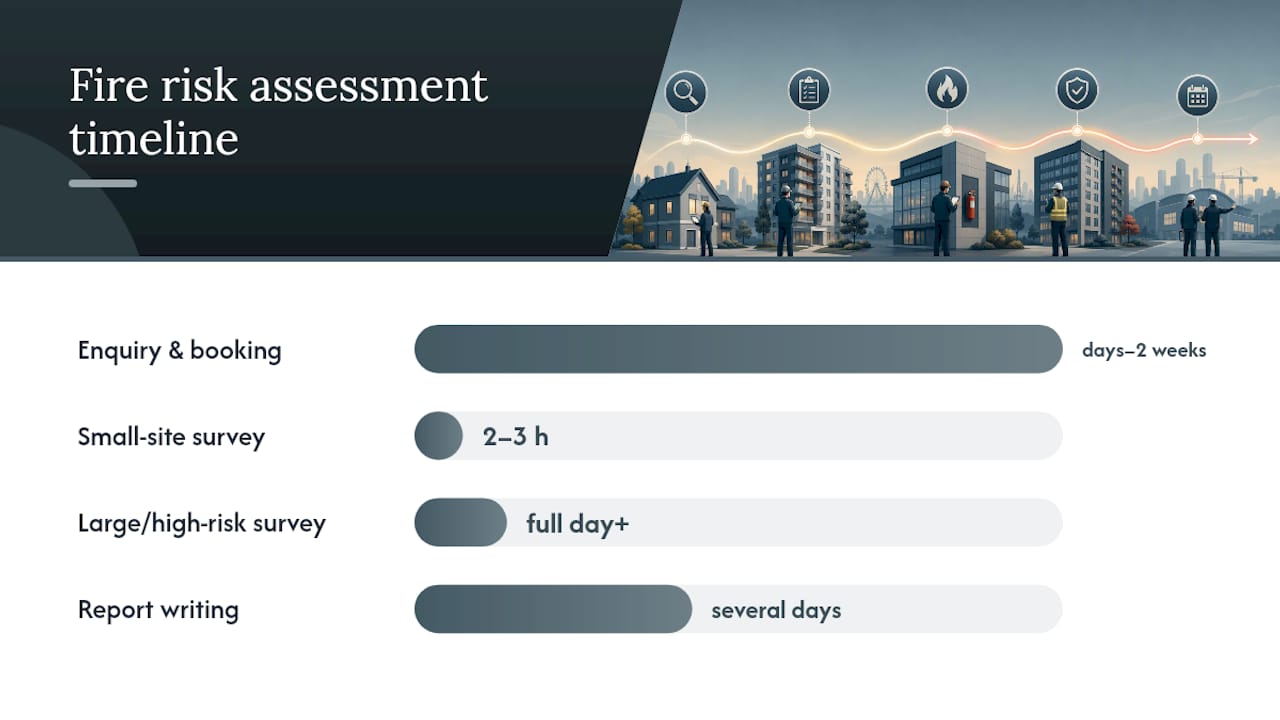
Most straightforward commercial premises can expect the whole process, from first enquiry to final report, to take between one and three weeks. Booking the initial site visit is usually the fastest part; reputable assessors can often visit within a few days to a couple of weeks, depending on demand in your area.
The site survey itself is quick relative to everything else. A small office or shop visit might take two to three hours, while a large or high-risk site with sleeping risk could need a full day or longer on-site. The bulk of the timeline sits in report writing, not the visit itself: a detailed, prioritised report for a complex building can take several days to compile properly, especially where the assessor needs to cross-reference existing records or consult additional technical guidance for sleeping-risk premises.
Urgency changes this considerably. If you need an assessment quickly, for example ahead of an insurance renewal or a licensing deadline, expect to pay a premium for a same-day or next-day visit, and be upfront about your deadline when requesting quotes. Assessors juggling multiple bookings will often prioritise clients who commit early, so a rushed request close to a deadline is where you’re most likely to face both a higher price and a compressed report turnaround.
What extra costs might appear on your final invoice?
The headline assessment fee rarely covers everything, and it’s worth asking about these before you sign off a quote rather than after the invoice arrives.
Travel is the most common add-on. Assessors based well outside your area may add mileage or a flat travel charge, particularly for rural or less accessible sites. This is one reason a locally available, UK-wide provider can work out cheaper in practice than a specialist flown in from another region.
Out-of-hours work carries its own premium. If your premises only allow access evenings, weekends, or overnight (common for retail units, schools or venues with daytime occupancy), expect a surcharge on top of the standard day rate, often in the same range as the urgency premiums discussed earlier.
Specialist consultancy is the other significant variable. Premises with unusual hazards, such as complex plant rooms, flammable storage, or heritage buildings with historic fabric, sometimes need input from a fire engineer or specialist consultant beyond the standard assessor visit. This isn’t included in a typical fixed-price quote and should be scoped separately.
Finally, watch for administrative extras: printed or bound copies of the report, additional site visits to brief staff, or VAT not being clearly stated in the initial figure. None of these are unreasonable charges, but they should appear in writing before you commit, not as a surprise on the final bill.
A short note on balancing cost, competence and compliance
Having worked through how these prices break down, my honest advice is simple: budget for competence, not just the lowest number on a quote. A properly recorded, detailed assessment costs more upfront but protects you far better if anything ever goes wrong, and it satisfies the recording duties that now sit alongside the core legal requirement. Keep a written record of who carried out your assessment and when your next review is due. That habit alone will save you time and stress at renewal.
— Gemma
Get a scoped, transparent quote for your fire risk assessment
Citypat is the alternative to a patchwork of separate contractors for fire and electrical compliance across England: one provider coordinating your fire risk assessment, PAT testing, EICR inspections and fire alarm testing, so you’re not paying for repeated site visits and duplicated admin.
When you request a quote, Citypat scopes the job properly first, covering premises type, sleeping risk where relevant, and existing records, so the price you’re given actually matches the work involved. You’ll also get the assessor’s name and organisation confirmed in writing for your compliance records, satisfying the recording duty that now applies under English fire safety regulations. If you manage several properties, ask about coordinating fire alarm testing and emergency lighting checks alongside your assessment to reduce total site visits across your portfolio. Get a free, no-obligation quote through Citypat’s quote request page and find out where your premises actually sit on the pricing scale.
Where to check the rules for yourself
Rather than take any single guide’s word for it, it’s worth reading the primary guidance directly, especially the recording requirements that now apply.
- The Home Office how-to guide sets out competence expectations and recording duties for anyone appointing an assessor.
- Gov explain the duty to carry out a suitable and sufficient assessment and keep it on record.
- The Section 156 Building Safety Act guidance confirms the requirement to record the completed assessment in full, along with the identity of whoever carried it out.
Sources
- 14.310 – HO – A guide for persons with duties under the Regulatory Reform (Fire Safety) Order 2005 (as amended) and the Fire Safety (England) Regulations 2022
- Gov
- Fire Risk Assessment Cost: Complete UK Pricing Guide & Calculator – Fire Risk Assessment Experts
FAQ
What is the average cost of a fire risk assessment in the UK?
Most premises pay somewhere between £200 and £1,500 or more, with many small and medium sites landing in the £300 to £800 range. The exact figure depends far more on complexity and sleeping risk than on floor area alone.
Can I complete my own fire risk assessment?
Yes, if your premises are small, low-risk and you’re genuinely competent to judge the hazards. Home Office guidance notes that premises up to three storeys and under 280 square metres can reasonably be self-assessed by a competent owner or occupier, though professional help is strongly recommended once complexity or sleeping risk enters the picture.
How can I get a cheap fire risk assessment for my building?
The safest route to a lower price is booking ahead rather than requesting an urgent visit, avoiding regional premiums where possible, and asking a provider who already visits your area for other compliance work. Coordinating your fire risk assessment alongside services like PAT testing or EICR inspections with one provider can reduce total site visit costs across the year.
Is it a legal requirement to do a fire risk assessment?
Yes. Under English fire safety regulations, the Responsible Person must carry out a suitable and sufficient fire risk assessment and keep a record of it. Failing to do so, or relying on an outdated or superficial assessment, is a compliance failure that can carry serious legal and insurance consequences.