
A fire risk assessment is a legal requirement for almost every non-domestic and multi-occupied residential building in England, and since the Building Safety Act 2022, it must be recorded in full. If you employ staff, let property, or manage a building with shared parts, you are likely the Responsible Person under the Fire Safety Order and the duty sits with you. Check your status below, then follow the five-step process to get compliant.
TL;DR:
- Fire risk assessments must now be fully documented, including all findings, responsible assessor’s identity, and fire safety arrangements, especially for high-risk premises.
- The five-step process involves hazard identification, risk assessment of all people, implementing controls, recording results with emergency plans, and regular reviews.
- Reviews are required after any significant building change, incident, or new occupancy, with most premises doing an annual check as a best practice.
- Competent in-house or external assessors can perform the assessment, but responsibility and liability always remain with the Responsible Person.
- Proper record-sharing in multi-occupancy buildings and comprehensive documentation prevent legal violations and help secure insurance and property transactions.
Table of Contents
- What is a fire risk assessment and who must arrange one?
- What the law actually requires you to record
- The five-step process you’re legally expected to follow
- How often should a fire risk assessment be reviewed?
- Who can carry out your fire risk assessment?
- Record-keeping and sharing duties in shared buildings
- What happens if you don’t comply
- The gaps I keep seeing in fire risk assessments
- Get your fire risk assessment sorted properly
- Sources
- FAQ
What is a fire risk assessment and who must arrange one?
The Responsible Person is whoever has control of the premises: an employer, the building’s owner, a landlord, or a managing agent. In blocks of flats or mixed-use buildings, several parties often hold overlapping duties for different parts of the same structure, and each must cover their own areas while cooperating on shared spaces like stairwells and corridors.
The duty under Article 9 of the Fire Safety Order 2005 applies to virtually all commercial, public, and multi-occupancy residential premises. The one significant exclusion is a single private dwelling occupied by one household. That means:
- Offices, shops, warehouses, and factories
- Hotels, hospitals, schools, and care homes
- The communal parts of blocks of flats and houses in multiple occupation
- Any workplace, regardless of size, where people other than the owner are present
If you are unsure whether the duty applies to you, the simplest test is this: does anyone other than you and your immediate family use or pass through the building? If yes, you almost certainly have a duty.
What the law actually requires you to record
The statutory standard is that your assessment must be “suitable and sufficient,” a phrase lifted directly from Article 9 of the Fire Safety Order. In practice, that means the assessment has to reflect the real hazards and people in your specific building, not a generic template copied from somewhere else.
Section 156 of the Building Safety Act 2022 changed the recording rules significantly. Where older guidance allowed some low-risk premises to keep only minimal notes, the Section 156 recording requirements now demand a fuller written record for most premises, covering:
- The complete findings of the assessment, not a summary
- The identity of whoever carried it out, whether that is you or a third party
- Your fire safety arrangements and who is responsible for them
- Contact details, shared where relevant with residents and other duty holders in multi-occupancy buildings
This closes a gap that used to let some Responsible Persons keep patchy or entirely undocumented assessments. If a fire investigator or inspecting officer asks to see your assessment and you cannot produce a full written record with an identified assessor, you are already in breach.
The five-step process you’re legally expected to follow
GOV.UK’s five-step checklist is the practical method behind the “suitable and sufficient” test, and it’s the framework most fire and rescue services expect to see reflected in your paperwork.
- Identify the hazards. Look at ignition sources (electrical faults, cooking equipment, smoking materials), fuel sources (storage, furniture, dangerous substances), and anything that could accelerate a fire’s spread.
- Identify who is at risk. This includes staff, visitors, contractors, anyone with a disability or mobility issue, and sometimes people in adjacent premises who could be affected by fire spreading.
- Evaluate, remove, or reduce the risk. Prioritise removing hazards outright where you can, then work through physical controls (fire doors, extinguishers, alarms) and procedural ones (permits to work, no-smoking policies).
- Record your findings and prepare an emergency plan. This includes evacuation procedures, staff training records, and Personal Emergency Evacuation Plans (PEEPs) for anyone who needs assistance leaving the building.
- Review and revise. Set a review date, and record the evidence that the review took place, not just the date it happened.
Pro Tip: Don’t treat step four as an afterthought. A fire and rescue officer will judge your entire assessment on the quality of your written record, even if the physical measures in your building are excellent.
How often should a fire risk assessment be reviewed?
Most premises are reviewed regularly, often about once a year, though this is common practice rather than a fixed statutory interval. What the law does require is a review whenever something material changes.
Triggers that should prompt an immediate reassessment include:
- Structural alterations or renovation work
- A change of use for the building or part of it
- New work processes, equipment, or storage arrangements
- Any fire, near miss, or enforcement visit
- A change in the number or type of occupants, particularly where vulnerable people are now present
Record the review date and keep the evidence, such as inspection notes or updated risk registers, alongside the original assessment.
Who can carry out your fire risk assessment?
The Home Office how-to guide is clear that you can do your own assessment if you are competent to do so, but the legal responsibility never transfers away from you, even if you commission someone else to write the report.
Competence means training, relevant experience, and knowledge specific to your type of premises. Before appointing a third-party assessor, ask for:
- Membership of a recognised certification scheme
- Evidence of experience with premises similar to yours (a care home assessor and a warehouse assessor need different expertise)
- Case studies or references from comparable clients
- A UK-based contact and address you can reach if questions arise later
For small, low-risk premises, a competent in-house manager working through GOV.UK’s own templates is often perfectly adequate. For high-rise residential buildings, heritage sites, care homes, or anywhere with complex evacuation needs, bring in a specialist. Guidance strongly recommends certificated assessors for higher-risk premises, and this may become a firmer expectation for high-risk buildings over time.
Pro Tip: Even a highly qualified third-party assessor doesn’t remove your liability. Keep a paper trail showing you checked their credentials before appointing them, since that due diligence is itself part of demonstrating a suitable and sufficient process.
Record-keeping and sharing duties in shared buildings
Under Section 156, your written record needs to include the full findings, your fire safety arrangements, the identity of the assessor, and contact details for whoever is responsible for fire safety day to day. In multi-occupancy residential buildings, guidance on Section 156 goes further and expects this information to reach residents, not just sit in a filing cabinet.
Practical ways to meet this include:
- Notices on communal noticeboards summarising fire safety arrangements
- A digital portal or shared folder residents and staff can access
- A handover pack for an incoming Responsible Person, so nothing gets lost when management changes
Where several duty holders manage different parts of one building, agree who holds the master record and how updates get communicated across the whole site.
What happens if you don’t comply
Local fire and rescue authorities enforce the Fire Safety Order, and London Fire Brigade’s own guidance sets out what that can look like in practice: improvement notices, prohibition notices that close part or all of a building, unlimited fines, and criminal prosecution for serious breaches. Beyond the legal exposure, insurers can decline claims where a valid assessment wasn’t in place, and lenders or buyers can walk away from a deal once due diligence turns up a compliance gap.
The gaps I keep seeing in fire risk assessments
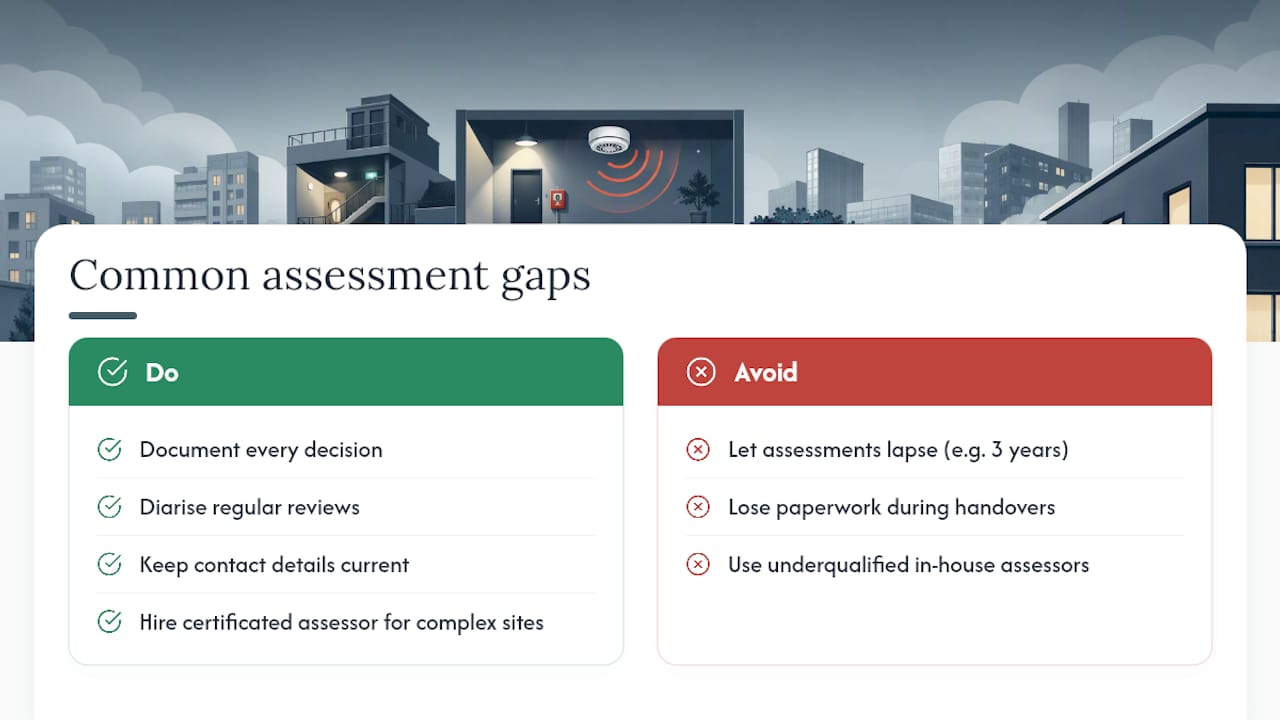
The failures that cause the most trouble aren’t dramatic. They’re mundane: an assessment that’s three years out of date because nobody diarised a review, a handover between managing agents where the paperwork simply vanished, or an in-house assessor who was competent for a shop but got handed a care home.
Document every decision, not just the outcome. Keep contact details current, especially in buildings where the Responsible Person changes hands. And where a building’s risk profile gets complicated, hire a certificated assessor rather than stretching in-house competence past its limits. A well-documented process from a genuinely qualified assessor is what protects you when someone comes asking questions.
— Gemma
Get your fire risk assessment sorted properly
Citypat is the practical alternative to juggling multiple contractors for your compliance paperwork. Alongside fire risk assessments, Citypat carries out PAT testing, EICR and fixed wire inspections, fire alarm testing, and emergency lighting checks, so your electrical hazards and your fire safety records come from one joined-up source instead of three separate reports that don’t quite match.
That matters when an inspector asks to see everything together: one supplier, one set of dates, one trail of evidence showing you took the duty seriously. If your last assessment is overdue for review or you’ve never had one done properly, get a free quote from Citypat and book an assessment before it becomes a problem rather than after.
This article is general information, not a substitute for advice from a qualified lawyer. Consult a qualified legal professional about your own circumstances before acting on anything here.
Sources
- The Regulatory Reform (Fire Safety) Order 2005 — Article 9
- Building Safety Act 2022 — Section 156 recording requirements (guidance)
- Gov
- Home Office: A guide for persons with duties under the Regulatory Reform (Fire Safety) Order 2005
FAQ
What are the legal requirements for fire risk assessments in the UK?
In England, the Fire Safety Order 2005 requires a Responsible Person to carry out a suitable and sufficient fire risk assessment for any premises that isn’t a single private dwelling, and Section 156 of the Building Safety Act 2022 requires that assessment to be recorded in full of the assessor’s identity noted.
What is the British Standard for fire risk assessments?
There isn’t a single mandatory British Standard governing the assessment process itself. The statutory framework is the Fire Safety Order and its “suitable and sufficient” test, supported by GOV.UK’s five-step checklist as the recognised practical method.
How often is a fire risk assessment required to be conducted in the UK?
There’s no fixed statutory interval, but annual review is common practice for most premises. You must also review immediately after building alterations, a change of use, new work processes, an incident or near miss, or a change in who occupies the building.
What are the legal requirements for risk assessment in the UK?
For fire specifically, the duty sits with the Responsible Person under the Fire Safety Order, who must identify hazards, identify people at risk, remove or reduce that risk, record the findings and emergency plan in full, and review regularly. Liability for getting this right stays with the Responsible Person even when a third-party assessor does the work.
Can I carry out my own fire risk assessment?
Yes, if you are genuinely competent for your premises type, using GOV.UK templates for straightforward buildings. For complex or high-risk premises, such as high-rises or care homes, appoint a certificated assessor instead, since the legal burden for suitability remains yours regardless of who writes the report.