
Before you appoint anyone, ask for five things: proof of independent registration or certification, the certificate’s scope and expiry date, a CV with relevant case examples, professional indemnity and public liability insurance evidence, and a written scope of works with a fixed fee. There is no single statutory qualification for fire risk assessors, so competence has to be demonstrated through this evidence rather than assumed from a title.
TL;DR:
- Verify that the fire risk assessor holds proper registration or certification from a recognized scheme such as UKAS, BS 8674:2025, FRACC, or IFE, specifically for your building type.
- Require detailed proof of the assessor’s experience, including case examples similar to your premises, and ensure their insurance coverage meets industry standards.
- Match the assessor’s competence level to your building’s complexity, with foundation for low-risk, intermediate for multi-story or care facilities, and advanced for high-rise or large infrastructure.
- Avoid appointing assessors whose scope or certification does not clearly mention your building type or lacks detailed examples demonstrating relevant expertise.
- When comparing quotes, ensure each covers the same scope, and ask for the precise certificate wording to verify scope before making a hiring decision.
Table of Contents
- What the law and official guidance actually require
- The evidence checklist to request before you appoint anyone
- Matching competence to your building and spotting red flags
- Building a procurement file that stands up to scrutiny
- Common hiring mistakes and one shortcut worth using
- How CityPat supports a defensible fire risk assessment
- Where to check the claims yourself
- Sources
- FAQ
What the law and official guidance actually require
The Regulatory Reform (Fire Safety) Order 2005 puts the duty squarely on you. As the responsible person, you must carry out a suitable and sufficient fire risk assessment and keep it under review, and if you appoint someone else to do it, you remain accountable for the result. The order requires competence to be judged by training, experience, knowledge and other relevant qualities, not by a single qualification, which is exactly why so many landlords and facilities managers struggle to know what “competent” looks like on paper.
Home Office guidance backs this up directly. A 2024 survey of fire risk assessors in England, which drew 1,272 responses, found there is no single professional body or universally agreed qualification route across the sector. For anything beyond the simplest premises, the guidance says you should appoint a professional and check their competence against the specific building type you need assessed, not against a generic certificate.
That leaves a verification gap, which is where a handful of bodies matter:
- UKAS accredits the certification bodies that check individual assessors or companies against a recognised scheme.
- BS 8674:2025 sets out a three-level competence framework (Foundation, Intermediate, Advanced) that gives you a structured way to judge fit.
- FRACC (the Fire Risk Assessment Competency Council) defines the competency criteria that registers and certification schemes are built on.
- IFE (the Institution of Fire Engineers) runs a public register of assessors who have been through peer assessment.
A significant share of the assessor market has no formal quality assurance route at all, according to Home Office research, which is exactly why the documents you request matter more than the job title on an invoice.
The evidence checklist to request before you appoint anyone
Put this in writing when you ask for quotes, and treat a vague or partial answer as a red flag in itself.
- Named assessor CV, including qualifications, years practising and two or three case examples from buildings similar to yours.
- Certificate or register entry, with the scheme name, registration number, scope of work covered and expiry date.
- Professional indemnity insurance evidence, either a certificate or an insurer’s letter stating the monetary limit.
- Public liability insurance evidence covering site visits and physical inspection work.
- References from at least two previous clients, ideally with similar premises.
- Complaints and impartiality procedure, showing how disputes or conflicts of interest are handled.
- Written scope of works and fee, specifying exactly what will and will not be inspected.
Company certification and individual registration answer different questions. Company certification, checked against a UKAS-accredited scheme, tells you about the firm’s management systems and quality control. Individual registration tells you whether the named person standing in your building has been independently assessed as competent. Ask for both where you can, and if a register entry is ambiguous about scope, contact the scheme operator directly rather than taking the assessor’s word for it.
Once you have this evidence from two or more providers, insist that every quotation covers an identical written scope before you compare prices. A cheaper quote that excludes intrusive inspection or specific fire safety systems is not actually cheaper.
Pro Tip: Ask each candidate for the exact wording of their certificate’s “scope” line. If it does not mention your building type or a comparable one, it is not the evidence you need.
Matching competence to your building and spotting red flags
Not every premises needs the same level of scrutiny, and BS 8674:2025 gives you the vocabulary to ask for the right one. Its three-level framework is a useful shorthand when briefing candidates:
- Foundation level typically suits simple, low-risk premises such as small offices or single-storey retail units.
- Intermediate level fits more complex buildings, including multi-storey offices, HMOs and small care settings.
- Advanced level is appropriate for high-rise residential blocks, large care homes, hospitals and entertainment venues, particularly where external wall assessments under PAS 9980:2022 are relevant.
Ask directly for examples of similar buildings the assessor has worked on, including the hazards encountered and their specific role on the project. A generic client list with no detail is weak evidence, whereas a named building type, a brief description of what was found and a redacted extract of the report tells you far more.
Several warning signs should make you pause before signing anything:
- A certificate whose scope is vague or does not mention your building type.
- No case examples, or examples that cannot be described in any detail.
- Insurance cover that falls well below what similar assessors in the market typically hold, or that the provider is reluctant to confirm in writing.
- Evasive answers when you ask how they would approach intrusive inspection or external wall review.
- No complaints procedure, or an unwillingness to explain how conflicts of interest are managed.
Pro Tip: If an assessor cannot name the specific standard or guidance they are working to, such as BS 8674:2025 or PAS 9980, treat that as a gap in their process, not just their paperwork.
Building a procurement file that stands up to scrutiny
A defensible procurement file should contain the named assessor’s CV and case history, copies or links to their certification or register entry, evidence of professional indemnity and public liability insurance, the written scope and fee, at least one reference, and the provider’s complaints procedure. Keep all of it together, whether the appointment goes ahead or not, because you may need to show due diligence later.
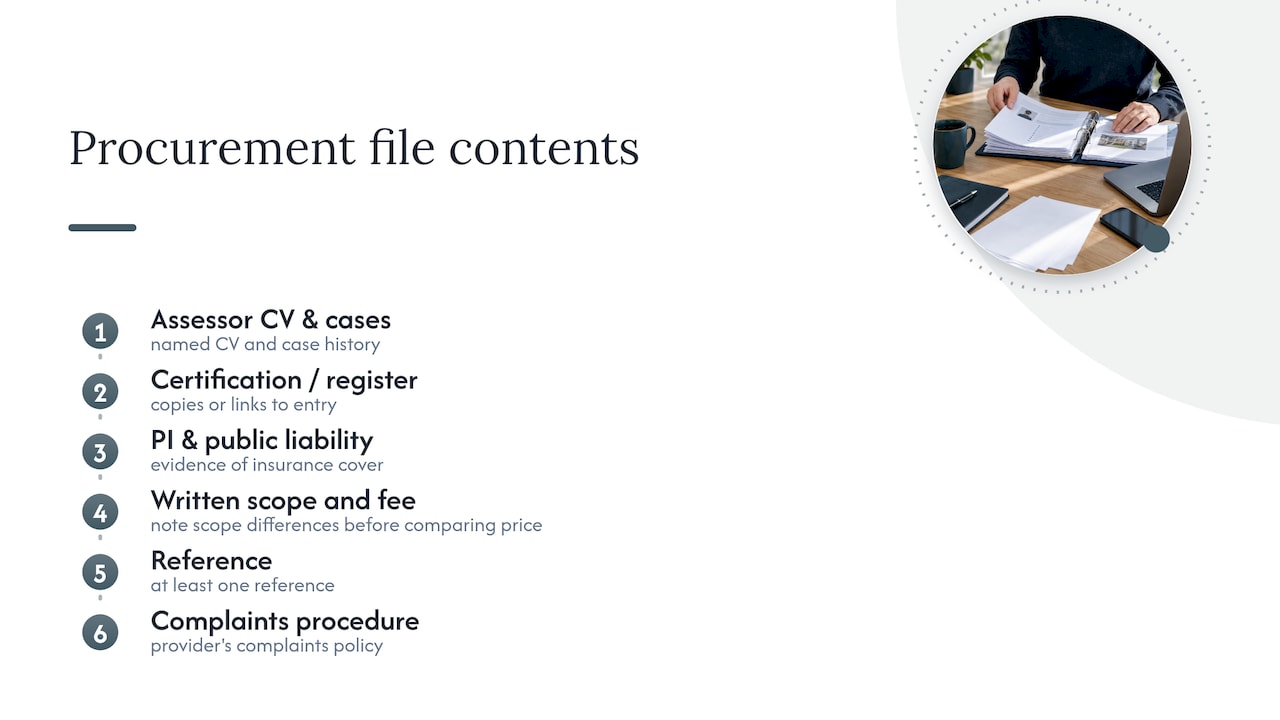
Where quotations differ in scope, document the differences in writing before comparing price. A quote that omits loft spaces, plant rooms or external cladding review is not comparable to one that includes them, and treating them as equivalent undermines the whole exercise.
These records matter beyond the immediate hire. Under the Building Safety Act and wider fire safety enforcement, you may be asked to demonstrate how you selected a competent assessor, and insurers increasingly expect to see this evidence before settling a claim linked to fire safety failings.
Common hiring mistakes and one shortcut worth using
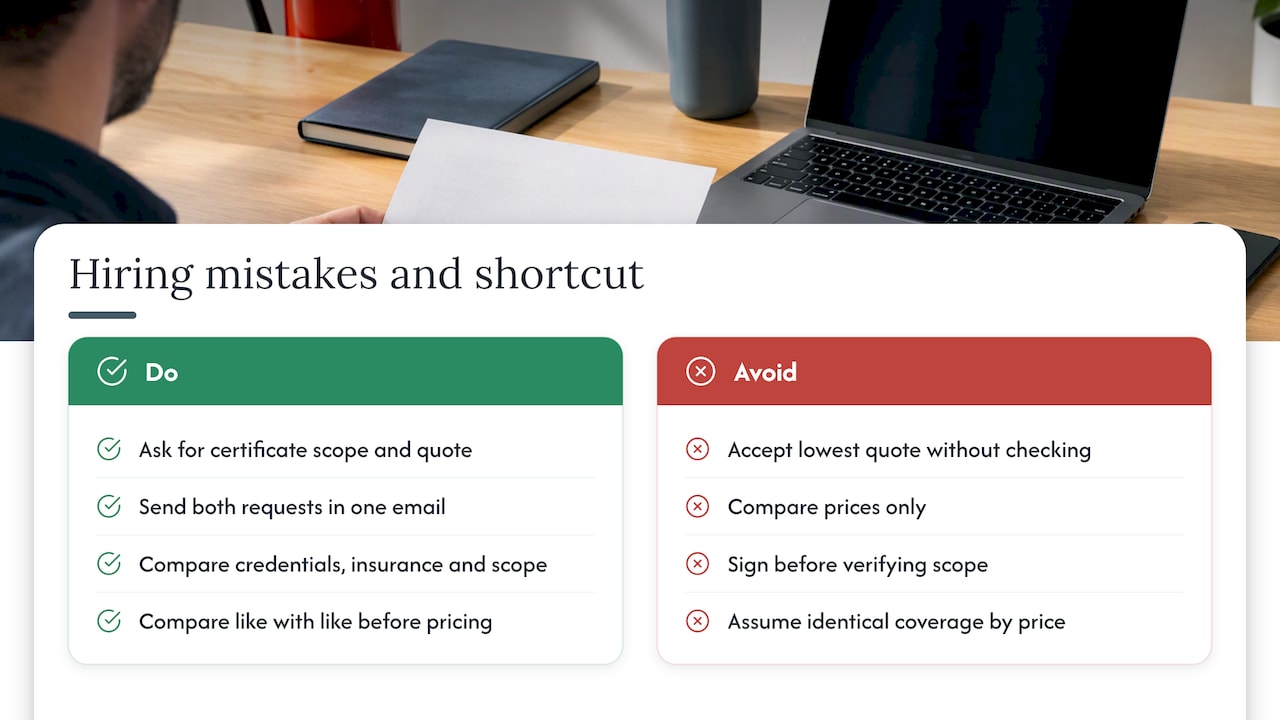
The mistake I see most often is accepting the lowest quote without checking what it actually covers. A landlord once compared three quotes that looked identical on price but turned out to exclude intrusive inspection on two of them, the exact work that mattered most for that building.
The shortcut that avoids this: ask every candidate for their certificate scope and written quote scope in the same email, before discussing price at all. Some providers structure their fire risk assessment work by documenting the assessor’s credentials, insurance position and exact scope alongside the fee, so clients can compare like with like from the outset rather than discovering gaps after signing.
— Gemma
How CityPat supports a defensible fire risk assessment
CityPat carries out fire risk assessments alongside fire alarm testing, emergency lighting checks and fire extinguisher servicing, which means the same provider can document your fire safety compliance across several systems rather than leaving you to reconcile separate paperwork from different contractors.
Every assessment comes with a documented scope, the named assessor’s relevant background, and evidence you can file alongside insurance records, so you are not relying on a single certificate to prove competence. CityPat also provides fire alarm testing and works across single and multi-site locations, which helps landlords and facilities managers with several properties keep inspection dates aligned instead of managing them one building at a time. If you want a fixed scope and fee before you commit, get a free quote and compare it directly against what other providers have offered.
Where to check the claims yourself
A handful of sources are worth bookmarking before you appoint anyone:
- Home Office fire risk assessor survey, for the current picture of competence and capacity in England.
- NFCC guidance on finding an assessor, for FRACC-based verification steps.
- IFE Fire Risk Assessors Register, to check whether a named individual is independently registered.
- BS 8674:2025 on BSI Knowledge, for the formal competence framework referenced throughout this guide.
Sources
FAQ
Is there a legal qualification required to carry out fire risk assessments?
No single statutory qualification exists. The Regulatory Reform (Fire Safety) Order 2005 requires the assessor to be competent through training, experience and knowledge suited to the specific premises, and the responsible person must verify that fit before appointing anyone.
How do I know if a fire risk assessor is properly insured?
Ask for written evidence of professional indemnity and public liability insurance, including the monetary limits, rather than a verbal assurance. For higher-risk work such as external wall assessments, PAS 9980:2022 guidance expects a signed statement of competence alongside proof of professional indemnity cover.
What is the difference between individual registration and company certification?
Individual registration, such as entry on the IFE Fire Risk Assessors Register, confirms that the named person has been independently assessed. Company certification checked against a UKAS-accredited scheme instead verifies the firm’s internal quality systems, so requesting both gives a fuller picture of competence.
Does CityPat carry out fire risk assessments as well as electrical testing?
Yes, CityPat provides fire risk assessments alongside fire alarm testing, emergency lighting checks and PAT testing, allowing landlords and facilities managers to manage several compliance requirements through one provider.
What should I do if a certificate’s scope is unclear?
Contact the scheme operator or certification body directly to confirm what the certificate actually covers rather than relying on the assessor’s description. Fire-service procurement guidance recommends treating an unclear or unverifiable scope as grounds to request clarification before proceeding with the appointment.