
Landlords in England must have a qualified person inspect and test every electrical installation at intervals of no more than five years, then supply tenants with the resulting EICR. Book that inspection now if you have not had one recently, read the report’s codes the day it lands, and act on anything marked C1, C2, or FI within 28 days. Miss any of this and you face council enforcement, not just a paperwork gap.
TL;DR:
- Landlords must have a qualified electrician inspect their electrical system every five years and supply the tenant with an official report within 28 days.
- Any issues marked C1, C2, or FI in the report require remedial action within 28 days, with urgent defects possibly needing immediate temporary measures.
- Unacceptable reports can lead to council enforcement, including fines up to £40,000 and mandatory repairs executed by authorities at the landlord’s expense.
- Proper documentation, including past certificates and remedial work confirmation, must be retained and shared promptly with tenants and authorities upon request.
- Regular visual checks and appliance testing between inspections help prevent common defects like overloaded units and DIY wiring from causing safety breaches.
Table of Contents
- Landlord electrical safety regulations: who they cover and what they demand
- What an EICR checks and how to read its codes
- Timing, remedial work, and what happens if you miss the deadline
- A practical checklist for the inspection itself
- Document supply duties: what tenants and councils are owed
- Going beyond the legal minimum
- Why CityPat treats EICRs as safety tools, not paperwork
- How CityPat helps you meet your electrical safety duties
- Sources
- FAQ
Landlord electrical safety regulations: who they cover and what they demand
The duty comes from Regulation 3 of The Electrical Safety Standards in the Private Rented Sector (England) Regulations 2020, which requires landlords to ensure the electrical installation in their property meets the national safety standard throughout the tenancy. That standard is BS 7671, commonly known as the Wiring Regulations, and it is the benchmark every inspector tests against. The regulations apply to most private rented tenancies in England, including assured tenancies, assured shorthold tenancies, and licences to occupy where rent is paid. Social housing was brought into scope through a later extension of the same regime.
Certain arrangements fall outside it. Lodgers living in a landlord’s own home, long leaseholders who have bought a fixed-term lease of more than seven years, and some student accommodation with its own separate regulatory regime are generally excluded. If you are unsure whether a particular letting counts, the Gov sets out the tenancy types covered in detail.
The person who carries out the inspection matters as much as the inspection itself. The regulations specify a “qualified person”, someone competent to inspect against BS 7671 and to issue a report you can actually rely on. In practice, that means:
- A registered electrician holding a recognised competent-person scheme membership
- Someone qualified to inspect against the current edition of BS 7671
- An inspector willing to put their name and registration number on the EICR itself
Existing tenancies needed their first inspection by a fixed deadline when the rules came in; new tenancies since then need one before occupation begins, then again every five years unless a report specifies sooner.
What an EICR checks and how to read its codes
An Electrical Installation Condition Report examines the property’s fixed wiring and connected infrastructure, not the tenant’s kettle or lamp. A thorough EICR covers:
- The consumer unit (fuse board), including circuit protection and whether it meets modern standards
- Protective bonding and earthing, the safety measures that stop faults turning into shocks
- Fixed wiring circuits throughout the property, checked for damage, overheating, and correct installation
- Lighting circuits and switches
- Fixed appliances wired into the installation, such as extractor fans or storage heaters
- Specialist circuits, including electric showers and, increasingly, solar PV connections
Every observation gets a code. C1 means danger present, a risk of injury right now, and the inspector will usually make it safe on the spot. C2 means potentially dangerous, requiring remedial work urgently but not necessarily an immediate shutdown. FI flags something that needs further investigation before anyone can say whether it is safe. C3 is advisory, an improvement worth making but not a safety failure.
Any report carrying a C1, C2, or FI is officially unsatisfactory, and that single word triggers your legal remedial duty. C3 items alone do not. Use the codes to prioritise: fix C1s immediately, C2s within the statutory window, and treat C3 recommendations as sensible maintenance rather than a legal deadline.
Timing, remedial work, and what happens if you miss the deadline
The 28-day clock for remedial work starts on the date of the inspection or test itself, not the date you happen to open the email containing the report. Where the inspector judges a defect urgent enough, they can specify a shorter window, and for a genuine C1 finding they may apply temporary measures immediately rather than wait for you to arrange anything.
Once remedial work is done, you need written confirmation from the electrician who carried it out, and you must be ready to supply that alongside the original EICR if a tenant or the local authority asks.
Local authorities can enforce this hard. Councils have the power to serve a remedial notice, arrange the work themselves with the tenant’s consent and recover the cost from you, and impose a financial penalty of up to £40,000 for non-compliance.
If your EICR comes back unsatisfactory:
- Get a written quote for remedial work from a registered electrician within days, not weeks
- Confirm the exact deadline stated in the report rather than assuming the full 28 days applies
- Keep every email, invoice, and completion certificate in one dated file
- Notify the tenant of the timeline so they know action is underway
A practical checklist for the inspection itself
Compliance goes wrong most often at the edges, before the electrician arrives and after they leave, not during the test itself.
- Locate previous certificates. Dig out the last EICR or Electrical Installation Certificate (EIC) before booking a new inspection, since a property that was fully rewired or newly built may already hold a valid EIC covering the same five-year period.
- Do a visual pre-let check. Walk the property looking for scorched sockets, exposed wiring, or DIY additions before a tenant moves in, catching obvious problems before they become part of a formal report.
- Notify the tenant and confirm access. Give reasonable notice, in line with the tenancy agreement, and agree a time window that actually works.
- Confirm scope with the electrician. Ask explicitly whether landlord-supplied appliances such as an integrated oven or immersion heater are included in the visit, since fixed appliances sit inside the EICR’s scope but portable ones do not.
- Request ISIT records where relevant. For any landlord-supplied item tested separately, get the in-service inspection and test paperwork filed alongside the EICR.
- Commission remedial work fast. Do not wait until day 27 of a 28-day window to call an electrician.
- Get written confirmation of completion, and supply copies of both the original EICR and the remedial confirmation to tenants and the council if either asks.
Pro Tip: Book your next EICR three to four months before the current one expires. Electricians get booked solid near renewal deadlines, and a rushed booking under time pressure is exactly when landlords accept a slower or less thorough inspector.
Document supply duties: what tenants and councils are owed
The paperwork duty is as strict as the inspection duty, and it trips up otherwise diligent landlords constantly. An EICR, or an EIC where the property was recently rewired or newly built, satisfies the requirement for five years from its issue date. Retain the current document until the next inspection replaces it, and keep the previous one too as evidence of an unbroken compliance record.
Supply timescales are specific:
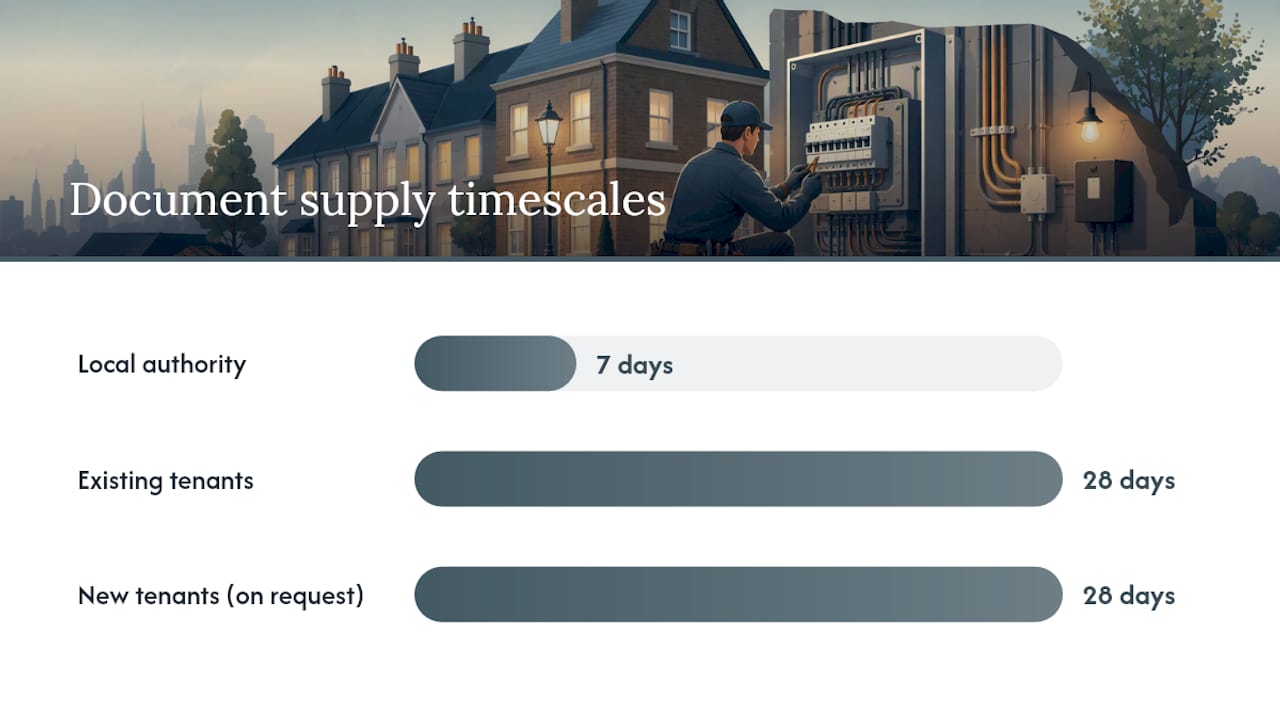
- Existing tenants get a copy within 28 days of the inspection
- A local authority that requests a copy must receive it within 7 days
- Prospective tenants should see it before they move in, and any new tenant must receive it within 28 days of a request
Digital record-keeping earns its cost back quickly here. A folder per property, date-stamped filenames such as “EICR_2026_flatA.pdf”, and a shared compliance calendar for renewal dates removes the risk of a document sitting unfiled on a desk when a council request arrives.
Going beyond the legal minimum
The five-year EICR is a floor, not a ceiling. NRLA and Electrical Safety First both note that many landlords treat the EICR as a box to tick rather than a tool for catching problems early, which misses the point of the whole exercise.
- Run a short visual check between every tenancy: sockets, visible wiring, and the fuse board
- Arrange PAT or ISIT testing for landlord-supplied appliances such as cookers, washing machines, or portable heaters
- Social landlords face the same five-year cycle but must fold appliance testing into it more formally
- Centralise scheduling across your portfolio so no property’s five-year date slips past unnoticed
Why CityPat treats EICRs as safety tools, not paperwork
Across the properties we inspect, the same handful of defects keep recurring: overloaded consumer units, degraded bonding, and DIY wiring from a previous occupier nobody flagged. An EICR that catches these before a tenant plugs in a space heater is doing its actual job, not just satisfying a council request. Landlords who bundle EICR, PAT, and remedial confirmation into one coordinated process resolve unsatisfactory reports faster, because nothing sits waiting on a second contractor’s diary. Treat the report as a hazard map for your property, not a certificate to file and forget.
— Gemma
How CityPat helps you meet your electrical safety duties
Some providers coordinate multiple compliance services through a single provider with nationwide coverage across single properties and multi-site portfolios.

The core service landlords need is EICR and fixed wire testing, which satisfies your Regulation 3 duty and comes with clear documentation designed to survive a council request without a scramble. For landlord-supplied appliances sitting inside your rental, PAT testing covers the ISIT records referenced earlier in this guide. Citypat’s scheduling approach exists specifically to stop five-year renewal dates slipping past unnoticed across a growing portfolio, with written confirmation supplied once remedial work is complete. If your last EICR is due for renewal, or you’ve never had one, get a free quote and get a date in the diary before it becomes a deadline you’re chasing.
Sources
- Electrical safety standards in the private and social rented sectors: guidance
- The Electrical Safety Standards in the Private Rented Sector (England) Regulations 2020
- Electrical safety in rented homes
FAQ
What are the new electrical safety requirements for landlords in England?
Landlords must have a qualified person inspect and test the electrical installation at intervals not exceeding five years, then supply the resulting EICR to tenants and, on request, to the local authority. Any report carrying a C1, C2, or FI code requires remedial work within 28 days, or sooner if the report specifies a shorter timescale.
Can a landlord be fined for not having an EICR?
Yes. A local authority can serve a remedial notice, arrange the work itself and recover the cost from the landlord, or impose a financial penalty of up to £40,000 for non-compliance with the 2020 regulations.
Is it illegal for landlords not to use a registered electrician?
The regulations require inspections to be carried out by a “qualified person”, someone competent to test against BS 7671 and willing to sign the report under their own registration. Using an unqualified person to inspect the installation does not satisfy that legal duty, even if the work looks fine on the surface.
How much does an electrical safety certificate cost for a landlord?
Costs vary by property size, location, and the electrician used, and no fixed national fee exists. Citypat does not publish a fixed price online; current quotes for EICR and fixed wire testing are available directly through the site.