
Yes, you almost certainly need a fire risk assessment, or a clear paper trail showing one covers your property. Blocks of flats, HMOs and mixed-use buildings need a written assessment under fire safety law; single private lets sit outside that law but landlords still carry duties under housing law and alarm regulations. The first move is simple: find out who the Responsible Person is and get sight of the current fire risk assessment.
TL;DR:
- Landlords of HMOs, blocks, and mixed-use buildings must have a written fire risk assessment covering the entire property, with responsibility confirmed in writing.
- Frequent testing and documentation of alarms, gas safety, electrical reports, fire doors, and emergency systems are essential to demonstrate ongoing compliance.
- A thorough fire risk assessment should include a site walk, hazard identification, risk ranking, an action log, and periodic reviews, ideally every one to two years.
- For complex or multi-occupancy properties, hiring a qualified fire safety assessor with proven experience is recommended over self-assessment.
- Maintaining an organized record pack with all test certificates, inspection notes, photographs, and assessment reports is key for passing official inspections and audits.
Table of Contents
- Who needs a landlord fire risk assessment and who is responsible for it
- The legal framework every landlord in England should recognise
- How to carry out a fire risk assessment step by step
- The checks that actually belong in your fire risk assessment
- HMOs, blocks of flats and buildings with extra fire safety duties
- What a compliant record pack looks like and how to prepare for an audit
- When to bring in a competent assessor instead of doing it yourself
- Why a proper fire risk assessment is about tenant safety, not paperwork
- How CityPat supports landlords with fire and electrical compliance
- Sources
Who needs a landlord fire risk assessment and who is responsible for it
Fire safety law splits properties into two camps. Common parts of blocks of flats, HMOs, and any mixed-use building with commercial space fall under fire safety legislation, meaning a written, suitable and sufficient assessment is mandatory. A single private dwelling let to one household is generally outside that regime, but the landlord still answers to housing law through the Housing Health and Safety Rating System, plus specific alarm rules.
Responsibility tracks control, not ownership. In a converted house split into flats, that’s usually the freeholder or managing agent for the communal areas, and the landlord for their own let. In practice:
- If you own a flat in a block, request the block’s fire risk assessment from the freeholder or agent before assuming someone else has it sorted.
- If you manage an HMO directly, you are almost certainly the Responsible Person for that building.
- Get written confirmation of who holds responsibility. Verbal assurances from a managing agent don’t hold up at inspection.
The legal framework every landlord in England should recognise
Three regimes overlap, and knowing which applies to your property saves confusion later. The Regulatory Reform (Fire Safety) Order 2005 requires the Responsible Person to carry out and record a suitable and sufficient fire risk assessment wherever it applies, mainly common parts, HMOs and workplaces. The Housing Health and Safety Rating System, run under the Housing Act 2004, covers everything else and is what most single-let landlords will actually be judged against, since HHSRS applies even where the Fire Safety Order doesn’t. Add the Smoke and Carbon Monoxide Alarm Regulations, which set out where alarms must be fitted and tested, and you have the full picture.
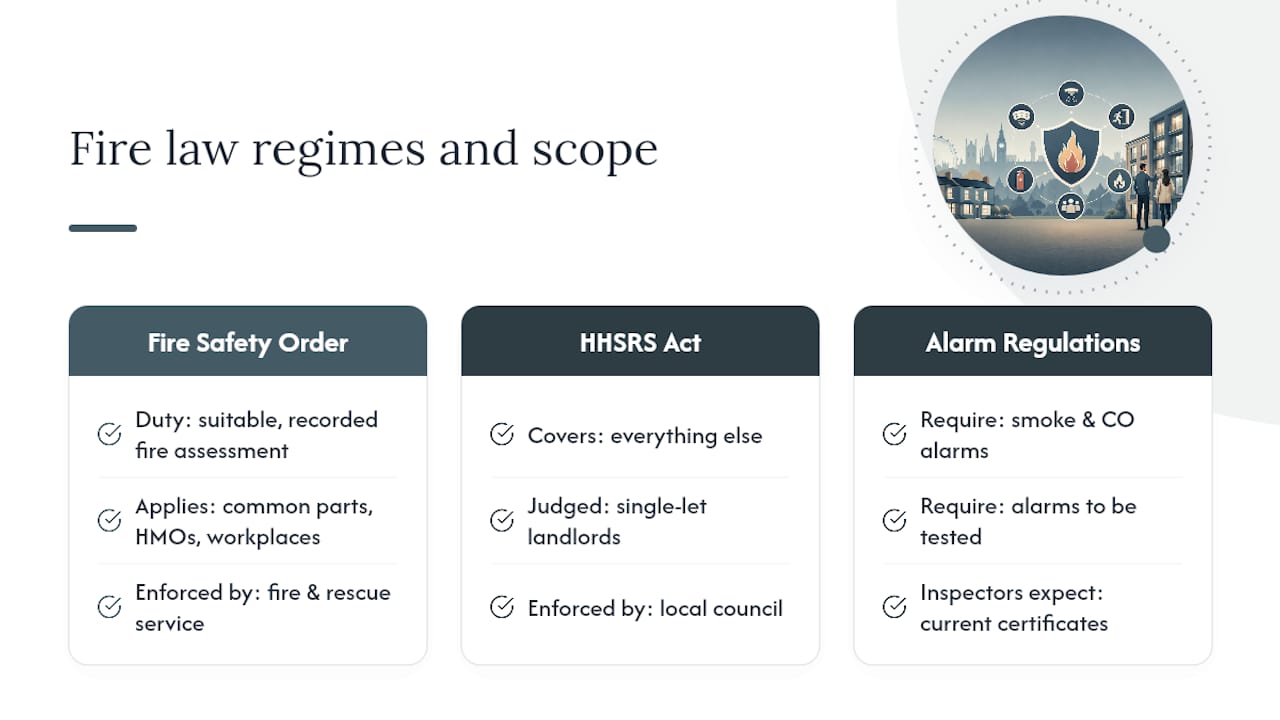
Enforcement runs through two doors: your local council’s housing team using HHSRS, and the fire and rescue service using fire safety law. Both can issue improvement notices, prohibition orders or prosecute for serious breaches.
A quick fact worth remembering: fire and rescue services in England recorded incident data for the year to March 2024, and dwelling fires remain one of the largest categories nationally. That’s the backdrop every inspector has in mind when they walk into your property.
Inspectors and councils expect to see a dated written assessment, an action log showing you followed through on findings, and current test certificates for alarms, gas and electrics.
How to carry out a fire risk assessment step by step
You can do a basic assessment yourself for a straightforward single let, or use these steps to brief a professional properly. Either way, the process is the same shape.
- Define the scope. Decide whether you’re assessing a single flat, a whole HMO, or just the common parts of a block. This determines what you’re legally required to record.
- Identify hazards. Walk the property looking for ignition sources (cookers, heaters, electrics), fuel sources (furniture, storage, waste), and anything blocking an escape route.
- Identify who’s at risk. Note vulnerable occupants, sleeping arrangements, and anyone who might struggle to escape quickly.
- Check existing precautions. Look at alarm coverage, fire doors, escape route clearance and whether furniture meets fire-resistance standards.
- Assess the risk level and list remedial actions. A missing smoke alarm in a hallway is a different priority to a slightly worn fire door seal, so rank them.
- Record everything. Write down significant findings and build an action log with an owner and a target date for each item.
- Set a review date. Annual review is sound practice for simple premises. Anything more complex, or any significant change to the building or occupants, should trigger an earlier one.
Pro Tip: Photograph everything as you go, dated and geotagged where your phone allows it. A written note saying “fire door checked” carries far less weight with an inspector than a timestamped photo of the door and its seals.
The checks that actually belong in your fire risk assessment
A fire risk assessment without underlying test records is just an opinion. The checks below are what turn it into evidence.
Smoke alarms need to be on every storey, with a carbon monoxide alarm in any room containing a fixed combustion appliance. Test them at each visit and log the date. An Electrical Installation Condition Report (EICR) should be renewed at least every five years, and it flags faults long before they become fire hazards. Any portable appliances you supply, kettles, microwaves, heaters, benefit from PAT testing to confirm they’re safe to stay in use.
Gas appliances need an annual safety check. Landlords must retain the CP12 record and give tenants a copy within 28 days of the check, or before a new tenant moves in. Fire doors in communal areas need regular visual inspection for gaps, seals and self-closers, and emergency lighting and communal alarm systems need periodic servicing, not just installation.
- Alarm test logs, dated
- EICR certificate and any remedial work invoices
- CP12 gas safety record
- Fire door inspection notes and photographs
- Emergency lighting and alarm service certificates
Keep every one of these. A fire risk assessment on its own, without the supporting paperwork behind it, tends to fall apart the moment a council officer asks a follow-up question.
HMOs, blocks of flats and buildings with extra fire safety duties
Multi-occupancy properties carry a heavier compliance load than a single let, and the gap has widened further in recent years. HMOs and blocks need a written fire risk assessment covering the whole building, not just individual units, and the Responsible Person has to be named and contactable. In taller residential buildings, the Building Safety Act framework adds Accountable Persons with statutory duties on top.
The Fire Safety (England) Regulations 2022 tightened inspection rules for flat entrance doors and communal fire doors, and increased how much documentation and cooperation is expected between different Responsible Persons in the same building.
- HMOs typically need more frequent internal checks than a single-let property, particularly on shared escape routes.
- If you own a flat within a managed block, request the current block FRA and clarify which safety measures (fire doors, communal alarms, external wall systems) you rely on without controlling directly.
- Confirming these dependencies in writing closes one of the most common enforcement gaps landlords fall into.
What a compliant record pack looks like and how to prepare for an audit
Fire and rescue service audits focus on one thing above all: does the paperwork match what’s actually on the ground. A complete record pack should contain the full written assessment, the action log with dates and completion status, the assessor’s identity or qualification, invoices for remedial work, and dated photographs.
- Keep every document in one folder, physical or digital, organised by date rather than by document type.
- Timestamp evidence wherever possible, particularly photos and test results.
- Review the assessment at least every two years for straightforward properties, and update it every four, tightening that cycle to annual for older buildings or complex layouts, as industry guidance on review cadence suggests.
- Brief tenants on escape routes and alarm locations, and keep a written record that you did.
There’s no single certificate that proves fire compliance the way a CP12 proves a gas check. It’s the collection of records together that carries the weight.
When to bring in a competent assessor instead of doing it yourself
HMOs, blocks of flats, and any property with an unusual layout are the clearest cases for hiring a professional rather than relying on a landlord’s own judgement. RICS recommends professional assessment for exactly these situations, treating the FRA as an ongoing life-safety process rather than a one-off form.
A competent assessor should hold recognised fire safety training, demonstrable experience with HMOs or blocks specifically, and produce a clear written report rather than a verbal opinion.
- Look for qualifications tied to a recognised fire safety body, not a generic “compliance” certificate.
- Ask for a sample report before booking, so you know what level of detail you’ll get.
- Confirm the assessor will provide photographic evidence and a prioritised action list, not just a pass or fail.
CityPat’s fire risk assessment service is built around exactly this kind of deliverable: a written assessment, a dated action log and supporting evidence you can hand straight to a council officer or insurer.
Pro Tip: If a landlord manages several properties and lacks the time for repeat inspections, a scheduled service with a single provider covering alarms, electrics and the FRA together tends to produce far more consistent records than piecing it together from different contractors.
Why a proper fire risk assessment is about tenant safety, not paperwork
Treat the fire risk assessment as a safety exercise first, and the compliance side takes care of itself. Properties with genuinely maintained alarms, doors and escape routes see fewer incidents and far calmer conversations with insurers when something does go wrong. Inspectors don’t reward a tidy-looking document. They reward evidence that you acted on what it found.
— Gemma
How CityPat supports landlords with fire and electrical compliance
If you’d rather have a qualified assessor handle the inspection and the paperwork, that’s precisely where CityPat fits in. As the alternative to piecing compliance together from separate contractors, CityPat covers fire risk assessments, EICR and fixed wire testing, PAT testing, fire alarm testing and servicing, and emergency lighting testing, all under one booking.
A site visit from a safety compliance provider can leave you with a written fire risk assessment, a prioritised action log, photographic evidence and current test certificates, exactly the record pack a council officer or insurer expects to see. For landlords managing HMOs or blocks with multiple compliance dates to track, having one provider handle the fire, gas-adjacent electrical and alarm checks together removes a lot of the scheduling headache. Get in touch through CityPat’s free quote page to arrange an assessment for your property.
This article is general information, not a substitute for advice from a qualified lawyer. Consult a qualified legal professional about your own circumstances before acting on anything here.
Sources
- The Regulatory Reform (Fire Safety) Order 2005
- Gov
- Fire safety for landlords (RICS)
- Gas safety: landlords’ duties (HSE leaflet)