
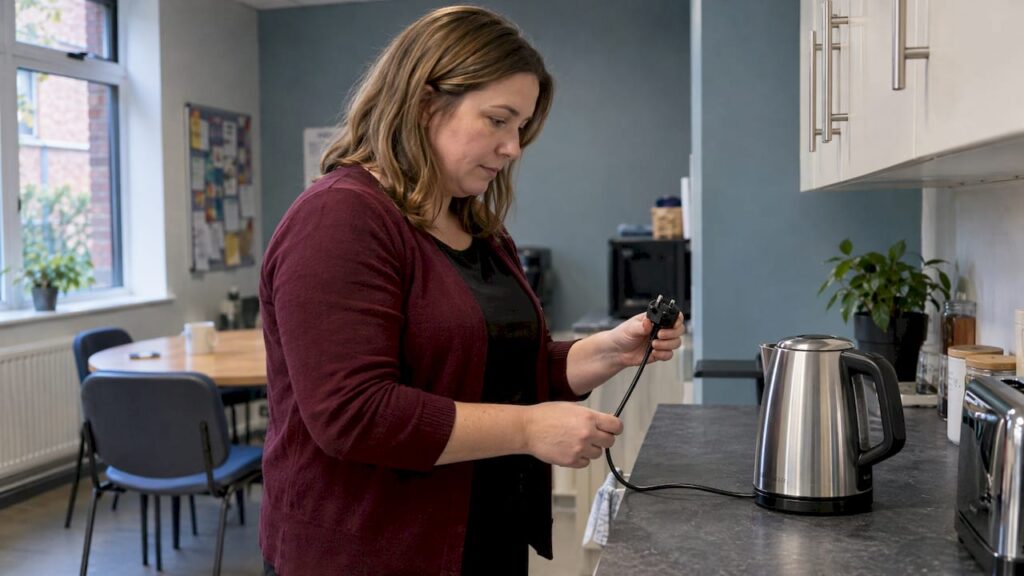
No, brand new appliances do not need a formal PAT test before first use. The HSE says new equipment should be supplied in a safe condition, and recommends a simple visual check to confirm nothing is damaged. The sensible next step is to record the item, put it on your asset register and bring it into your regular inspection and testing cycle. That is where a single provider handling your electrical and fire safety checks, such as our PAT testing service, keeps the paperwork in one place and the dates from slipping.
This guide covers what the law says about new equipment, what to check on the day it arrives, and how schools in England can handle new purchases, frequency and records.
TL;DR
- New electrical equipment does not legally need a PAT test before first use. A visual check for damage is what the HSE recommends.
- The law (the Electricity at Work Regulations 1989) requires electrical equipment to be maintained to prevent danger. It does not set a test frequency or demand annual testing.
- Schools should check each new item on arrival, add it to the asset register and plan its first test with the next scheduled round.
- Risk decides frequency: items that are moved, used outdoors or handled heavily need checking more often than a desktop computer.
- Records and labels are not a legal requirement, but they are the easiest way to show you have managed the risk.
Table of Contents
- What the law says about new electrical equipment
- What to check when a new appliance arrives
- High-risk places and cautious policies
- PAT testing in schools: what is actually required
- How often should school equipment be inspected and tested?
- Records, labels and proving you manage the risk
- Who should carry out the checks?
- Beyond PAT: the rest of your compliance picture
- Let us take the scheduling off your hands
- FAQ
- Sources
What the law says about new electrical equipment
Two points sit at the heart of this question.
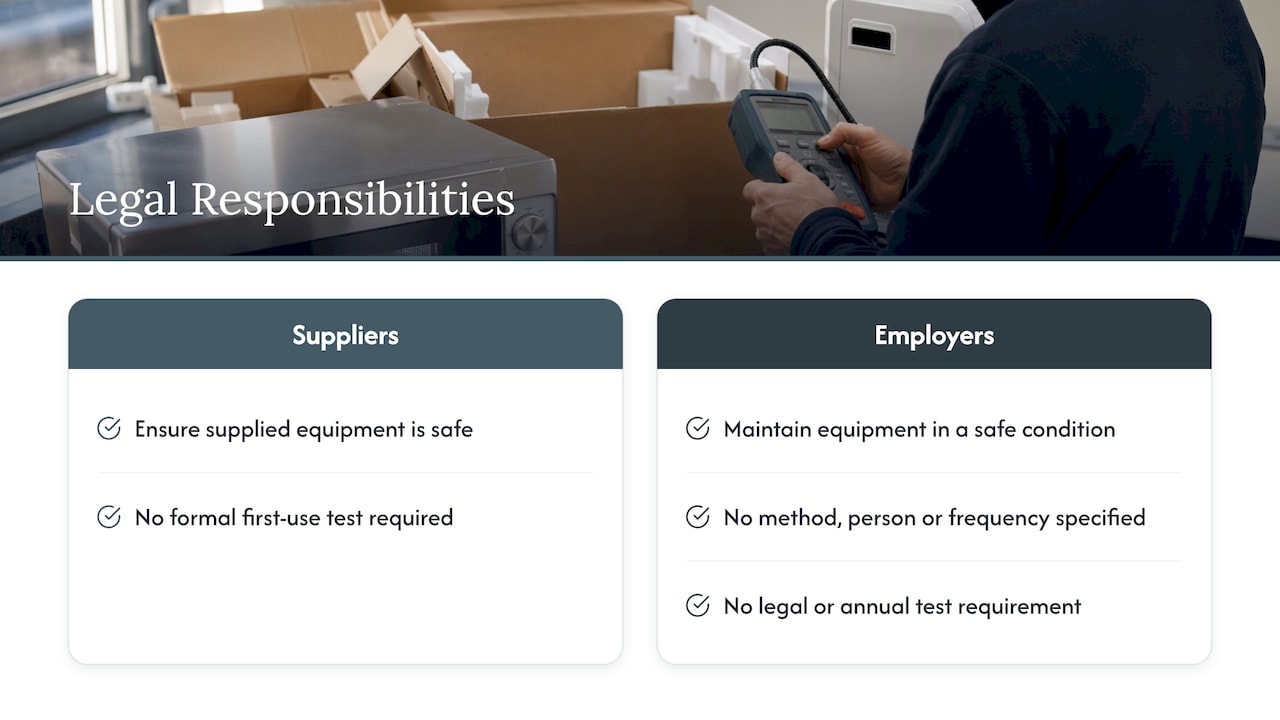
First, the people who make and supply equipment carry the legal duty to supply it safely. The University of Reading’s code of practice on portable appliance testing states that manufacturers and suppliers must ensure new or second-hand equipment they supply is safe for use at work. It adds that no formal inspection or test is required before first use. The user should still check for obvious damage to the plug, cable or casing.
Second, the duty to maintain falls on the employer or the organisation running the premises. The HSE explains that the Electricity at Work Regulations 1989 require electrical equipment that could cause injury to be maintained in a safe condition. The regulations do not say what must be done, by whom or how often. They do not make testing a legal requirement, and they do not require it annually. Our own page on PAT testing regulations in England covers the same ground for employers and landlords.
That last point matters for new kit. “No formal test on day one” does not mean “no further thought”. The equipment enters your maintenance regime the moment you plug it in.
What to check when a new appliance arrives
The HSE’s own guidance, INDG236, encourages staff to look at the supply cable and the equipment before use. Damaged or faulty equipment should be taken out of use without delay and either repaired by someone competent or disposed of so that nobody uses it again.
For a new item, a practical arrival check looks like this:
- Packaging and transit damage. Look for cracked casing, dents, loose parts or a crushed cable.
- Plug and flex. Check the plug is the correct type for your supply, is undamaged and has the cable gripped firmly where it enters. Look for pinched or exposed cores.
- Markings and paperwork. Make sure the rating plate and safety markings are present and the instructions are included.
- Suitability for the environment. The University of Cambridge’s electrical safety guidance says new equipment should suit where it will be used. For example, check the Ingress Protection rating for outdoor use, or the relevant standards for potentially explosive atmospheres.
- Log it. The same guidance says to place new equipment on the PAT test register if one exists.
Furniture and fitted units can hide the very things you need to see. Cables routed inside cabinets, desks or display units are hard to inspect once they are installed. If you are specifying or buying fitted furniture, planning cable routes in furniture so that plugs and flexes stay reachable makes later visual checks far easier.
Why the visual check carries so much weight
The Association for Science Education (ASE) notes in its overview of school electrical safety that more faults in school equipment are found by inspection than by the portable appliance tester. A Montessori school’s published electrical appliances policy goes further and states that over 80% of electrical faults are discovered by visual inspection. Whichever figure you prefer, the message is the same: a careful look is the foundation of every inspection routine, and it is the first thing a new appliance should get.
High-risk places and cautious policies
A new item from a reputable manufacturer is designed to meet product safety standards. Even so, some organisations choose to run a full electrical test before first use where the setting is demanding, such as a workshop, a building site or a harsh industrial area, or where the arrival check raises a question. That is a policy decision, and a sound one for rough environments.
Schools rarely sit at that extreme, but parts of them can. A design and technology workshop, a kitchen, a caretaker’s outdoor equipment and extension leads used on the playground for events all take more punishment than a classroom projector. Treat those areas as higher risk when you write your policy.
PAT testing in schools: what is actually required
Schools ask this question more than most because they hold hundreds of portable items, from laptops and kettles to visualisers and PA systems. The legal position is the one above. The Electricity at Work Regulations require maintenance to prevent danger. There is no statutory annual test, no statutory label and no statutory record.
What that leaves is a duty of judgement. The governing body or the academy trust has to be able to show that it has a reasonable system. In practice that means:
- a register of portable electrical equipment,
- a way for staff to report damaged items,
- regular user checks and formal inspections,
- electrical testing where the equipment type and use call for it,
- competent people doing the work.
If you want a school-specific view of how we approach this, see our page on PAT testing for schools.
Equipment classes and what each needs
The ASE explains that Class 1 equipment depends on a low-resistance earth connection to its metal exterior parts and needs an insulation test. Class 2 (double-insulated) equipment generally needs an inspection to confirm that the case and lead are undamaged. The HSE’s INDG236 reflects the same split: equipment that is not double insulated should have a portable appliance test, including its leads.
This helps when you sort new purchases. A new laminator or kettle (Class 1, commonly) goes on the register as a test item. A new phone charger or desk lamp marked as double insulated may need inspection only. Your register should note the class so the right check is scheduled.
Computers and sensitive electronics
The ASE warns that passing large earth test currents through electronic instruments and IT equipment can damage printed circuit boards and components. The Montessori school policy says much the same about computers, noting that high test voltages and currents may cause permanent damage. Testing sensitive equipment needs someone who understands the right method for it, not just someone holding a tester.
How often should school equipment be inspected and tested?
The law gives no figure. The HSE’s INDG236 says the law requires equipment that can cause danger to be maintained but does not say how or how often. It then offers guidance for low-risk environments:
- All portable equipment should be visually inspected at initial intervals which could be anywhere between six months and four years, depending on the type of equipment.
- Equipment that is not double insulated should have a portable appliance test at initial intervals which could be between one and five years.
The ASE says many schools choose to schedule a combined formal inspection and electrical test of all portable equipment yearly, although the regulations do not require it. It also describes a risk-based alternative: the least risky items formally inspected yearly and electrically tested perhaps every four years, with high-risk items given a combined inspection and test every six months.
The Montessori school policy shows a worked version of a risk-based schedule:
| Risk level | Typical items | Inspection | Electrical test |
|---|---|---|---|
| High | Heavy use or outdoor use | Every time they are used | Every 6 months |
| Medium | Moved, but used indoors in dry conditions | Every time they are used | Every 12 months |
| Low | Infrequently moved but regularly used, such as personal computers | Regularly | Every 5 years |
That table is one school’s policy, not a legal standard. Use it as a model for how to think about risk rather than as a number to copy. Your own intervals should reflect how your equipment is used, how likely it is to deteriorate and what a fault would cost.
A simple way to place a new item in the cycle
The same Montessori policy sets out a clear routine for new purchases. A visual check is required on arrival. The first PAT is carried out at the next calendar opportunity when PAT takes place. A dated PASS label goes on the appliance, and on the plug if the lead is detachable. Results are recorded centrally so they are ready for audit.

That routine is easy to adopt. Check on arrival, register, label and test at the next scheduled round. Nothing is left in a gap, and no item waits a year with no record.
Records, labels and proving you manage the risk
The HSE is clear that keeping records and labelling tested equipment are not legal requirements. It also says you may find both useful. For a school, the argument for doing so is practical.
- Inspectors and insurers. A dated record shows that equipment was checked and by whom.
- Trend spotting. If the same type of item keeps failing, the register shows it.
- Handover. When a site manager leaves, the system stays.
- New purchases. A register is the only reliable way to catch the new appliance bought on a department budget and never seen by the site team.
Our PAT testing checklist sets out what to check before and after a test visit, which helps when you are preparing a school for a round of testing.
Who should carry out the checks?
The HSE says the person doing testing work must be competent. In many low-risk environments, a sensible member of staff can carry out visual inspections if they have enough knowledge and training. Combined inspection and testing requires more: the right equipment, the ability to use it properly and the ability to interpret the results.
In a school, that usually means a split. Teachers and support staff do the user check each time they use something. A competent person handles formal inspection and testing. For schools juggling term dates, exam periods and limited site staff, handing the testing round to a provider is the simplest way to make sure it happens.
Beyond PAT: the rest of your compliance picture
Portable appliances are one part of electrical and fire safety. The fixed installation, the alarm system, emergency lighting and extinguishers all need attention on their own schedules. If you are managing a school or a multi-site organisation, it helps to see them together.
- Fixed wiring: our EICR and fixed wire testing covers the installation behind the sockets.
- Fire detection: fire alarm testing and emergency lighting testing.
- Risk assessment: a fire risk assessment for the premises.
What we think about new appliances
When someone asks us whether a new appliance needs a PAT test, the honest answer is that the law does not demand one on day one, and that the useful question is a different one: what happens to this item after day one?
The items that cause trouble are rarely the ones that failed a first-day check. They are the ones nobody wrote down. A kettle bought for a staff room, a heater donated for a cold classroom, a laminator ordered by a department: each one needs to enter a system the moment it arrives.
That is how we think about compliance at City PAT. We coordinate electrical and fire safety services through one provider, with clear documentation and scheduling designed to minimise disruption and missed inspection dates. For a school or a multi-site organisation, that means new equipment is added to a plan that already exists, rather than waiting for someone to remember it.
Check it when it arrives, record it, and let the next scheduled round pick it up.
Gemma
Let us take the scheduling off your hands
If you are setting up a routine for new and existing equipment, we can carry out your portable appliance testing on site and coordinate it with your other electrical and fire safety checks. We work across the UK and support single and multi-site organisations, including schools, offices and retail premises. Our PAT testing page explains the service, and you can get a free quote when you are ready.
If you manage a larger estate, our pages for offices and retail businesses show how the same approach works in other settings.
FAQ
Do brand new electrical items need PAT testing?
No. The HSE says new equipment should be supplied in a safe condition and does not need a formal inspection or test, but recommends a simple visual check for damage. After that, add the item to your register so it is picked up in your normal inspection and testing cycle.
Do new appliances need PAT testing in schools?
Not before first use. Schools should check each new item on arrival, record it and test it at the next scheduled round if its type calls for testing. Workshop, kitchen and outdoor equipment may justify an earlier test because the risk is higher.
Is PAT testing a legal requirement for schools?
The Electricity at Work Regulations 1989 require electrical equipment to be maintained to prevent danger, but they do not make PAT testing compulsory. They also do not set a frequency or require records. Many schools test annually or on a risk basis because it is a straightforward way to show the equipment is being managed.
How often should school appliances be tested?
The law gives no interval. HSE guidance suggests visual inspections between every six months and four years, and tests for equipment that is not double insulated between every one and five years, depending on type and use. High-use items sit at the short end and low-risk items at the long end.
Can a member of staff do the checks?
For visual user checks, yes. The HSE says a sensible, trained member of staff can do visual inspections in many low-risk settings. Combined inspection and testing needs the right equipment and the knowledge to interpret results, so a competent person should carry it out.
Sources
- HSE: PAT (Portable appliance testing), answers to popular questions
- HSE: Maintaining portable electrical equipment in low-risk environments (INDG236)
- University of Reading: Safety Code of Practice 12, Portable Appliance Testing
- University of Cambridge: Guidance for working safely with electricity
- ASE: school electrical safety overview
- Walthamstow Montessori School: Electrical Appliances and PAT Test Policy