

For most UK homes and hallways, an optical (photoelectric) alarm or an optical multi-sensor alarm is the better choice. Optical alarms pick up slow, smouldering fires sooner and are less likely to go off when you cook. Ionisation alarms react faster to fast, flaming fires, and any working alarm is better than none. This guide explains the difference, shows where each type belongs and sets out what UK fire services and guidance say.
TL;DR
- Optical alarms are typically more effective at slow-burning fires. Ionisation alarms are typically more effective at fast, flaming fires, according to Manchester Fire and Rescue Service.
- Optical or multi-sensor alarms are recommended for hallways and landings, because ionisation types are more prone to false alarms from cooking fumes and dust.
- Fit a heat alarm, not a smoke alarm, in the kitchen.
- Look for BS EN 14604 and the Kitemark, and where possible choose an optical multi-sensor alarm with a 10-year life.
- Landlords in England must have at least one smoke alarm on each storey used as living accommodation. The type is your choice, so choose to suit the building and the tenants.
Table of Contents
- How the two sensor types work
- Which responds sooner: smouldering or flaming fires?
- Nuisance alarms: cooking, steam and dust
- So which is better, ionisation or photoelectric?
- What the law says for landlords in England
- Homes versus workplaces
- Choosing and fitting: a short checklist
- Let us handle the testing
- FAQ
- Sources
How the two sensor types work
Both types are looking for the same thing, smoke particles, but they detect them in very different ways.
Ionisation alarms
An ionisation alarm contains a tiny amount of americium-241. Its radiation ionises the air in the detecting chamber, and smoke particles entering the chamber react with some of those ionised air molecules. That changes the electrical behaviour of the chamber and triggers the alarm, as the Fire Protection Association explains. The US standards body NIST describes the same principle: the radioactive material is safely shielded, it charges air between two metal plates to create a small current, and particles entering the chamber attract the ions and reduce that current.
Optical (photoelectric) alarms
An optical alarm uses an infrared emitter and a receiver in a dark chamber. In clean air the light does not reach the receiver. When smoke enters, it scatters the light towards the receiver, and the alarm sounds once the signal passes its threshold. Photoelectric is the American term for the same technology. In the UK you will see it sold as optical.
Multi-sensor alarms
Multi-sensor alarms combine more than one sensing method, often optical with heat. NFPA notes that these multicriteria alarms use sensors such as photoelectric, ionisation and heat together with an algorithm designed to reduce nuisance alarms from sources such as cooking.
Which responds sooner: smouldering or flaming fires?
The difference comes down to the size of the smoke particles.
Fast, flaming fires, such as burning fat or paper, produce large numbers of small, dark soot particles. NIST says ionisation-based alarms tend to detect these more quickly. Slow, smouldering fires, such as foam furniture or an overheated cable, give off larger, paler particles that reflect light, and photoelectric detectors tend to be more sensitive to those.
Research from BRE agrees. Optical detectors respond to smouldering fires very quickly because the larger particles scatter more light. The same chambers become less sensitive as particles get smaller, which is why they can be slower on small flaming-fire particles.
| Ionisation | Optical (photoelectric) | |
|---|---|---|
| Detects | Small soot particles | Larger, lighter particles |
| Typically stronger on | Fast, flaming fires | Slow, smouldering fires |
| Cooking and dust | More prone to nuisance alarms | Less prone to nuisance alarms |
| Cost | Cheapest and widely available | Usually costs more |
| UK fire service view | Acceptable, not preferred for hallways | Preferred for circulation spaces |
The cost point comes from East Sussex Fire and Rescue Service, which says ionisation alarms are the cheapest and most readily available, and that optical alarms are more expensive but less likely to go off accidentally.
How big is the gap in practice?
It depends on the fire. A Norwegian full-scale study (Meland and Lernvik) found that in smouldering fires only the optical detectors gave satisfactory safety. In flaming fires the ionisation detectors reacted first, but the advantage was about 15 to 20 seconds, which it said would be decisive for loss of life only in extraordinary circumstances. The US Fire Administration adds that in some full-scale tests the time-to-alarm difference was trivial, and in others considerable.
Smouldering fires matter because they are the dangerous ones at night. According to a BS 5839-6 guide, slow smouldering fires are the most common fatal fire type in UK dwellings. Smoke from a smouldering sofa can spread while people sleep, so early detection of that kind of fire counts for a lot.
Modern materials have not made alarms obsolete either. BRE’s principal consultant Raman Chagger told the BBC in January 2026 that optical alarms are slightly better with the large particles from smouldering fires, and that alarms still respond to the main fires we get today.
Nuisance alarms: cooking, steam and dust
Nobody keeps an alarm that sounds every time the toast browns, and people who disable alarms are not protected at all. So false alarms are a safety issue, not just an annoyance.
The FPA says ionisation alarms are extremely sensitive to small particles from flaming fires but also to cooking fumes and dust. That makes them unsuitable for circulation areas or close to kitchens where fumes are frequent. Optical detectors are less likely to respond to cooking fumes.
There is a trade-off built into every smoke detector. NIST explains that a detector sensitive enough to catch almost any smoke would also react to cooked food and dust, while a less sensitive one risks being slow or silent in a real fire. Good placement and the right sensor type manage that balance.
What to put in the kitchen
UK guidance is consistent: use a heat alarm in the kitchen. Manchester Fire and Rescue Service advises a heat alarm in the kitchen area and a smoke alarm in a circulation space on every level. Redbridge Council’s building control guidance says optical detectors rather than ionisation types should be fitted in hallways and landings, with heat alarms in kitchens and other rooms where the use may trigger false alarms.
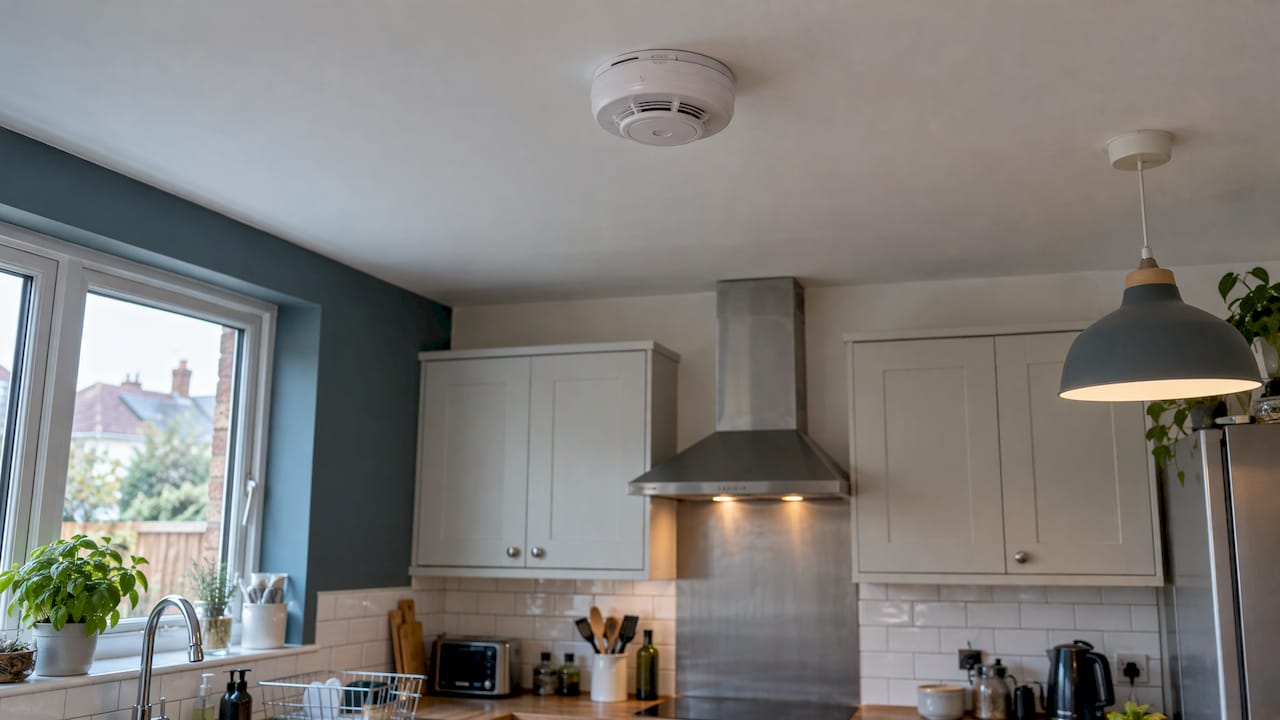
If a smoke alarm must sit fairly close to the kitchen, RiskFire advises choosing an optical type, as optical units are less prone to reacting to cooking and steam. A heat alarm ignores cooking aerosols entirely.
So which is better, ionisation or photoelectric?
Here is how the main bodies line up.
- Manchester Fire and Rescue Service recommends fitting an optical multi-sensor smoke alarm with a 10-year life span where possible, and looking for a British Standard Kitemark.
- The Fire Protection Association says BS 5839-6 and UK fire and rescue services recommend optical or multi-sensor alarms over ionisation alarms in hallways and landings as a minimum level of protection.
- East Sussex Fire and Rescue Service recommends one of each type for the best protection. It adds that if you can only afford one alarm, having either is safer than having none, and that alarms should meet BS EN 14604.
- NFPA and the US Fire Administration in America recommend both technologies or a combined dual-sensor alarm for the best coverage.
The practical reading is straightforward. If you are buying one alarm for a hallway or landing, make it optical, or an optical multi-sensor. If you want the broadest coverage, a multi-sensor unit, or a mix of types, covers both fire profiles. BRE’s own conclusion is that each type is attuned to certain fires, so the right device should be chosen using the relevant codes of practice.
One more point: ionisation alarms are still very common in battery-powered domestic units. If you already have one, do not strip it out in a panic. Make sure it works, keep it clear of the kitchen, and plan to upgrade when it reaches the end of its life.
What the law says for landlords in England
The Smoke and Carbon Monoxide Alarm (England) Regulations 2015, as amended in 2022, require landlords to equip each storey that has a room used as living accommodation with at least one smoke alarm. The regulations do not stipulate whether alarms are mains or battery-powered, so there is no legal ban on either sensor type. The official landlord guidance recommends choosing alarms to suit the building and its tenants, compliant with BS 5839-6, and says that where battery alarms are used, sealed-for-life batteries are the better option than replaceable ones.
For a wider view of your duties, see our guide to landlord fire safety in England. Property managers handling several buildings may find our overview of electrical and fire safety compliance for property managers useful for keeping inspections on schedule.

Homes versus workplaces
Everything above is about domestic-style alarms. A business premises, HMO or block of flats usually has a wired fire alarm system rather than a few standalone units. Detector choice there is made at design stage, based on the building’s use, its fire risks and the standard the system is built to. For a plain-English summary of the standard behind these systems, this guide to BS 5839 fire alarm requirements is a good starting point for property owners and specifiers.
Once a system is installed, the detectors need regular attention whatever their sensor type. We cover the routine in weekly fire alarm testing, the servicing duties in England and how to keep a fire alarm logbook that stands up to an inspection.
Choosing and fitting: a short checklist
- Count your levels. Manchester Fire and Rescue Service advises at least one working smoke alarm on every level of the home, preferably in a hallway or landing.
- Pick the sensor. Optical or optical multi-sensor for circulation spaces and living areas. Heat alarm for the kitchen.
- Check the marks. Look for BS EN 14604 and ideally the British Standard Kitemark.
- Think about the battery. A 10-year sealed unit removes the job of changing batteries. Landlords are told that sealed-for-life is the better battery option.
- Mind the budget. Manchester Fire and Rescue Service says smoke alarms can cost as little as £5 to £10 and are sold in DIY stores, electrical shops and high-street retailers.
- Test and record. Test as the manufacturer instructs, and in a rented or commercial setting write the result down.
Our view on detector choice
Most of the questions we get are not really about sensors. They are about whether a building will pass an inspection and whether anyone will notice a failed detector before it matters. Sensor type is one decision. Documented testing, clear responsibility and a schedule that does not slip are the others.
We see this most with landlords and multi-site operators. The alarm that matters is the one that is installed to suit the building, tested on time and recorded. That is why we coordinate electrical and fire safety services through one provider, so that PAT, fixed wire inspections, fire alarm testing, emergency lighting, extinguisher servicing and fire risk assessments sit on one calendar with clear documentation.
Our advice is simple. Choose detectors in line with fire service guidance, keep them tested, and have a competent person review your wider fire risk. If you want help with the testing side, we are here to take it off your hands.
Gemma
Let us handle the testing
Choosing the right detector is only half the job. The other half is proving it works, every time it is due. We provide on-site fire alarm testing across the UK, with scheduling designed to minimise disruption and missed inspection dates, and clear documentation afterwards.

If you manage more than one building, we can also coordinate fire risk assessments, emergency lighting, extinguisher servicing and electrical testing through one provider. Visit City PAT to request a quote.
FAQ
Is an ionisation alarm unsafe?
No. Ionisation alarms are typically more effective at fast, flaming fires, and any working alarm is safer than none. Their weakness is that they are more prone to nuisance alarms and are typically less effective on slow-burning fires. For hallways and landings, UK fire services prefer optical or multi-sensor types.
Which type of smoke alarm has the fewest false alarms?
Optical alarms are less likely to sound from cooking fumes and steam than ionisation alarms. Heat alarms avoid cooking aerosols entirely, which is why they are advised for kitchens. Multi-sensor alarms are designed to use extra sensing and an algorithm to reduce unwanted alarms.
How often should I replace smoke alarm batteries?
Follow the manufacturer’s instructions for replaceable batteries. Many people now choose sealed alarms with a 10-year life, which Manchester Fire and Rescue Service recommends where possible, so there is no battery to change. GOV.UK guidance for landlords says sealed-for-life batteries are the better option over replaceable ones.
Should I fit both types in my home?
East Sussex Fire and Rescue Service recommends one of each type for the best protection, or you can choose a multi-sensor alarm. If budget allows only one alarm per level, fit an optical one in the hallway or landing and add a heat alarm in the kitchen.
Sources
- Smoke and Heat Alarms 2026, Manchester Fire and Rescue Service
- Better protection, Fire Protection Association
- How Do Smoke Detectors Work? NIST
- Smoke Alarm Types, NFPA
- Characterising the smoke produced from modern materials, BRE
- Smoke Alarms, East Sussex Fire and Rescue Service
- Detection of Smoke: Full-Scale Tests with Flaming and Smouldering Fires, IAFSS
- U.S. Fire Administration Position Statements
- BBC News: how smoke detectors are evolving
- BS 5839-6 Domestic Fire Alarm Grades And Categories, squote
- What Sets Off a Smoke Alarm? RiskFire
- Loft conversions, Redbridge Council
- Smoke and Carbon Monoxide Alarm (England) Regulations 2015 Q&A booklet, GOV.UK