
Use PAS 79-1:2020 to structure a fire risk assessment for any premises other than housing, and BS 9792:2025 for housing stock. Whichever applies, the Regulatory Reform (Fire Safety) Order 2005 already obliges you as Responsible Person to hold a suitable and sufficient fire risk assessment. Your immediate next step is simple: check the report on your desk follows the ten PAS 79 section headings, carries a documented, prioritised action plan, and states a review date.
TL;DR:
- A PAS 79 fire risk assessment report must include explicit evidence for each risk rating, not just color codes or vague statements.
- Every report should have a clear scope statement, list items not inspected with reasons, and contain an action plan with assigned owners and deadlines.
- Assessors need relevant qualifications, practical experience, and ongoing familiarity with current standards to produce defensible, compliant assessments.
- External assessors are advisable for complex premises, while straightforward buildings may be managed internally if personnel are qualified and diligent.
- Proper documentation, including detailed site-specific evidence and clear communication of findings, is essential to withstand regulatory scrutiny.
Table of Contents
- What does a PAS 79 fire risk assessment checklist need to cover?
- Section-by-section PAS 79-1 breakdown: what to document in each of the 10 sections
- What is the legal requirement for fire risk assessments in the UK?
- Where do you get PAS 79 templates and how do you adapt them?
- Common assessor pitfalls and practical fixes
- How should you prioritise and time the action plan?
- What competence do you need to carry out a PAS 79 assessment?
- Should you appoint an external assessor or do it in-house?
- How do you document findings so they hold up to scrutiny?
- How do you communicate the findings to the people who need to act on them?
- What good practice actually looks like on site
- How CityPat supports your PAS 79 fire risk assessment
- Sources
- FAQ
What does a PAS 79 fire risk assessment checklist need to cover?
A PAS 79-compliant report stands or falls on whether each section carries evidence, not just a tick. Before you file or accept a report, run through this:
- Scope statement naming the premises, areas covered, areas excluded, and the date of the site visit.
- Ten-section structure present in full, from premises description through to conclusions, with no section skipped or merged.
- Evidence behind every risk rating, not just a colour code. If a section says “medium risk”, there should be a sentence explaining why.
- Occupancy and vulnerability factors recorded, including shift patterns, sleeping risk, or reduced mobility where relevant.
- Action plan entries each with a named owner, a specific task, a deadline, and a priority category.
- Items not inspected listed explicitly, with the reason and what should happen next (locked plant room, absent keyholder, and so on).
- Reviewer name and date, plus a stated next review date.
A report missing the scope statement or the “not inspected” record is often the weakest point assessors overlook, and it is exactly what an inspector or insurer will ask about first.
Section-by-section PAS 79-1 breakdown: what to document in each of the 10 sections
PAS 79-1:2020 sets out a fixed sequence of sections, with model pro forma in the annexes. Here’s what belongs in each, and what separates a defensible entry from a weak one.
1. Premises description. Record construction type, number of storeys, use classes, and any recent alterations. Weak version: “Office building.” Strong version: “Three-storey mixed office and warehouse unit, 1970s steel frame construction, warehouse floor reconfigured in 2023 with a new mezzanine.”
2. Legislation and guidance applied. State the Fire Safety Order, any relevant British Standards referenced (BS 9999 for fire safety design, BS 9991 or BS 9792 where housing elements exist), and any licensing conditions.
3. Fire hazards. List ignition sources, fuel sources and oxygen sources separately rather than lumping them together. A kitchen extraction system, a battery charging bay, and stored packaging materials are three distinct hazards, not one line item.
4. People at risk. Name categories, not just numbers: staff, visitors, contractors, sleeping occupants, lone workers, and anyone with a disability affecting evacuation. Include maximum likely occupancy, not just current headcount.
5. Fire protection measures. Cover detection and alarm systems, emergency lighting, means of escape, compartmentation, and firefighting equipment. This is where maintenance records matter: a fire alarm system tested six months ago with no record since is a finding, not a footnote.
6. Management of fire safety. Look at training records, fire drill frequency, evacuation procedures, and whether a fire warden system actually functions day to day, not just on paper.
7. Significant findings. This is the section enforcing officers read first. Each finding needs a clear description, the risk it creates, and a cross-reference to the relevant action plan item.
8. Fire risk evaluation. State the overall risk rating and, critically, the reasoning. Weak: “Risk rating: medium.” Strong: “Risk rating: medium, based on adequate means of escape offset by inconsistent fire door maintenance identified during inspection of Floor 2.”
9. Action plan. Every item needs an owner, a deadline, and a priority category (more on this below).
10. Conclusions. A short summary confirming whether the fire risk assessment is, in the assessor’s professional opinion, suitable and sufficient, along with the review date.
For housing premises, the structure shifts. BS 9792:2025 now governs housing fire risk assessments, replacing the old PAS 79-2. Where a building is mixed use, apply PAS 79-1 to the commercial parts and BS 9792 to the residential parts, and say so explicitly in your scope statement. Trying to force a purely residential block through the PAS 79-1 template, or vice versa, is one of the more common structural mistakes assessors make.
What is the legal requirement for fire risk assessments in the UK?
Every Responsible Person in England, whether that’s an employer, landlord, or occupier of non-domestic premises, is legally required by the Regulatory Reform (Fire Safety) Order 2005 to carry out and maintain a suitable and sufficient fire risk assessment. Failure to comply can lead to enforcement notices, prohibition notices, or prosecution, and the Responsible Person named on the report is personally accountable, not just the organisation.
PAS 79 itself carries no legal force. It’s a recognised methodology, not statute. But when a fire and rescue service inspector reviews your report, a PAS 79-structured document with clear evidence trails is far easier to defend as “suitable and sufficient” than a vague narrative report with no consistent headings. IFSM’s practice guide treats PAS 79-1 as the industry benchmark precisely because it gives inspectors a familiar structure to check against.
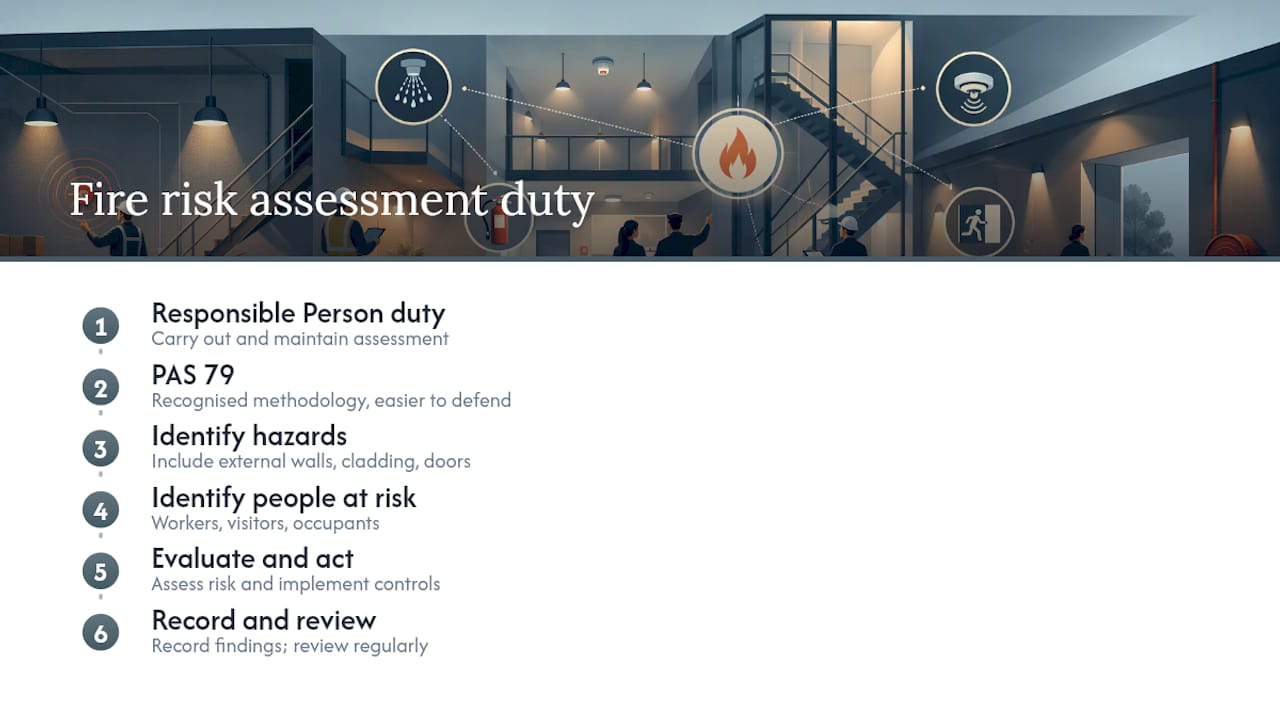
Gov mirrors much of the PAS 79 logic: identify hazards, identify people at risk, evaluate and act, record findings, and review. Where the Fire Safety Act 2021 adds weight is in clarifying that external walls, cladding and flat entrance doors fall within scope for relevant buildings, so multi-occupancy premises need particular attention in the hazard identification section.
Where do you get PAS 79 templates and how do you adapt them?
You don’t need to build a PAS 79 report from a blank page. The Fire Industry Association hosts free downloadable proforma templates reproducing the Annex A and Annex D model forms from PAS 79-1. BSI’s own standard includes an exemplar completed assessment in Annex E, useful for seeing what a finished report should actually look like rather than just the blank structure.
Downloading a template is the easy part. Adapting it properly is where reports go wrong. Keep these fields non-negotiable on every job: date of assessment, name and qualification of the assessor, scope and any exclusions, evidence references for each finding, and a signature block for review sign-off.
Never copy findings verbatim from a previous job into a new template, even for near-identical premises. A proforma speeds up production, but only site-specific evidence keeps it defensible in front of an inspector or in court. If you’re assessing a mixed-use block with commercial tenants, it’s also worth checking lease and management documentation early using a resource like this commercial property document checklist, since responsibility for fire safety measures can sit with different parties depending on tenancy terms.
Common assessor pitfalls and practical fixes
Three faults turn up repeatedly in weak PAS 79 reports, and all three are avoidable with better habits, not more time.
- Missing scope statement. If the report doesn’t say what was excluded and why, an inspector will assume nothing was excluded, which then looks like an oversight rather than a deliberate limitation.
- Generic risk-rating language. “Risk rating: low” with no supporting sentence is not evidence, it’s an opinion with no basis shown.
- Action items with no owner or deadline. “Improve fire door maintenance” achieves nothing without a named person and a date.
- No review date stated. Every PAS 79 report needs an explicit next review trigger, not an implied “we’ll get to it”.
When writing a risk evaluation, document the actual scenario you considered, the evidence behind your likelihood judgement, the consequence you assumed, and the professional reasoning that produced the combined rating. That level of detail is what separates a defensible report from boilerplate.
Pro Tip: For anything you couldn’t inspect, record it as a named limitation with a reason and a follow-up date, rather than leaving it out entirely. A locked plant room noted as “not inspected, key holder unavailable, follow-up visit required by [date]” protects you far more than silence ever will.
How should you prioritise and time the action plan?
A PAS 79 action plan is only useful if the priority categories actually mean something. Structure it like this:
- Immediate/urgent. Life-safety issues requiring action within 24 to 48 hours, such as a blocked fire exit or a disabled alarm system.
- High priority. Significant findings needing resolution within 30 days, such as fire doors failing to self-close correctly.
- Medium priority. Findings requiring action within 90 days, such as updating fire safety signage or refreshing training records.
- Low priority. Improvements with a 6 to 12 month horizon, such as reviewing storage layout to reduce fuel load.
Review cadence should follow risk level: low-risk premises can typically go 12 months between full reviews, medium-risk premises benefit from a check at 6 to 12 months, and higher-risk or complex occupancies often warrant more frequent review. Beyond the calendar, certain events should trigger an earlier reassessment regardless of schedule: a change of use, a significant refurbishment, a fire incident on the premises, or a change in occupancy numbers. GOV.UK’s own prioritisation tool is designed to help decide which of several premises needs attention first when resources are stretched. Record every completed review action against the original action plan item, with the date closed and who verified it, so the audit trail stays intact.
What competence do you need to carry out a PAS 79 assessment?
There’s no single licence that makes someone a “PAS 79 assessor”. Competence is judged on a combination of relevant qualifications, demonstrable experience, and ongoing familiarity with current guidance, not a single certificate.
Look for evidence across three areas. First, formal training, such as a recognised fire risk assessment qualification or membership of a professional body relevant to fire safety. Second, practical experience assessing premises of a similar type and complexity, since a competent assessor for a small retail unit isn’t automatically competent for a hospital or a high-rise residential block. Third, evidence of staying current, given that PAS 79-1:2020 and the newer BS 9792:2025 both reflect updated thinking on documentation and housing risk that older guidance doesn’t cover.
The Responsible Person carries the legal duty regardless of who physically produces the report, so checking competence before appointing someone isn’t optional diligence, it’s part of meeting the “suitable and sufficient” test itself. A report signed off by someone with no demonstrable fire safety background offers little protection if challenged later. Ask any prospective assessor for examples of previous PAS 79-structured reports for comparable premises, and ask how they document findings they couldn’t verify on site. Their answer tells you more about competence than any qualification list.
Should you appoint an external assessor or do it in-house?
The honest answer depends on premises complexity and internal expertise, not on cost alone. Straightforward, low-risk premises with a knowledgeable in-house health and safety lead can often manage routine reviews internally, provided the person doing the work genuinely understands PAS 79’s structure and evidence expectations rather than just filling in a template.
Complexity changes that calculus quickly. Multi-occupancy buildings, premises with sleeping risk, sites with unusual fire loads, or anywhere with a history of enforcement action benefit from an external, competent assessor who assesses similar buildings regularly and can benchmark findings against comparable sites. External assessors also bring independence, which matters if a report is ever scrutinised by an inspector or insurer questioning objectivity.
A practical middle ground many organisations use: in-house staff handle interim checks and evidence gathering between full assessments, while a competent external assessor conducts the full PAS 79-structured review and any reassessment triggered by significant change. That split keeps costs manageable while ensuring the formal document carries genuine independent scrutiny. Whichever route you choose, document the decision itself, including why the chosen assessor was judged competent for that specific premises type.
How do you document findings so they hold up to scrutiny?
Good documentation practice comes down to specificity, traceability and consistency, applied every time, not just on the sections you expect to be checked.
Specificity means naming the exact location, the exact hazard, and the exact evidence. “Fire door on Floor 2, corridor to stairwell B, failed to self-close during test on [date]” tells an inspector far more than “some fire doors need attention”. Traceability means every significant finding in section 7 links directly to a numbered action in section 9, so nothing gets raised and then quietly dropped. Consistency means using the same risk-rating scale and the same terminology throughout the report, rather than switching between “low/medium/high” in one section and “acceptable/marginal/unacceptable” in another.
Photographic evidence, dated and captioned with location, strengthens findings considerably, particularly for items like blocked escape routes or damaged fire-stopping that are hard to convey in text alone. Where equipment testing feeds into your findings, such as emergency lighting checks or fire alarm servicing records, reference the specific test date and result rather than a general statement that “systems are maintained”. That level of detail is what turns a fire risk assessment from a compliance exercise into a genuinely useful working document.
How do you communicate the findings to the people who need to act on them?
A technically excellent PAS 79 report that never reaches the right people, or reaches them in a format nobody reads, achieves nothing. The significant findings section should be written so a non-specialist Responsible Person can understand the risk and the required action without needing the full ten-section document explained to them line by line.
A short covering summary, one page, listing only the urgent and high-priority items with deadlines, gets far more attention from busy stakeholders than a request to read the full report cover to cover. Walk through the findings verbally where possible, particularly the urgent items, rather than relying solely on an emailed PDF that might sit unread. For organisations with multiple stakeholders, such as a landlord, a managing agent and individual tenants, clarify in writing who owns which action items so responsibility doesn’t quietly evaporate between parties.
Follow-up matters as much as delivery. A brief written confirmation once each action is closed, referencing the original finding number, keeps the audit trail clean and gives the Responsible Person a defensible record that the process actually worked, not just that a report was produced and filed away.
What good practice actually looks like on site
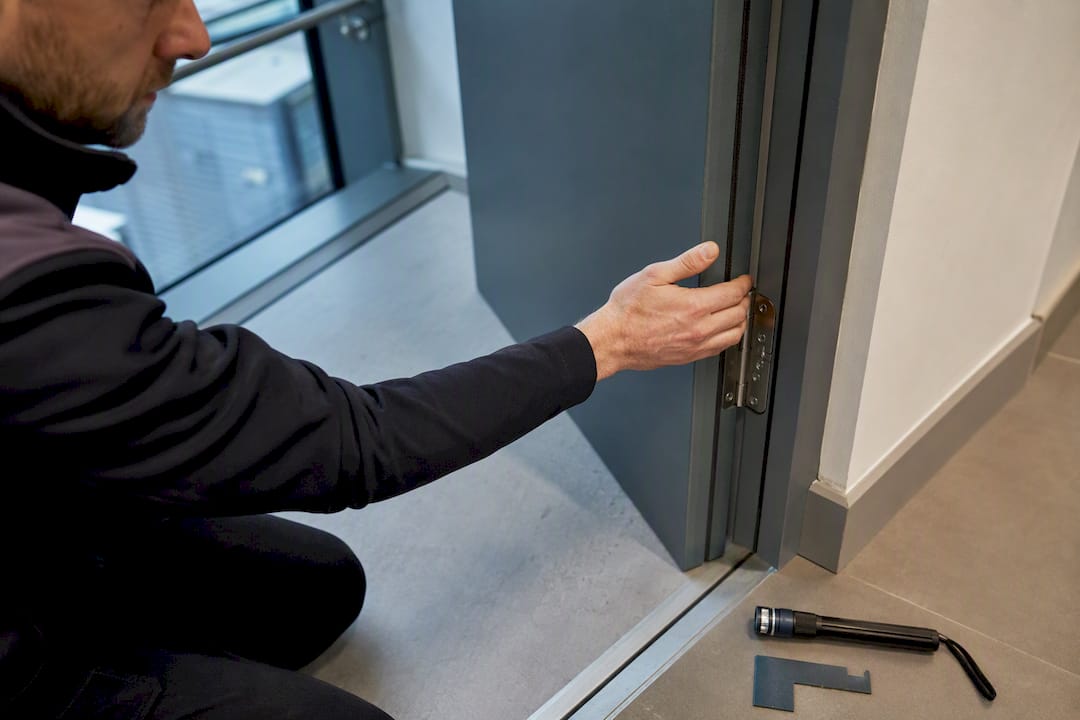
There’s a gap between what most fire risk assessment guidance promises and what actually holds up when an inspector starts asking questions. The guidance says “document evidence for every rating.” What that means in practice is standing in front of a fire door, testing it, photographing the gap where the intumescent strip has perished, and writing down exactly what you saw rather than reaching for a stock phrase from a template.
CityPat’s engineers see this gap most often in the “not inspected” gaps that get quietly dropped rather than recorded. A locked electrical cupboard skipped during a site visit and never mentioned again in the final report is a far bigger liability than the same cupboard listed honestly as an outstanding item with a follow-up date. One recurring pattern from routine testing work: a fire alarm panel showing a fault log going back months, never flagged because nobody had checked it since installation. Recorded properly, that single finding became a same-day action item with a named engineer and a fixed deadline, rather than sitting buried in a maintenance folder nobody opened.
The uncomfortable truth is that most PAS 79 reports fail not because the assessor lacked knowledge, but because the writing was rushed and the evidence trail was thin.
— Gemma
How CityPat supports your PAS 79 fire risk assessment
A practical route to a PAS 79-structured report for businesses, landlords and property managers is to appoint a competent assessor rather than build one in-house from a blank template. Qualified engineers carry out the site visit, work through the full PAS 79 section structure with photographic evidence at every finding, and provide a prioritised action plan with named owners, deadlines and a review date.
Because fire safety compliance rarely stops at the FRA itself, CityPat also covers the emergency lighting testing and fire alarm servicing records your report will reference in the protection measures section, plus EICR and fixed wire testing and PAT testing where electrical safety findings overlap with fire risk. If your current report is missing a scope statement, an action plan, or a review date, don’t wait for an inspection to expose it. Get a free quote for a site visit and find out what a properly documented, PAS 79-structured assessment actually costs for your premises.
Sources
- Gov
- Proforma templates contained within PAS 79-1 and PAS 79-2 are now freely available for download from the FIA website — Fire Industry Association
- Fire Risk Assessment Practice Guide Part 1 — IFSM (31 Dec 2025)
- London Fire Brigade — Fire safety law explained
FAQ
Is PAS 79 still valid?
Yes, PAS 79-1:2020 remains the current code of practice for fire risk assessments of premises other than housing. For housing, it has been superseded by BS 9792:2025, so check which standard applies to your premises type before relying on an older PAS 79-2 report.
What is PAS 79 fire risk assessment?
PAS 79 is a British Standards Institution code of practice that structures a fire risk assessment into ten sections, from premises description through to conclusions, with model pro forma provided in the annexes. It’s a recognised methodology rather than a legal requirement itself.
What is the legal requirement for fire risk assessments in the UK?
The Regulatory Reform (Fire Safety) Order 2005 requires every Responsible Person in England to carry out and maintain a suitable and sufficient fire risk assessment for non-domestic premises, with a written record required under GOV.UK guidance.
Which standard applies to housing premises?
Housing fire risk assessments should now follow BS 9792:2025, which replaced PAS 79-2:2020. Mixed-use buildings need a dual approach, PAS 79-1 for commercial areas and BS 9792 for residential areas, stated clearly in the report’s scope.