
Most businesses in England pay between £1 and £3 per appliance for PAT testing, but almost every small job gets swallowed by a minimum call-out charge of £40 to £90, higher again in London and the South East. If you’re testing fewer than 20 or 30 items, that visit fee is the number that matters, not the per-item rate on a website. Ask any supplier for one fixed total price before booking, and only consider training staff in-house if you’re testing appliances regularly enough to justify it.
TL;DR:
- Small jobs typically incur minimum call-out fees of £40 to £90, which often dominate the total cost for fewer than 20 appliances.
- Per-item prices decrease significantly as volume increases, with rates falling below £1.50 per appliance beyond 250 units, but minimum charges remain the main factor for small sites.
- Regional differences matter, as London and the South East often charge 15% to 30% more due to higher labour and travel costs.
- Bundling PAT testing with other compliance services like EICR can reduce overall costs by combining call-out fees into one visit.
- Hiring in-house staff for PAT testing only makes financial sense for businesses with very high, predictable testing volumes and available staff capacity.
Table of Contents
- PAT testing cost per item: prices, minimums and regional differences
- How PAT testers calculate a quote: the cost drivers you must check
- Worked examples and the simple calculator rule-of-thumb
- How to reduce costs: bundling, preparation and contract options
- Who can carry out PAT testing and which qualifications matter
- Hire or train: Citypat’s practical view on when in-house testing pays
- How to get an accurate, comparable quote: checklist and script
- Author perspective and recommendation for budgeting in England
- Citypat: how we help and where to get a quote
- Sources
- FAQ
PAT testing cost per item: prices, minimums and regional differences
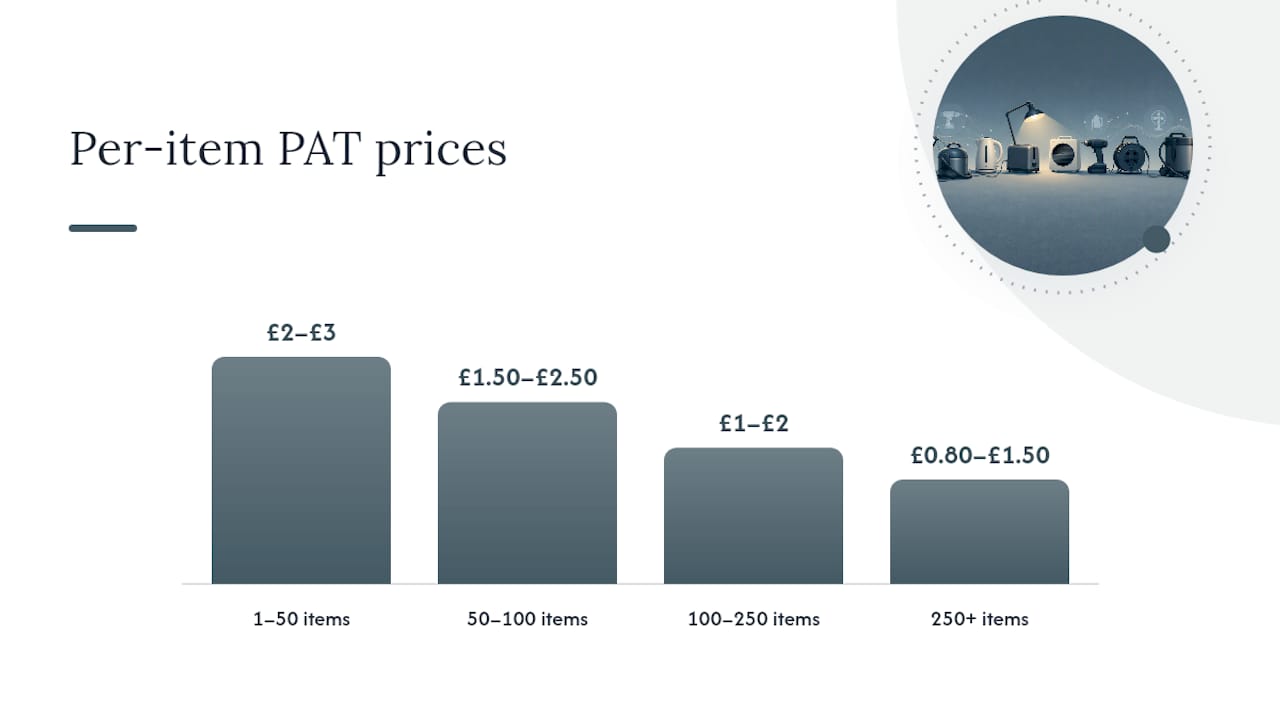
Per-item pricing drops sharply as volume rises, which catches out a lot of first-time buyers who quote themselves off a headline rate meant for large sites. Market guides put small-batch testing (1 to 50 items) at roughly £2 to £3 per appliance, dropping to £1.50 to £2.50 for 50 to 100 items, £1 to £2 for 100 to 250 items, and as low as £0.80 to £1.50 once you’re past 250, according to Elec-Mate’s pricing guide. Above roughly 250 units, many testers move to a day rate instead of counting items individually.
None of that matters much for a small site, because the minimum charge usually decides the bill. Total Skills UK puts typical call-out fees at £40 to £90, with London and the South East sitting at the top of that band or above it. A landlord testing fewer than 20 or so items typically pays the minimum call-out fee rather than a per-item cost multiplied by number of items.
Here’s how that plays out across common property types:
| Premises type | Typical item count | Expected total cost |
|---|---|---|
| Small flat or single let | 15 to 20 items | £40-£90 (minimum fee dominates) |
| Three-bedroom rental house | 20–30 items | £50-£100 |
| Small office | 50–100 items | £50 to £90 minimum charge |
| Retail unit | 50 to 100 items | £40 to £90 minimum charge |
| Large office or multi-floor site | 250+ items | £300 to £400 total |
VAT is added on top of all these figures if the supplier is VAT-registered, so always ask whether a quoted price is inclusive. A standard visit typically covers a pass/fail test, appliance labelling and a basic PDF report, according to Fantastic Services, but a proper digital asset register or ongoing compliance tracking usually costs extra. If your quote doesn’t mention what’s included, that’s the first question to ask.
How PAT testers calculate a quote: the cost drivers you must check
A PAT testing quote isn’t just “items times price.” Testers build a figure from several moving parts, and understanding them helps you spot a fair quote from a padded one, or a suspiciously cheap one that’s cutting corners.
- Labour rate and throughput: an experienced tester covers around 100 to 150 items a day on a typical mixed office site, according to Total Skills UK, though industrial or awkward-access sites slow that down considerably.
- Travel and call-out: rural sites, multiple floors, or restricted parking all add time before a single appliance gets tested.
- Appliance type and access: three-pin plug items test quickly, but three-phase or industrial kit needs specialist equipment and takes longer per unit.
- Reporting detail: a basic pass/fail log costs less than a full digital asset register with photographs and serial-number tracking.
- Repairs and replacements: fixing a failed plug or cable on the spot is often billed separately from the testing fee itself.
- Minimum thresholds and surcharges: many testers set a minimum item count (often 25 to 30) before per-item rates apply, and out-of-hours or weekend visits usually carry a premium.
Pro Tip: Never accept a per-item rate alone. Ask for the total visit price in writing, including the minimum charge, VAT and any travel cost, before you compare two suppliers side by side.
Proof of competence matters just as much as price. Ask what qualification the tester holds and whether they carry liability insurance, since a rock-bottom quote with no paperwork to back it up usually means corners are being cut somewhere.
Worked examples and the simple calculator rule-of-thumb
A rough formula does most of the work here: total cost = the higher of (minimum charge) or (per-item rate × number of items), plus any extras and VAT. This mirrors the logic behind the PAT testing cost calculator on MyJobQuote, and it’s worth running before you ring anyone for a quote.
Three scenarios show how this plays out in practice:
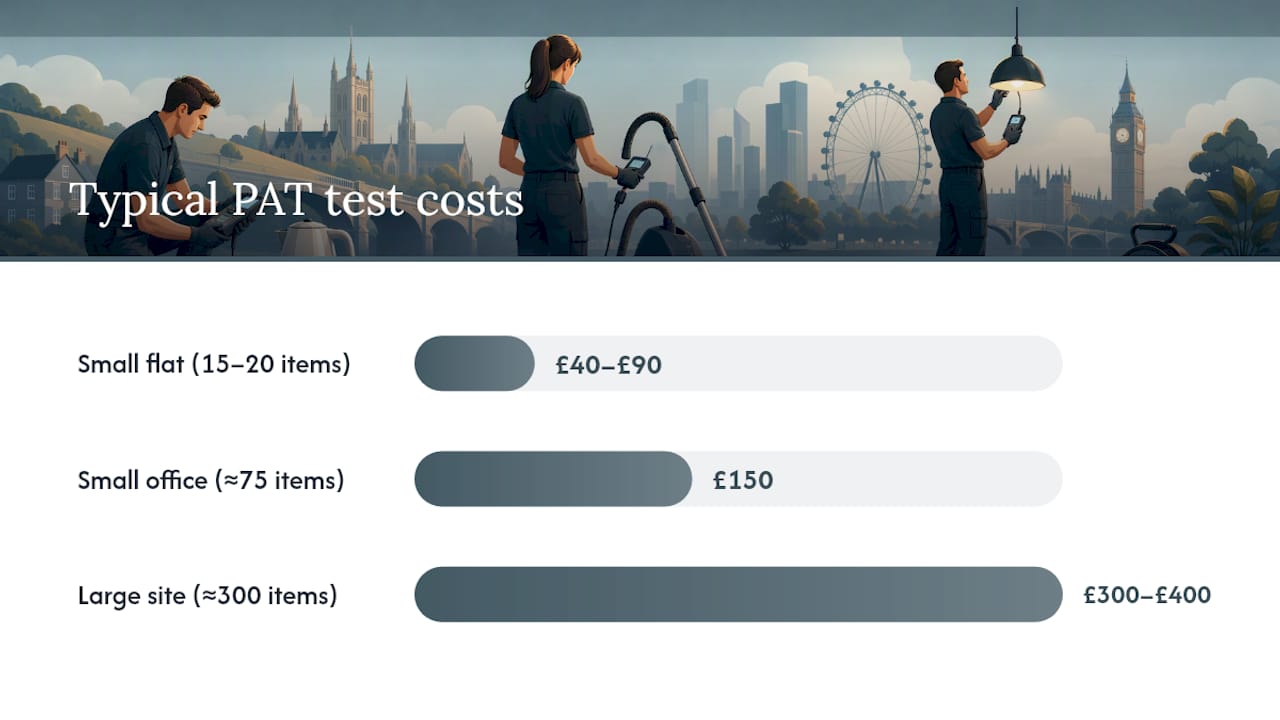
- Small flat, 15 to 20 items. At £2.50 per item, 20 items would come to £50, but the £40 to £90 minimum charge takes over instead. Expect to pay close to the flat call-out fee regardless of how few items you have.
- Small office, 50 to 100 items. At an average of £2 per item, 75 items lands around £150, comfortably above the minimum, so the per-item rate now genuinely drives the price.
- Large site, 250-plus items. Per-item rates fall to roughly £0.80 to £1.50, or the tester quotes a day rate instead. A 300-item office might land between £300 and £400 total, far below what a naive per-item calculation would suggest.
Add a regional adjustment on top of all three. Providers in London and the South East typically charge 15% to 30% more than those in the North, according to Elec-Mate, largely because of higher labour and travel costs in those areas. A Manchester or Cheshire business quoting the same job as a London office should expect a noticeably lower final figure.
How to reduce costs: bundling, preparation and contract options
The single biggest lever most businesses ignore is bundling. Combining PAT testing with an EICR or fixed wire inspection means one call-out fee instead of two, and suppliers often quote a better blended rate for the combined visit.
A few other practical moves cut costs without cutting corners:
- Schedule during normal working hours. Out-of-hours and weekend visits carry a surcharge that’s entirely avoidable for most offices.
- Prepare appliances beforehand. Group items by location, clear access to plug sockets, and have an existing asset list ready so the tester isn’t hunting for kit.
- Sign an annual or multi-site contract. Recurring clients typically unlock a lower per-item rate than one-off bookings, since the supplier can plan routes and staffing in advance.
- Clarify deliverables up front. Confirm whether labelling, a PDF report and a basic asset register are included, or billed as extras.
- Decide on repairs in advance. Ask whether minor fixes (a new plug, a re-terminated cable) are covered in the visit fee or charged item by item.
Pro Tip: If you manage more than one site, ask for a single annual contract covering all of them. Coordinated scheduling across locations often reduces the effective per-item rate more than negotiating on any single visit.
Who can carry out PAT testing and which qualifications matter
There’s no single law that mandates PAT testing by name. The HSE is explicit that employers must ensure electrical equipment is safe, but it doesn’t prescribe one fixed testing regime, PAT is simply the recognised, practical way most businesses meet that duty. The HSE’s HSR25 guidance backs this up with wider safety context for electrical risk management.
That flexibility means competence, not a specific job title, is what actually matters. The most widely recognised qualification is the City & Guilds 2377-77 PAT testing course, and it’s what most professional testers and increasingly many in-house staff hold.
- A trained in-house employee can legally test appliances once competent, but they need the right tester equipment and time allocated to do it properly.
- A contracted electrician or dedicated PAT firm brings consistent reporting, insurance cover and, usually, faster throughput on larger sites.
- Liability sits with whoever signs off the test, so check insurance cover either way.
- Red flags to walk away from: no written report, no evidence of training or qualification, and a price so low it doesn’t cover a proper minimum visit.
Hire or train: Citypat’s practical view on when in-house testing pays
Training a staff member on the City & Guilds 2377-77 course typically costs £260 to £350, according to Total Skills UK, plus a tester unit and labelling printer running £500 to £1,000, per Elec-Mate. Run that against contracting out, and a business testing a few hundred items once a year rarely breaks even on training within two years. A business testing thousands of items across multiple sites, with staff time genuinely spare, might.
The maths only works in your favour if testing volume is high and predictable. Most businesses we speak to underestimate the ongoing cost of staff time, equipment upkeep and keeping certification current, and overestimate how much a single annual visit actually costs them.
Contracting keeps things simple in ways training rarely matches: one point of liability, consistent report formatting across every site, and no need to schedule around a staff member’s other duties, especially when using specialized electrical estimating and bid software designed for professional contractors. For single-site landlords and most small offices, an external PAT testing visit usually wins on cost and hassle. For large multi-site operators with steady, high-volume testing needs, training in-house staff can pay off, provided someone actually has the spare capacity to do it properly.
How to get an accurate, comparable quote: checklist and script
Before you contact anyone, write down the number of appliances, site access details (parking, floors, restricted areas), and what deliverables you want (labels, PDF report, asset register).
Then ask each supplier the same set of questions:
- What’s your minimum call-out charge, and does it apply to my job?
- What’s the per-item rate once I’m above your minimum threshold?
- Is VAT included in that figure?
- What’s included in the report, and can I see a sample?
- Can you confirm your qualification and current liability insurance?
- What’s the single fixed total price for this job, including travel?
A short script covers it: “I need roughly [number] appliances tested at [postcode]. Can you give me one fixed total price including VAT, travel and a sample report, along with proof of your qualification and insurance?” Any supplier hesitant to answer that plainly is worth avoiding.
Author perspective and recommendation for budgeting in England
Get fixed-visit quotes, not per-item estimates, and lock in an annual contract if testing recurs. Run the calculator rule before you ring anyone: it stops you being surprised by a minimum fee. Coordinated PAT, EICR and fire safety scheduling suits businesses juggling more than one compliance deadline.
— Gemma
Citypat: how we help and where to get a quote
Citypat is the alternative to juggling separate contractors for every compliance deadline. Instead of booking one firm for PAT testing, another for your EICR, and a third for fire alarm checks, Citypat coordinates PAT testing, EICR and fixed wire testing, emergency lighting checks and fire alarm testing through a single scheduling process, with paperwork clear enough to satisfy insurers and inspectors alike.
That matters most for landlords and facilities managers running multiple sites, where a missed test date on one property can quietly become a compliance gap you don’t spot until an insurance claim gets questioned. Nationwide scheduling means one point of contact rather than five separate suppliers with five separate renewal dates to track. If you’re weighing up costs from this guide against your own site, request a free, no-obligation quote and get a fixed total price to compare against whatever else you’ve been quoted.
Sources
- HSE: Portable appliance testing (PAT) – frequently asked questions
- PAT Testing Cost UK: Price Per Item & What to Expect (2026) | Total Skills UK
- How Much Does PAT Testing Cost in 2026? | UK Guide
FAQ
Can I do my own PAT testing in the UK?
Yes, there’s no law requiring a specific qualification, but the HSE expects whoever tests equipment to be genuinely competent. Most businesses train a staff member on the City & Guilds 2377-77 course rather than relying on untrained testing, since liability sits with whoever signs off the result.
What are the estimated costs of PAT testing in 2026?
Expect £1 to £3 per appliance depending on volume, with a minimum call-out fee of £40 to £90 that usually decides the bill for small jobs, according to Total Skills UK. London and the South East typically sit at the higher end of that range.
Is there a shortage of PAT testers in the UK?
Demand for competent testers has grown alongside tighter compliance expectations from insurers and landlords, which is part of why many businesses now weigh training staff in-house against contracting out. Booking ahead, especially around annual renewal periods, tends to secure better availability and pricing than last-minute requests.
Can any electrician do a PAT test?
A qualified electrician has the underlying electrical knowledge to test appliances competently, but PAT testing itself is a distinct skill built around the City & Guilds 2377-77 course rather than automatically included in a standard electrician’s qualification. Always ask a contractor directly whether they hold this specific certification before booking.