
In England, no law tells an ordinary employer to keep PAT testing records or to label tested appliances. HSE says so plainly. But the law does require you to keep electrical equipment from causing danger, and a clear, item-level record is the easiest way to show you are doing that. Landlords face a different set of paperwork, and it is easy to mix the two up.
This guide explains what the rules say, what a record worth keeping looks like, how long to hold it, and where certificates, registers and installation reports differ.
TL;DR
- HSE states there is no legal requirement to keep PAT records or label equipment, but records help show your maintenance scheme exists and works.
- HSE advises keeping inspection results at least until the next inspection of that equipment. Electronic records are acceptable if held securely.
- A useful record is item-level: asset ID, description, location, date, result, tester, action taken and next review date.
- An EICR covers fixed installations. It is not proof that portable appliances were tested, so keep the two documents separate.
- Scotland is stricter for landlords: a prescribed record, kept for six years. Do not apply that rule to England.
Table of Contents
- What the law says about PAT records in England
- What a useful PAT record contains
- How long to keep PAT records
- Landlords: different documents for different jobs
- Build a record system that stands up to questions
- Who needs the strongest records
- Planning around availability and cost
- Our view: records should make decisions easier
- Let us keep the paperwork straight
- FAQ
- Sources
What the law says about PAT records in England
The starting point is the difference between a duty and a method. The duty is to maintain electrical equipment so that it does not create danger. PAT is one way of meeting that duty, not the duty itself.
HSE’s own answer on the point: there is no legal requirement to label tested equipment or to keep records of testing. It adds that records and labels can show a maintenance scheme exists, and help you monitor and review it.
HSE’s wider guidance on work equipment goes a step further. It says you should inspect equipment in line with a risk assessment, that the result should be recorded, and that the record should be kept at least until the next inspection. Records do not have to be on paper. Read together, the position is this:
- No statute says “you must hold a PAT certificate”.
- HSE strongly points you towards recording inspection results.
- If something goes wrong, the person asking questions (an inspector, an insurer, a solicitor) will want evidence that your system was suitable and followed.
That last point is where records earn their keep. A business with no paperwork can be fully compliant in theory and still struggle to prove it. If you want the wider picture on frequency, our guide to PAT testing regulations in England explains why there is no fixed annual rule.
A certificate is not the same as a record
Many people say “PAT records” and mean the certificate handed over after a visit. A certificate is a summary: it confirms testing was done on a date and by whom. A record, in the sense HSE means, is the underlying list of what was inspected and what happened to each item.
HSE also notes that a quick pre-use check does not normally need a formal entry. The record should be proportionate to the risk. Nobody needs a log entry every time someone glances at a kettle lead. They do need one when a formal inspection or test takes place, and when something is found wrong.
What a useful PAT record contains
HSE does not prescribe a form, so you can design one that suits your premises. What matters is that you can trace any item from the day it was tested to the day it was repaired or removed. A record that does that will usually hold:
| Field | Why it matters |
|---|---|
| Asset ID or barcode | Links the entry to the physical item and its label, if you use one |
| Description and serial number (where available) | Tells similar items apart, for example 14 identical extension leads |
| Location or department | Lets you find the item and spot problem areas |
| Visual inspection result | Many faults are found by eye, so the record should show this stage happened |
| Electrical test result | The measured outcome, where a test was appropriate |
| Date of inspection or test | Starts the clock for your review interval |
| Pass, fail or action | The outcome in plain terms |
| Tester or competent person | Shows who made the judgement |
| Remedial action | Repaired, replaced or withdrawn, and when |
| Next review date, if one is set | Supports planning rather than panic |
This is the field list we would expect from a well-run register. It is our practical reading of HSE’s expectations, not a government template.
Failed items need their own trail
The weakest records are the ones that say “pass” for everything. A record should show what happened to an item that failed: taken out of use, repaired by a competent person, retested, or binned. HSE’s advice is to remove damaged plugs, cables, burn-marked equipment or exposed wires from service straight away and have them repaired by someone competent. If your register shows a fail with no follow-up, a reader will assume the item went back into use.
How long to keep PAT records
HSE’s wording sets the minimum: keep the result at least until the next inspection of that equipment. In practice most organisations keep at least the previous cycle as well, so they can show a history, such as an appliance that fails repeatedly or a department where damage is common.
Two points are worth settling in your own policy:
- Format. HSE says records need not be written down, and electronic records are acceptable if held securely and available to an enforcing authority when asked. Whatever you choose, test that you can produce it quickly.
- Retention beyond the minimum. Insurers and legal advisers may want longer. Where you can store a record cheaply, keeping it longer costs little.
If you already use a simple online tool for business paperwork, the principle is the same one used for tax records: keep them organised, searchable and exportable. A guide to how long sole traders should store records and what to retain shows the same habit applied to Self Assessment, and it carries over neatly to an inspection register.
Spreadsheet or software?
For a small business, a searchable spreadsheet or a secure cloud register can be perfectly defensible. HSE advises tailoring checklists to the equipment and keeping the burden to what safety needs. What the register must do is keep its history. Overwriting last year’s result with this year’s removes the very evidence you are trying to build. Lock the file, back it up and record who may edit it.
Larger operators with many sites tend to need barcode-driven systems because the number of assets makes manual lists unworkable. The test is the same: can you produce a clean history for any item within minutes?
Landlords: different documents for different jobs
This is where generic advice goes wrong. Landlords hold at least two kinds of electrical paperwork, and they answer different questions.
Fixed installations: the EICR
In England, GOV.UK guidance on electrical safety standards (published 1 November 2025) says private landlords must have the electrical installations in their properties inspected and tested by a qualified person at least every five years. The landlord must obtain a report and provide a copy to tenants, and to the council if it asks.
That report is an installation document. It covers wiring, consumer unit and fixed parts of the system. It does not tell you whether the toaster, the lamp or the landlord-supplied fridge was checked.
Portable appliances in lets
The same guidance does not create a universal PAT-at-fixed-intervals rule for every private landlord. It does describe a separate record, the ISIT record, for electrical equipment provided by social landlords. For private landlords who supply appliances, the sensible approach is a risk-based check regime with a simple record behind it. If you let HMOs, your licence conditions may set the schedule, which we cover in our guide to HMO PAT testing in England.
The mistake to avoid is treating an EICR as proof that portable appliances were tested. File them separately, label them clearly and keep both where you can find them.
If you also have property in Scotland
Scotland has a statutory regime for private landlords. Under the Housing (Scotland) Act 2006, as amended, the person carrying out the inspection must prepare a record of it. Scottish law requires inspections at intervals of no more than five years, and the landlord must supply the latest record before a tenancy starts and later inspection records during it. Our research shows the prescribed record covers the date, property, inspector and qualifications, items inspected, defects and remedial action, and that the landlord must retain it for six years.
Those duties apply in Scotland. Do not copy them across to a property in England, and do not assume a generic UK certificate meets the Scottish format. If you hold stock in both nations, keep the records in separate folders.
Build a record system that stands up to questions
Here is a workable sequence for an English business that wants a defensible, low-cost record.
- List your equipment. Walk the premises and record every portable item, including those staff bring in and those hired or leased.
- Group by risk. HSE says to consider the type of equipment and how it is used when setting intervals. Items that are moved often, used heavily or sit in wet or dusty places deserve more attention than a rarely moved desktop device.
- Set an inspection approach for each group. This might be user checks, formal visual inspection, or inspection plus electrical testing, at intervals your risk assessment can justify.
- Assign IDs. Barcodes, labels or a simple numbering scheme all work. Labels are not a legal requirement, but they make the register usable.
- Record each inspection. Use the fields in the table above, including failed items and what happened next.
- Tell staff how to report faults. A record is only as good as the information reaching it. If users report a damaged lead, the log should show the report and the response.
- Review the pattern. If the same item type keeps failing, change the intervals or replace the equipment.
What an old certificate cannot do
HSE’s message is that PAT is a means, not the legal objective. A business can be compliant without annual PAT, but it cannot defend itself simply by holding an out-of-date certificate if users have reported faults or the risk assessment no longer fits. The record supports the system. It does not replace it.
Who needs the strongest records
Not every organisation faces the same level of scrutiny. These are the cases where we see records matter most:
- Retail chains and multi-site operators. Many sites, many staff changes and many contractors. A central register that shows each site’s status is far more useful than a folder of PDFs.
- Landlords with furnished lets or HMOs. Tenants, councils and insurers may ask for evidence, and licence terms can add their own expectations.
- Workplaces with hire-in or heavy-use equipment. Tools that move around sites or sit in harsh conditions fail more often and cause more serious injuries when they do.
- Businesses that have had an incident or insurance query. After a claim, evidence of a working system is what you want to hand over.
Planning around availability and cost
Two practical matters often catch people out.
Cost. The Portable Appliance Testing Trade Association’s 21 May 2024 estimate puts the UK market at roughly 50p to £4 per item, with an average around £1.20. Per-item figures mislead for small jobs, though, because low-volume work usually attracts a call-out or minimum charge, and site access, travel and how densely items sit all change the effective price. Ask for a quote that states how items are counted and what the record includes. Our own services have no published price, so we quote after hearing what you have.
Availability. A 20 March 2025 industry survey by ECA with BESA, SELECT and SNIPEF found 37% of respondents reporting a significant shortage of qualified electricians. That is a figure about electricians generally, not PAT testers specifically, and we would not claim otherwise. It does suggest booking early for multi-site programmes. A live register that shows which items are due lets you book by risk and expiry, not only when a label is about to lapse.
Our view: records should make decisions easier
We test equipment for businesses and landlords, and the pattern we see is consistent. The sites with trouble are rarely the ones with no paperwork at all. They are the ones with paperwork that cannot answer a simple question: which items failed, and what was done?
Our view is that a PAT record should do three jobs. It should prove that someone looked, it should show what they found, and it should tell the next person what to do and when. Anything beyond that is decoration.
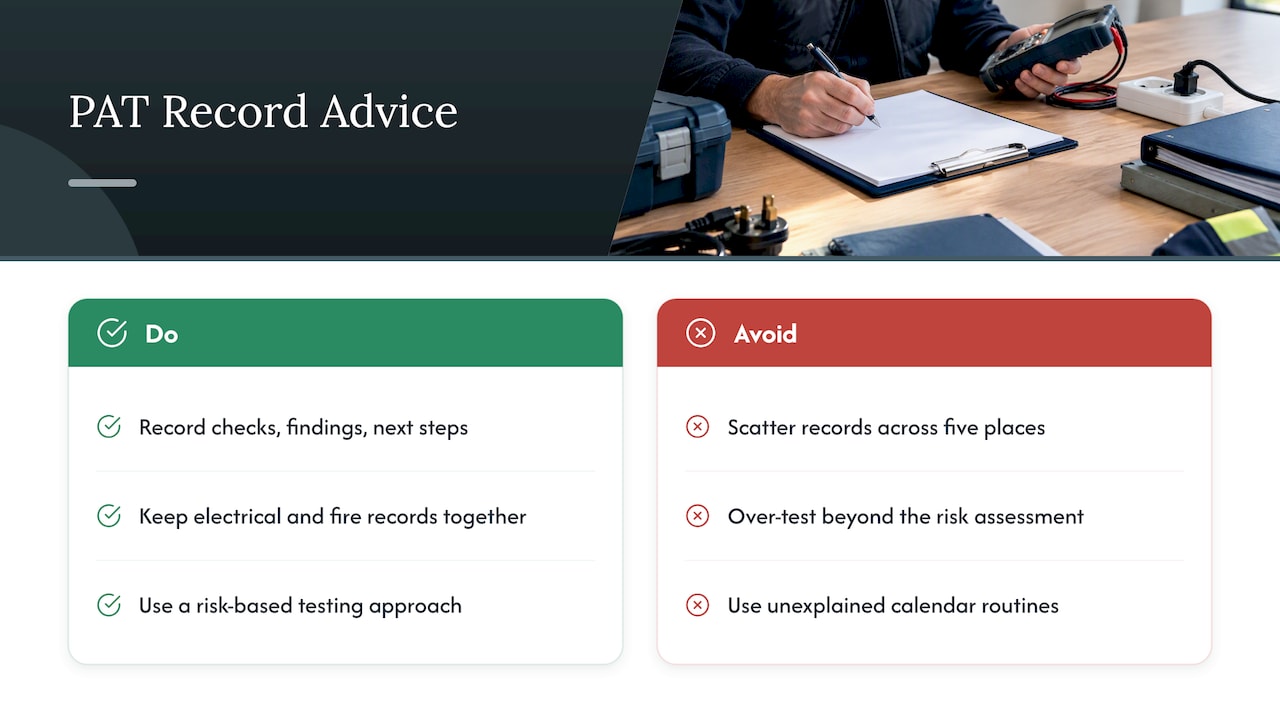
We also think electrical and fire paperwork should live together. A site that has PAT results, an EICR, emergency lighting test sheets, fire alarm logs and a fire risk assessment in five different places will miss something. Coordinating those services through one provider, with clear documentation and a schedule that avoids missed dates, is how we try to keep clients out of that position. For multi-site clients, the same layout at every site means a manager can compare locations at a glance.
And we say this to every customer: do not buy more testing than your risk assessment needs. A well-reasoned, recorded, risk-based approach beats a calendar routine nobody can explain.
— Gemma
Let us keep the paperwork straight
If you would rather not build the register yourself, our PAT testing service covers on-site inspection and testing with clear documentation for your files. Where your premises also need fixed-wire checks, our EICR and fixed wire testing keeps installation reports separate from appliance records. We work across the UK, including from our base in Greater Manchester, and we can arrange single-site or multi-site schedules. Tell us what you have and we will quote.
FAQ
Do I legally have to keep PAT testing records in England?
No. HSE says there is no legal requirement to keep records of testing or to label tested equipment. The legal duty is to maintain electrical equipment to prevent danger. Records are the practical evidence that you do so, and HSE says they help you monitor and review your scheme.
How long should I keep PAT test results?
HSE advises keeping the result at least until the next inspection of that equipment. Many businesses keep the previous cycle too, so they can see trends. Electronic records are fine if they are secure and you can produce them when an enforcing authority asks.
Is an EICR the same as a PAT record?
No. An EICR reports on fixed electrical installations, and English landlords must have one at least every five years. It does not show that portable appliances were checked. Keep the two documents separate and label them clearly.
Do the Scottish record rules apply in England?
No. Scottish private landlords must keep a prescribed inspection record and provide records to tenants, with a six-year retention duty set out in the legislation. English employers and landlords follow HSE guidance and the GOV.UK regime. If you own property in both countries, keep separate files for each.
Sources
- HSE: PAT, answers to popular questions
- HSE: Inspection of work equipment
- HSE: Introduction to electrical safety
- GOV.UK: Electrical safety standards in the private and social rented sectors
- Housing (Scotland) Act 2006, section 19B
- Housing (Scotland) Act 2014, section 23
- PATTA: How much to charge per item
- ECA: Industry survey, March 2025