
For most occupied homes, a modern wireless alarm is the better choice because it installs in a day with no mess and today’s supervised radio systems are reliable enough for everyday use. Wired systems still make sense for new builds, larger or commercial premises, and situations where a landlord or local standard specifically calls for a mains-wired setup. The rest of this guide unpacks why, with a practical checklist by property type.
TL;DR:
- Wireless alarm systems are ideal for occupied homes due to quick installation, easy relocation, and reliable supervised radio signaling to detect faults.
- Wired systems provide stronger resilience in larger or multi-occupancy buildings, with interlinked detectors powered by mains and backed by rechargeable batteries.
- Installation costs and disruption are significantly lower for wireless systems in occupied properties, while wired systems are more cost-effective during new builds or major renovations.
- Opting for a system depends on property type, occupancy, and landlord requirements, with professional inspections recommended to verify compliance and system integrity.
Table of Contents
- How wireless alarm systems work
- How wired mains alarm systems work
- Installation: disruption, timelines and cost drivers
- Reliability, failure modes and resilience
- Long-term costs and maintenance
- Which system suits which property: a decision checklist
- Regulations, standards and landlord considerations
- Smart home integration and monitoring options
- Expert note from City Appliance Testing on testing and compliance
- A concise, risk-based recommendation
- How CityPat can help with alarm compliance
- FAQ
- Sources
How wireless alarm systems work
Wireless alarms run on batteries rather than household electrics, which is what makes them quick to fit and easy to move. Most professional kits use tamper-proof, long-life lithium cells that last several years, though some cheaper sensors still take replaceable batteries with shorter lifespans. Detectors talk to a central panel over a radio link (often called radiolink), while the panel itself may connect to Wi-Fi or the cloud for app alerts and remote monitoring.
A properly specified system includes:
- Sensors and detectors: door and window contacts, motion sensors, smoke or heat detectors depending on the kit.
- A control panel: the hub that manages sensors and triggers the siren or alert.
- A siren: internal, external, or both.
- Optional monitoring: a link to a monitoring centre or a self-monitoring app.
Jamming is a genuine, if often overstated, risk; for enhanced protection, consider specialized visitor management for data centres that incorporate robust access control and monitoring systems. Reputable systems counter it with supervised signalling, sometimes called a ‘heartbeat’ check, where the panel confirms each sensor is still reporting in. Dual-path signalling, which backs up radio with a second communication route, reduces the chance of a silent failure going unnoticed.
How wired mains alarm systems work
Wired systems draw power from the mains, usually with a rechargeable battery back-up so they keep working through a power cut. In UK guidance, a dedicated supply (sometimes called a dedicated landlord supply) is often specified so the alarm circuit cannot be switched off accidentally by a tenant or isolated with another circuit.
Detectors, typically optical smoke detectors in hallways and living areas and heat detectors in kitchens, are hardwired together so that one triggering sounds every unit in the property. This interlinking is what gives a whole-house evacuation warning rather than a single beeping box.
- Mains plus battery back-up: keeps the system live if the power fails.
- Hardwired interlinking: every detector sounds together, wherever the fire starts.
- Professional installation: wiring work should meet BS 7671 wiring regulations, carried out by a qualified electrician.
- Hybrid option: mains-powered detectors interlinked by radio rather than cable, useful where rewiring an existing property is impractical.
That hybrid route, replacing detector heads with radio-link capable units on an existing mains circuit, is a recognised way to add interlinking without lifting floorboards.
Installation: disruption, timelines and cost drivers
Fitting a wired system into an occupied property usually means chasing cable into walls, lifting floorboards and patching plaster afterwards, which can take several days and leaves redecorating to do. A wireless kit, by contrast, is typically fitted in a single visit with no structural work.
- New builds and extensions: wiring during construction is straightforward and often the most cost-efficient time to fit a mains system.
- Occupied retrofits: wireless avoids the mess entirely; wired retrofits cost more in labour and making good.
- Hidden costs to budget for: a dedicated circuit or consumer unit work, electrician call-out fees, and in some flats a building warrant.
- Getting an accurate quote: ask for a fixed price covering parts, labour, making good and a test certificate, not just the hardware.
As a rough illustrative example only, say a three-bedroom retrofit needs two days of electrician time plus redecorating, against a half-day wireless install: the labour gap alone often justifies the wireless route for an occupied home.
Reliability, failure modes and resilience
Every alarm system can fail, the question is how visibly. Wireless systems depend on battery charge and radio range, so supervised signalling that flags a weak or silent sensor before it fails completely matters more than the brand of panel. Wired systems depend on mains power and a healthy back-up battery; neglecting the battery risks a power cut leaving the whole system down.
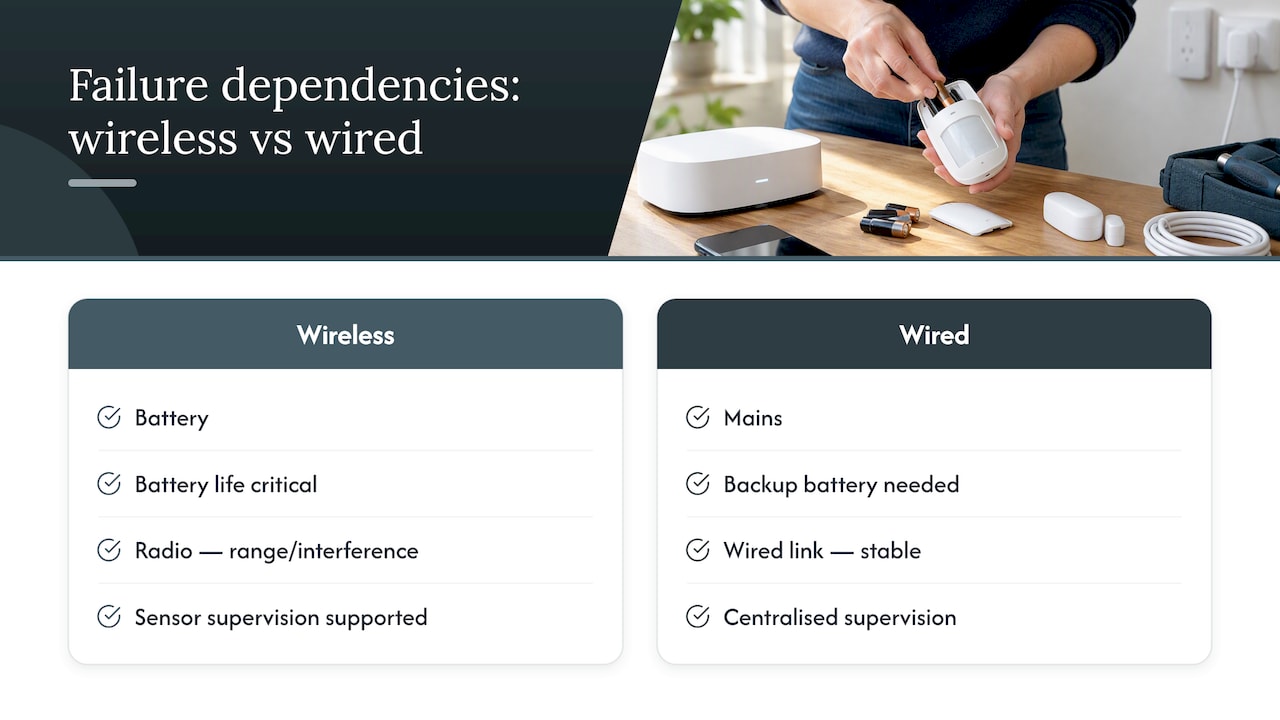
Radio interference is rare in domestic settings but not impossible near industrial equipment or in steel-framed buildings. Ask any installer how their system supervises each sensor and whether it uses a second communication path as a fallback.
Pro Tip: Ask your installer to demonstrate a simulated sensor failure during handover, so you know exactly what a fault alert looks like before you need it.
Wired systems still have an edge where uninterrupted power and simple, centralised supervision matter most, such as larger multi-occupancy buildings with a dedicated fire panel.
Long-term costs and maintenance
Running costs differ more than purchase price does. Wireless sensor batteries typically last two to five years depending on type and usage, while mains back-up batteries in wired panels are usually replaced every three to five years as part of routine servicing. Professional monitoring adds an ongoing subscription; self-monitoring through an app is cheaper but relies on you acting on the alert yourself.
- Battery replacement: budget for periodic sensor and back-up battery swaps on either system type.
- Servicing: a qualified installer or electrician should check interlinking, battery health and detector sensitivity annually.
- Monitoring: weigh a monitored contract against the lower-cost, self-managed app route.
Household uptake of alarms and other security measures has risen over time according to the latest crime statistics, reflecting growing reliance on these systems as a visible deterrent. Over a five to ten year horizon, factor in batteries, servicing visits and any subscription fees rather than just the upfront install cost.
Which system suits which property: a decision checklist
The right choice depends on your property’s fabric, who lives there, and what any landlord obligations require. An occupied terrace, a small house, a short-term let, or a standalone outbuilding all favour wireless for the lack of disruption. A new build, a larger multi-unit block, or a property where a landlord mandates a specific standard points towards wired or hybrid.
- Check your property type: new build or major renovation favours wired; occupied retrofit favours wireless.
- Check occupancy and tenancy: rented or HMO properties may have specific landlord-supply requirements.
- Ask three questions of any installer: how is the system supervised, what happens in a power cut or flat battery, and what certificate will you receive.
| Property type | Usually best fit |
|---|---|
| Occupied retrofit house | Wireless |
| New build or extension | Wired |
| Short-term let or outbuilding | Wireless |
| HMO or large shared building | Wired or mixed system |
Regulations, standards and landlord considerations
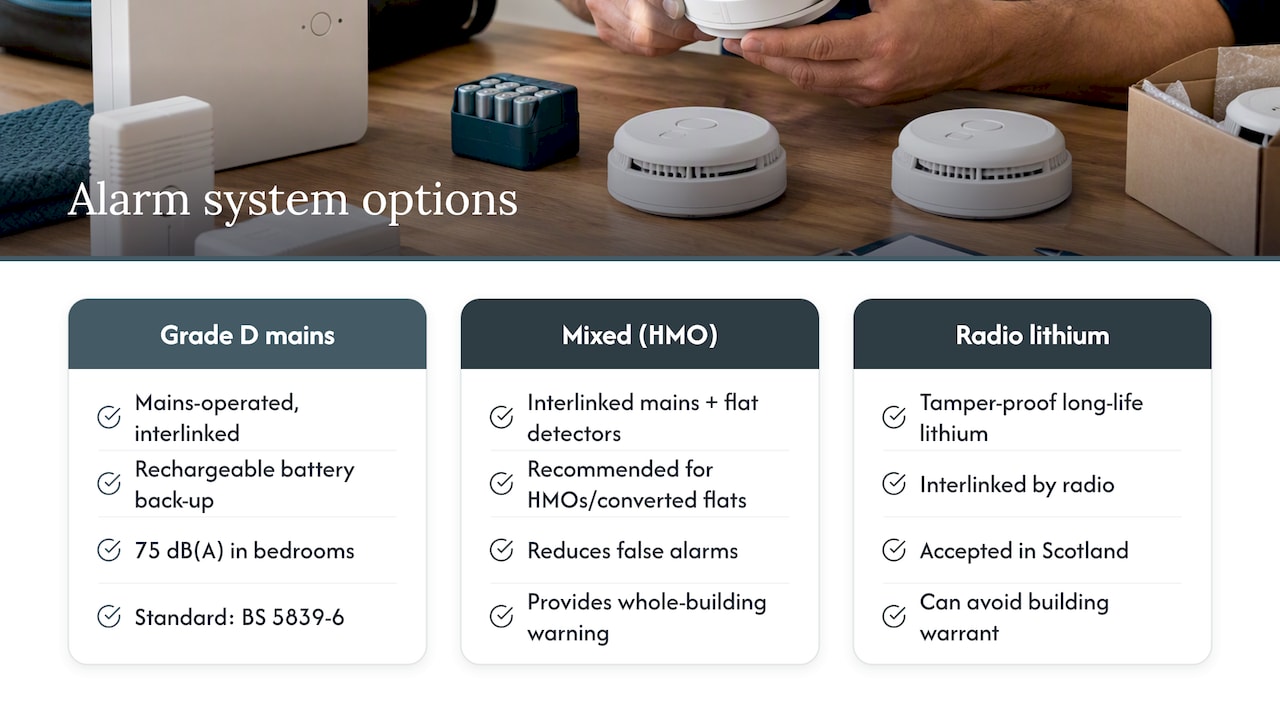
UK guidance for domestic fire alarms is set out in BS 5839-6, which describes Grade D systems as mains-operated, interlinked detectors with rechargeable battery back-up, designed to reach 75 dB(A) in bedrooms. For HMOs and converted flats, a mixed system combining an interlinked mains system with individual flat detectors is commonly recommended to reduce false alarms while still giving whole-building warning.
Separately, guidance for Scottish homes confirms that tamper-proof, long-life lithium battery alarms interlinked by radio are an accepted alternative to mains wiring in many domestic situations, and can avoid the need for a building warrant. Landlords should confirm a dedicated supply where mains systems are used and ask any installer to confirm which standard their work meets, backed by a certificate.
Smart home integration and monitoring options
Self-monitoring through an app, professional monitoring via a monitoring centre, and verified police response are three distinct tiers, and it matters which one you are actually buying. A self-monitored alert only helps if someone sees it and acts; professional monitoring adds a human checking in; verified response depends on local protocols and monitoring type.
Interoperability standards such as Zigbee, Z-Wave and Wi-Fi matter mainly if you plan to expand the system later with cameras or smart locks. Any cloud-connected system is only as secure as its account protections, so a strong, unique password and two-factor authentication are worth setting up from day one.
Expert note from City Appliance Testing on testing and compliance
We recommend mains alarm wiring is always carried out by a qualified electrician and checked against BS 7671 requirements, whichever system type you choose. Scheduled testing, not just a one-off install, is what keeps either wired or wireless alarms reliable year after year.
For landlords and property managers, combining fixed wire inspection, fire alarm testing and portable appliance testing in one schedule makes it easier to keep documentation current and avoid missed renewal dates across a portfolio.
A concise, risk-based recommendation
For most occupied homes, wireless wins on disruption and modern reliability, while wired remains the safer default for new builds, larger shared buildings and anywhere a landlord-mandated standard applies. If you are weighing the two, survey your property first, ask any installer the three questions on supervision, power cut resilience and certification, then arrange a compliant inspection before you commit. Where you need help verifying wiring or documentation, a qualified testing visit settles the question properly.
— Gemma
How CityPat can help with alarm compliance
Whichever system you choose, the wiring, supplies and documentation behind it benefit from a professional check rather than a guess. We offer the services that cover the ground an alarm decision touches: fixed wire inspection for mains circuits, fire alarm testing and certification, portable appliance testing, and fire risk assessments for the wider property.

- EICR and fixed wire testing: confirms your mains supply and wiring meet current standards.
- Fire alarm testing: checks interlinking, sounders and battery back-up are working as specified.
- Fire risk assessments: looks at the whole property, not just the alarm system.
A professional visit is scheduled around your site to minimise disruption, and you leave with clear certificates for your records. Get a free quote to arrange a visit.
FAQ
Can burglars disable wireless alarms?
Jamming wireless signals is technically possible but uncommon in practice, and professional systems counter it with supervised signalling that flags a lost connection. A system with dual-path communication, radio backed by a second route, further reduces this risk.
What are the disadvantages of a wireless alarm system?
Wireless sensors rely on batteries that need periodic replacement, typically every two to five years, and can suffer occasional radio interference near heavy machinery or in steel-framed buildings. They also generally cost more upfront per sensor than a basic wired detector, though installation is far less disruptive.
Do burglars avoid houses with alarms?
A visible alarm box acts as a deterrent, and household uptake of alarms and other security measures has risen over time alongside other protective measures. How much deterrence any single alarm provides still depends on local offending patterns and whether the alarm is monitored.
Which fire alarms does the fire brigade recommend?
Guidance points to interlinked systems, either mains-wired to BS 5839-6 Grade D or tamper-proof long-life lithium battery alarms interlinked by radio, so that every detector sounds together wherever a fire starts. The right choice depends on your property type and whether a landlord-specific standard applies.
Sources
- Specification and guidance for fire alarm systems in dwellings (BS 5839: Part 6, Grade guidance) — Bedford Borough Council (extract)
- Fire alarms in Scottish homes: guidance
- Crime in England and Wales: year ending September 2025 — ONS