
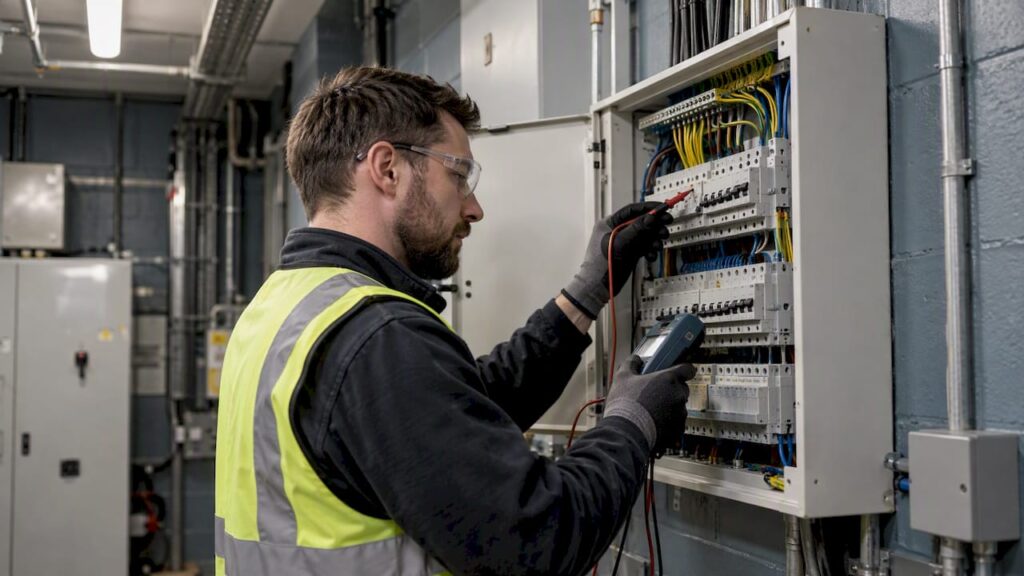
An EICR is an Electrical Installation Condition Report: a formal record of the condition of the fixed electrical wiring in a property. NICEIC describes it as a report used to confirm whether an installation is safe for continued use. If you have seen the terms “EICR”, “EICR meaning” or “fixed wire testing”, they point to the same thing. This guide explains what is checked, who needs one in England, how to read the result and what to do next.
TL;DR
- EICR stands for Electrical Installation Condition Report. It covers the fixed electrics: wiring, consumer unit, sockets, switches and protective devices.
- “Fixed wire testing” is another name for an EICR, as NICEIC confirms.
- Landlords in England and Wales must have rental properties inspected at least every five years. Employers must keep electrical systems safe.
- Results are coded C1, C2, C3 or FI. Any C1, C2 or FI makes the report unsatisfactory.
- Only a competent, registered electrician should carry out the inspection.
Table of Contents
- What an EICR actually is
- EICR and fixed wire testing: the same thing?
- What an EICR inspection covers
- Understanding the result codes
- Who needs an EICR?
- How often should you have one?
- Who can carry out an EICR?
- Why the record matters
- Perspective
- Getting an EICR booked
- FAQ
- Sources
What an EICR actually is
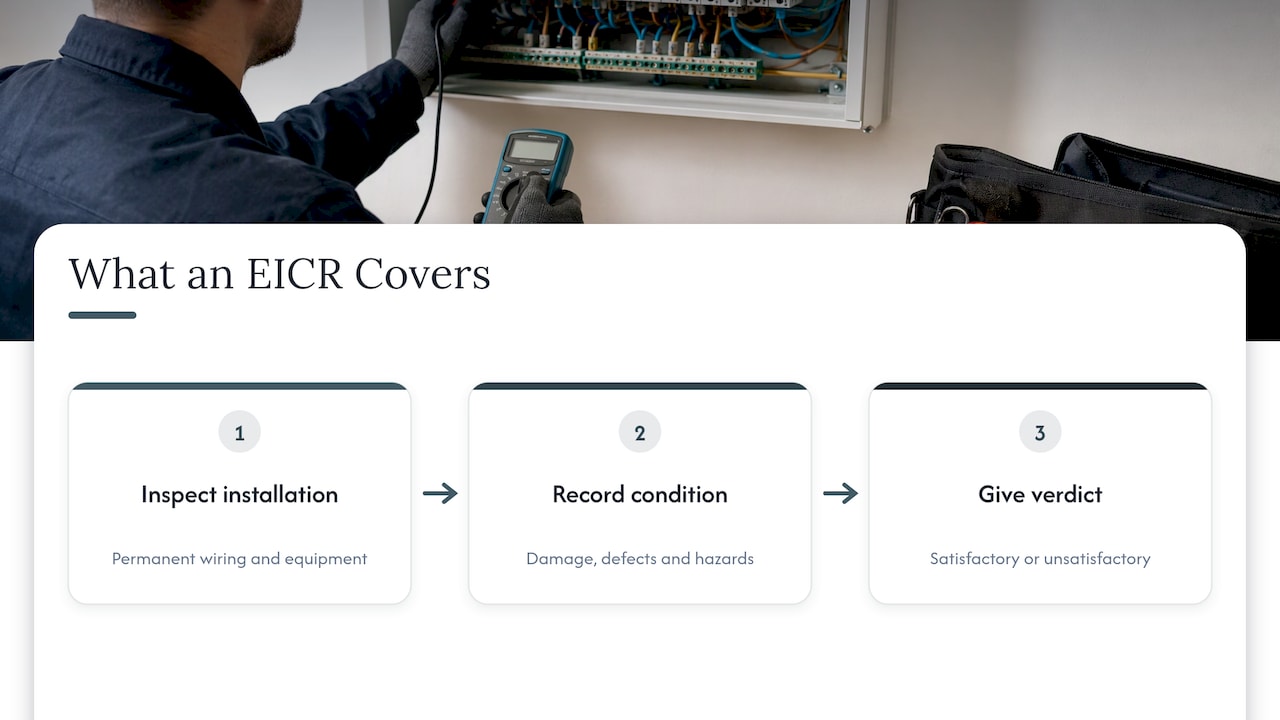
An EICR is a snapshot of how safe your electrical installation is today. The inspector examines the permanent wiring and equipment, records any damage, deterioration, defects or dangerous conditions, and gives the installation an overall verdict: satisfactory or unsatisfactory.
The report describes condition. It is not a repair quote. SELECT’s best practice guidance stresses that an EICR is a factual report on the installation, describing specific defects rather than proposing remedial work. Any repair pricing comes separately.
According to the same guidance, the purpose of periodic inspection is to find electric shock risks, fire hazards arising from defects, and wear and deterioration, and to check the installation is suitable for its use.
What EICR is not
Two confusions come up often:
- It is not PAT testing. An EICR covers the fixed installation, not portable appliances such as kettles, lamps or extension leads, as The Electrical Safety Council explains. Portable appliances are covered by PAT testing.
- It is not an EPC. An Energy Performance Certificate rates energy efficiency. An EICR rates electrical safety.
EICR and fixed wire testing: the same thing?
Yes. Fixed wire testing is the older and still widely used name for the periodic inspection and testing of a building’s permanent electrical infrastructure, and NICEIC treats it as essentially another term for an EICR. In practice, landlords and homeowners tend to say EICR, while facilities managers and commercial clients tend to say fixed wire test. The document you receive at the end is the same kind of report. Our own page on EICR and fixed wire testing covers both.
What an EICR inspection covers
The inspector checks the wiring, consumer units (fuse boards), fixed electrical equipment and protective devices. According to NICEIC, this involves a visual inspection plus tests including:
- continuity of conductors
- insulation resistance
- polarity
- earth fault loop impedance
- RCD (residual current device) testing
In plain terms, the inspector is looking for things like overloaded circuits, damaged or ageing cabling, missing or poor earthing and bonding, and protective devices that would not trip when they should.
Extent and limitations
Before work starts, the extent of the inspection and any limitations should be agreed with the person ordering the report. The IET model forms require the report to state these. For example, a sample of circuits may be tested in a large building, or some areas may be inaccessible. Ask what is included before you book.
Which standard applies
Observations are judged against the edition of BS 7671 (the Wiring Regulations) current at the time of inspection, not the rules in force when the wiring was installed, per SELECT. That is why older installations can attract observations even though they met the standards of their day.
Understanding the result codes
Every observation gets a code. The IET model forms set them out:
| Code | Meaning | Effect on the report |
|---|---|---|
| C1 | Danger present, risk of injury | Unsatisfactory |
| C2 | Potentially dangerous | Unsatisfactory |
| FI | Further investigation required | Unsatisfactory |
| C3 | Improvement recommended | Does not make it unsatisfactory |
If a C1 is found, the owner or user should be told as a matter of urgency. The coding is an engineering judgement by the inspector based on urgency, as the IET’s inspection and testing FAQs explain, which is why a qualified and experienced inspector matters.
What to do with an unsatisfactory report
- Read the observations and ask the inspector to explain any code you do not understand.
- Arrange for C1 and C2 items to be fixed as a priority, and for any FI items to be investigated further.
- Have the work done by a competent electrician and obtain the relevant certificates.
- Keep all the paperwork together with the original report.
For landlords, there are deadlines for remedial work. Our guide to landlord electrical safety duties in England sets out what is expected.
Who needs an EICR?
Landlords
Landlords in England and Wales must have rental properties inspected at least every five years, according to Electrical Safety First’s landlords’ guide. For social housing in England, the report must also include a statement confirming that safety checks on any portable electrical equipment provided are up to date. Our pages on the landlord electrical certificate and EICR validity explain how the next inspection date works.
Businesses and employers
Employers must keep electrical equipment in their buildings in a safe condition. NICEIC strongly recommends regular EICRs as the way to show that the fixed installation has been checked. An EICR is not automatically required by name for every commercial premises, but it is the standard evidence that you have met your duty, and insurers often ask for it.
Homeowners
There is no general legal requirement for owner-occupiers, but an EICR is sensible when buying an older property, before major renovation, or if you notice warning signs.
How often should you have one?
The right interval depends on the type of premises and its condition. The IET model forms say the recommended interval until the next inspection should take into account regulatory requirements and the overall condition of the installation. Five years is the common maximum for rented homes. Some settings are stricter: Transport for London’s property compliance guide asks for an EICR at least every three years for London Underground station properties and every five years for others.
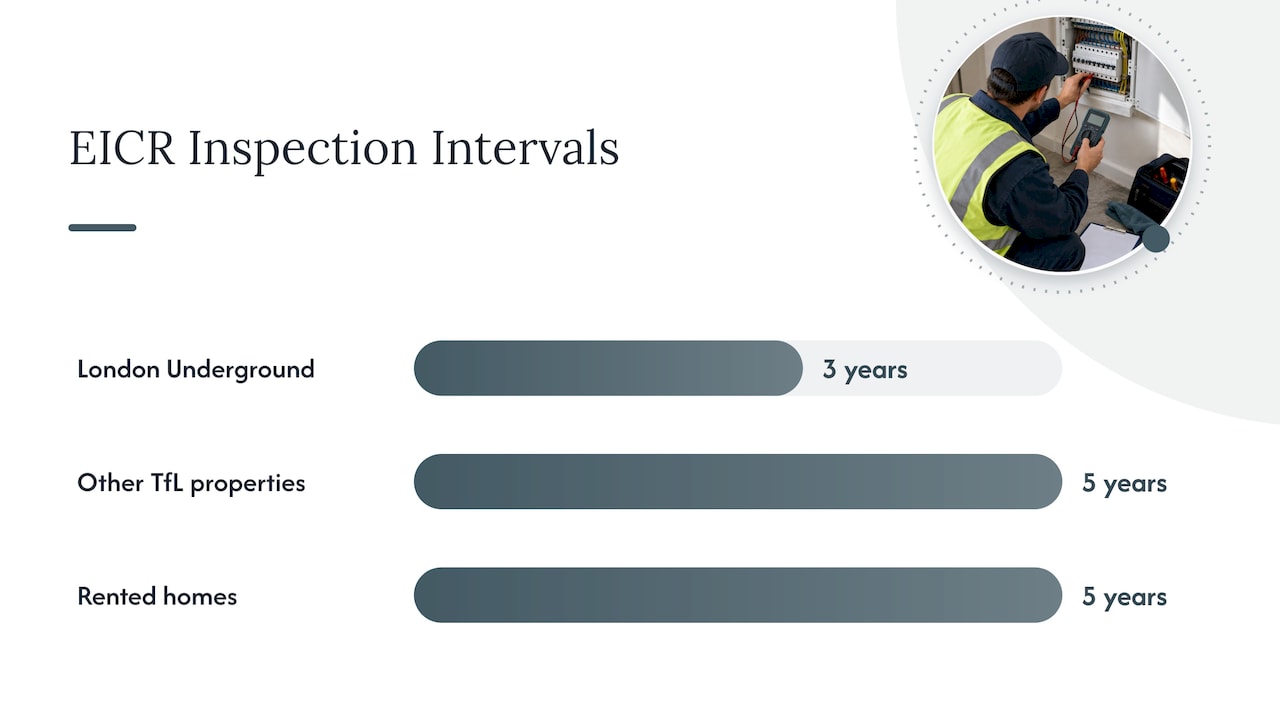
An inspector can recommend a shorter gap where the installation is old or has faults. See our guide to EICR cost in England for how property size and condition affect price.
Who can carry out an EICR?
A competent person must do it. That means a qualified electrician registered with a UKAS-approved certification body such as NICEIC or NAPIT, according to the TfL guide. Before booking, ask:
- Which scheme are you registered with?
- Do you hold qualifications in inspection and testing?
- Will you agree the extent and limitations in writing?
- Does the price include the written report and any observations?
A good report also describes defects clearly rather than hiding them behind jargon.
Why the record matters
The IET guidance describes the EICR as a vital historical record that should be kept and passed to anyone doing future work on the installation. Keep each report, and any remedial certificates, in one place. Next time, the inspector can compare results and spot deterioration.
Perspective
Most of the confusion we meet is about words, not wiring. Customers ask whether they need an EICR, a fixed wire test or an electrical certificate, and it is one inspection with different names.
What we see matters more is what happens after the visit. A report that sits in a drawer helps nobody. We think the best approach is to treat the EICR as part of a wider schedule: the fixed wiring, the portable appliances, and the fire safety checks that sit alongside them. Using one provider for those services means one set of records and fewer missed dates, especially across several sites.
If you manage a single rental flat or a chain of shops, the aim is the same: know the condition of your electrics, fix what is urgent, and keep clear documentation.
Gemma
Getting an EICR booked
If you need an EICR, we carry out EICR and fixed wire testing for landlords, businesses and organisations across the UK, as one-off jobs or on a schedule so your next inspection is not missed. We can also coordinate PAT testing, fire alarm, emergency lighting and fire risk work through one provider. See our EICR testing page or get in touch via citypat.co.uk.

FAQ
What does EICR stand for?
EICR stands for Electrical Installation Condition Report. It is a formal report on the state of a property’s fixed wiring, circuits and accessories, and whether the installation is safe to keep using.
Is an EICR the same as fixed wire testing?
Yes. Fixed wire testing is another term for the periodic inspection and testing of permanent electrical installations, which is what an EICR records. Different industries simply favour different names.
Does an EICR include portable appliance testing?
No. An EICR covers the fixed installation only. Portable appliances need separate PAT testing, though for social housing in England the EICR must include a statement that safety checks on any provided portable equipment are up to date.
What happens if my EICR is unsatisfactory?
An unsatisfactory result means at least one C1, C2 or FI code was recorded. Urgent remedial work or further investigation is needed to make the installation safe. Ask a competent electrician to carry it out and keep the new certificates with the report.
How much does an EICR cost?
Price depends on the size of the property, the number of circuits and its condition. Our EICR cost guide explains what affects the quote and how to avoid surprise repair bills.
Sources
- NICEIC: Electrical Installation Condition Reports
- SELECT: Electrical Installation Condition Reporting
- IET: Model forms for certification and reporting (EICR)
- IET: BS 7671 all forms
- IET: Inspection and testing FAQs
- Electrical Safety First: Landlords’ guide to electrical safety
- TfL Property Compliance Guide
- The Electrical Safety Council: What is an EICR?