
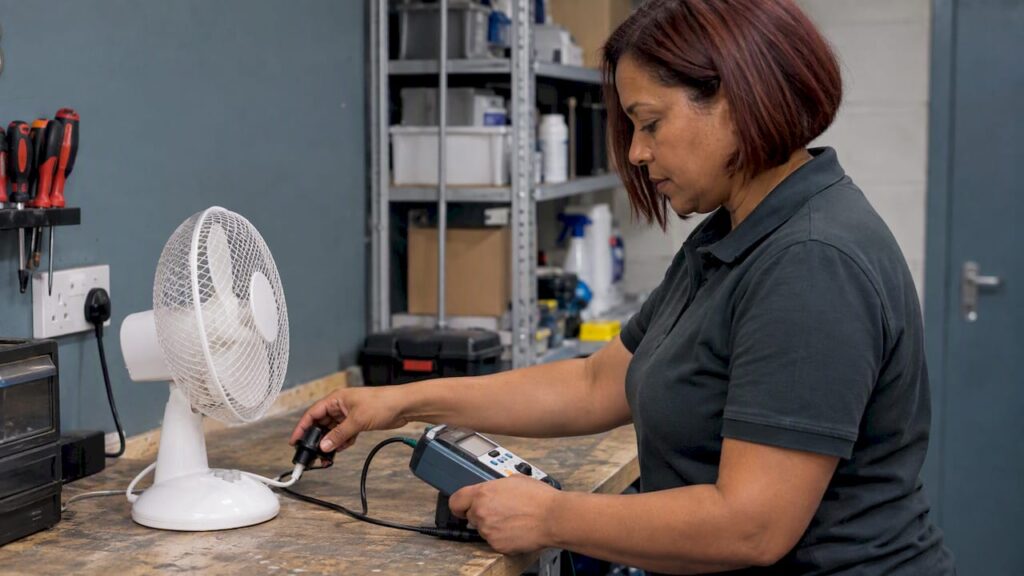
A good PAT testing checklist has four parts: list every portable appliance you own, run user checks and visual inspections, have a competent person carry out the electrical tests where your risk assessment calls for them, and keep simple records of the result. This page gives you that checklist in the order you will use it, with the legal background in plain words, so you can prepare a workplace or rental property without paying for a visit that turns up half-ready.
TL;DR
- PAT testing covers portable equipment that connects by a flexible cable and a plug, including extension leads and cord sets.
- No law sets an annual test. Duty holders decide how often to inspect and test, based on risk, and the HSE’s suggested intervals are not legal requirements.
- Most faults are found by looking: user checks and formal visual inspections do much of the work, with electrical tests added where risk justifies them.
- Anything that fails must be labelled, taken out of use and either repaired or disposed of.
- Records and labels are not a legal requirement, but they are the easiest way to prove your system exists.
Table of Contents
- What a PAT testing checklist is for
- Step 1: Build your appliance inventory
- Step 2: Set the risk-based plan
- Step 3: User checks anyone can do
- Step 4: The formal visual inspection
- Step 5: Electrical tests
- Step 6: Handle failures properly
- Step 7: Keep the right records
- A printable checklist you can copy
- Special cases to flag early
- Our view: the checklist is a system, not a sticker
- Getting the testing done
- FAQ
- Sources
What a PAT testing checklist is for
Portable appliance testing is the routine inspection and testing of electrical items that can be moved, so they stay safe to use. A checklist turns that idea into something a site manager, landlord or office administrator can actually follow.
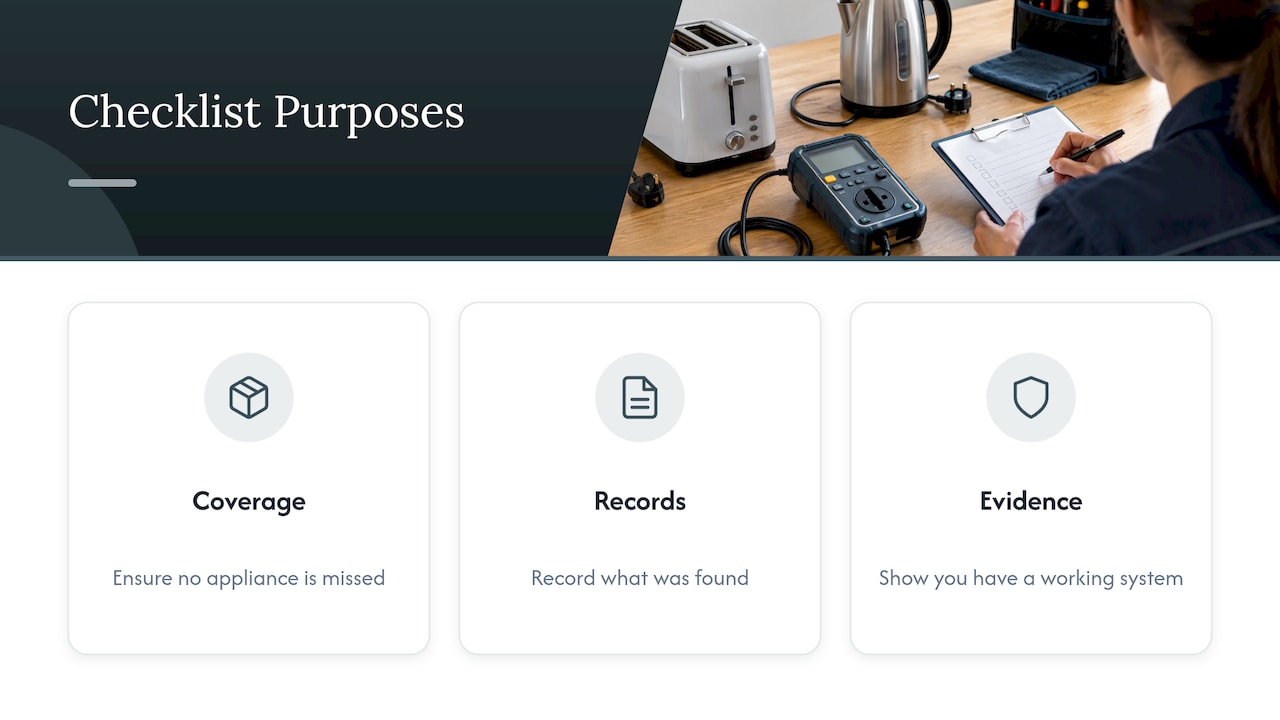
It has three jobs. It makes sure no appliance is missed, it records what was found, and it shows anyone who asks (an insurer, a licensing officer, an inspector) that you have a working system rather than a vague intention.
The legal backdrop is short. The Electricity at Work Regulations 1989 require dutyholders to maintain electrical systems and equipment, so far as is reasonably practicable, to prevent danger. They do not say what must be done, by whom or how often. Precautions should fit the risk. That is why a checklist, built on your own risk assessment, matters more than a fixed calendar date. If you want the longer explanation, our guide to PAT testing regulations in England covers why there is no annual rule for employers or landlords.
Step 1: Build your appliance inventory
Start with a walk-round and a spreadsheet, or a clipboard if you prefer. The HSE describes the scope as portable, movable or transportable equipment connected by a flexible cable and a plug and socket or spur box. That includes extension leads, plugs, sockets and cord sets, not just the obvious appliances.
For each item, note:
- A description and, if visible, make and model
- Location or department, and who uses it
- How it is used (desk, workshop, kitchen, outdoors, shared or hired out)
- Any asset or serial number
- The date of its last inspection or test, if known
The “where and how it is used” line is the one people skip. The HSE guidance asks businesses to identify the portable equipment they maintain and where and how it is used, because a kettle in a staff room and a hand-held drill on a building site carry very different risks.
Typical items to list
Use this as a prompt, then add what is specific to your premises.
| Area | Common portable items |
|---|---|
| Office | Desktop computers, monitors, printers, shredders, desk lamps, phone chargers |
| Kitchen and staff room | Kettles, toasters, microwaves, fridges, coffee machines |
| Retail and hospitality | Display lighting, tills, heaters, fans, vacuum cleaners |
| Workshop and site | Power tools, extension leads, cable reels, portable heaters |
| Rental property | Appliances you supply: kettles, toasters, lamps, washing machines, fridges |
Don’t forget items that live out of sight: a spare heater in a cupboard, a fan under a desk, a lead running behind a display. They are plugged in sometimes, so they belong on the list.
Step 2: Set the risk-based plan
Before anyone picks up a test instrument, decide how often each category needs attention. The HSE is clear that frequency is a matter of judgement based on risk assessment, and that its suggested initial intervals in HSG107 vary by equipment and environment. Those intervals are guidance, not law.
Things that push an item towards more frequent checks:
- It is moved around a lot, or used by many different people
- The environment is harsh: damp, dusty, hot, or on a building site
- It is hand-held, or pulls a lot of current
- It has a history of damage or faults
Things that allow longer gaps: equipment that sits on a desk, is rarely moved and has a clean inspection history.
A combined visual inspection and electrical test is justified when there is reason to believe equipment may be defective, after any repair or modification, or at intervals set by risk assessment. Write those triggers into your plan so the decision is not left to memory.
Rented homes and social landlords
If you let property, the rules differ by tenure and by nation. In England, social landlords are expected to have appliances they provide checked by a qualified and competent electrician, commonly called PAT, at intervals of no more than five years. For private lets, the fixed installation certificate is the headline requirement, and we explain it in our guide to the landlord electrical certificate in England. For shared houses, your licence terms may set the schedule, as we cover in HMO PAT testing.
Step 3: User checks anyone can do
The lowest tier costs nothing and catches a lot. User checks can be done by employees, with no test equipment and no special qualification. Formal inspection and testing is a separate job for a competent person, but the person using the kettle is best placed to notice that the cable has gone stiff or the plug is warm.
Ask staff or tenants to look, before each use, for:
- Damage to the cable, such as cuts, fraying, kinks or exposed inner wires
- A cracked, bent or discoloured plug, or pins that look burnt
- Cable gripped loosely or pulling out of the plug or appliance
- Cracks or missing screws on the casing
- Marks that suggest overheating, such as scorching or a burning smell
- Liquid spills, or damp where the appliance sits
- Overloaded sockets, or extension leads daisy-chained together
- Anything that does not behave normally: tripping, buzzing, intermittent power
Make the rule simple: if in doubt, unplug it and report it. Put a name or a phone number on the reporting route, or the rule will not work.
Step 4: The formal visual inspection
A formal visual inspection is more structured than a user check. It is done by someone who knows what they are looking at, usually with the casing or plug opened where appropriate. The research from a university safety guide describes a regime made up of user checks, formal visual inspections and electrical tests, and it is the visual stage that decides whether an electrical test is even worth running.
A competent inspector will typically work through:
- The plug: correct type, undamaged, correct fuse rating for the appliance, terminals secure, cable grip effective
- The cable: sheath intact along its length, no joins or repairs with tape, no signs of crushing
- The appliance: casing sound, vents clear, switches and controls working, no signs of ingress or contamination
- The environment: is the item suited to where it is used, and is it being used as the manufacturer intended
- Accessories: extension leads and adaptors in good order, suitably rated for the load
The HSE also expects equipment to be used according to the manufacturer’s instructions, so a quick check that nothing is being used outside its design purpose belongs here too.
Step 5: Electrical tests
Where your plan calls for it, or where the visual inspection raises doubt, the next step is instrument testing. The common tests listed in the research are earth continuity, insulation resistance and functional checks.
In plain terms:
- Earth continuity confirms that the protective earth path from the plug to the appliance’s metal parts is intact, where the appliance relies on one.
- Insulation resistance checks that the insulation between live parts and the user-accessible casing is still doing its job.
- Functional check confirms the appliance operates as it should after the other tests.
Not every item gets every test. The right tests depend on how the appliance is constructed, and the person using the instrument needs to know which apply. That is where competence comes in.
Who should do the testing
The guidance separates two levels. A Level 1 tester uses a simple pass/fail instrument and does not interpret readings. A Level 2 tester uses more sophisticated instruments and needs the technical knowledge or experience to interpret the readings. Either way, a PAT tester should be competent through training and experience, and formal inspection and testing must be performed by someone competent in the safe use of test equipment and the interpretation of results.
There is no single legal licence to carry out PAT testing, so ask any provider what training they have, what instrument they use and when it was last calibrated. Ask to see a sample report before you book.
Step 6: Handle failures properly
A failed item is the reason you test, so decide in advance what happens next. If equipment is found defective, it should be clearly marked, for example with a red “FAIL” label, withdrawn from use, and the user informed so that it can be repaired or disposed of.
Your checklist should include:
- Label the item as failed on the spot
- Unplug it and move it somewhere it cannot be picked up by mistake
- Tell the person who uses it, and their manager or the property owner
- Record the fault and the date
- Decide: repair by a competent person, replace, or dispose
- Re-inspect and re-test after any repair, which the HSE lists as a trigger for a combined inspection and test
For cheap items, replacement often costs less than repair. For specialist equipment, get the manufacturer or a competent engineer involved.
Step 7: Keep the right records
Here many people overspend on worry. The HSE states there is no legal requirement to label tested equipment or to keep records, although it recommends both as a management tool to monitor how well maintenance is working and to show that a scheme exists.
In practice, an insurer, a licensing officer or a solicitor will ask for evidence. A useful record shows:
- Asset description and location
- Date of inspection or test, and who carried it out
- The result (pass or fail) and any readings taken
- Action taken on failures
- The date the next check is due, and the reasoning behind it
Our page on what PAT testing records to keep in England goes through the format in more detail. If you also manage fire systems, the same discipline applies to a fire alarm logbook.
A printable checklist you can copy
Use this as your working sheet. Tick each line for each site.
| Stage | Check | Done |
|---|---|---|
| Inventory | Every portable appliance, lead and adaptor listed with location | ☐ |
| Inventory | Hired, shared and staff-owned items identified | ☐ |
| Risk plan | Categories set by environment, use and history | ☐ |
| Risk plan | Triggers for extra tests written down (damage, repair, modification) | ☐ |
| User checks | Staff or tenants know what to look for and who to tell | ☐ |
| Visual inspection | Plugs, fuses, cables, casings and cable grips checked | ☐ |
| Electrical tests | Done by a competent person on items that need them | ☐ |
| Failures | Labelled, withdrawn, repaired or disposed of | ☐ |
| Records | Results, dates and next due date stored | ☐ |
| Review | Plan revisited after incidents or changes of use | ☐ |
Special cases to flag early
Some situations need a line on the checklist of their own.
- Building sites and 110V tools. Reduced-voltage tools and their transformers have their own considerations, which we set out in our guide to 110V PAT testing.
- Multi-site operators. Shops, clinics or offices across several addresses need one consistent inventory format, or you will never know which site is overdue.
- Shared or rented-out equipment. Items that change hands often should be checked at each return, not on a calendar.
- Staff-owned appliances. If personal kettles or heaters are plugged in at work, they are part of your premises’ risk. Decide whether to allow them, and if so include them.
- Fixed wiring. A PAT test says nothing about the sockets the appliance plugs into. That is the job of an EICR and fixed wire inspection.
Our view: the checklist is a system, not a sticker
We test appliances for businesses, landlords and organisations, and the same pattern repeats. The sites that struggle are rarely the ones with failed kettles. They are the ones where nobody knows how many appliances there are, where the last test was recorded on a loose sheet, or where three buildings follow three different routines.
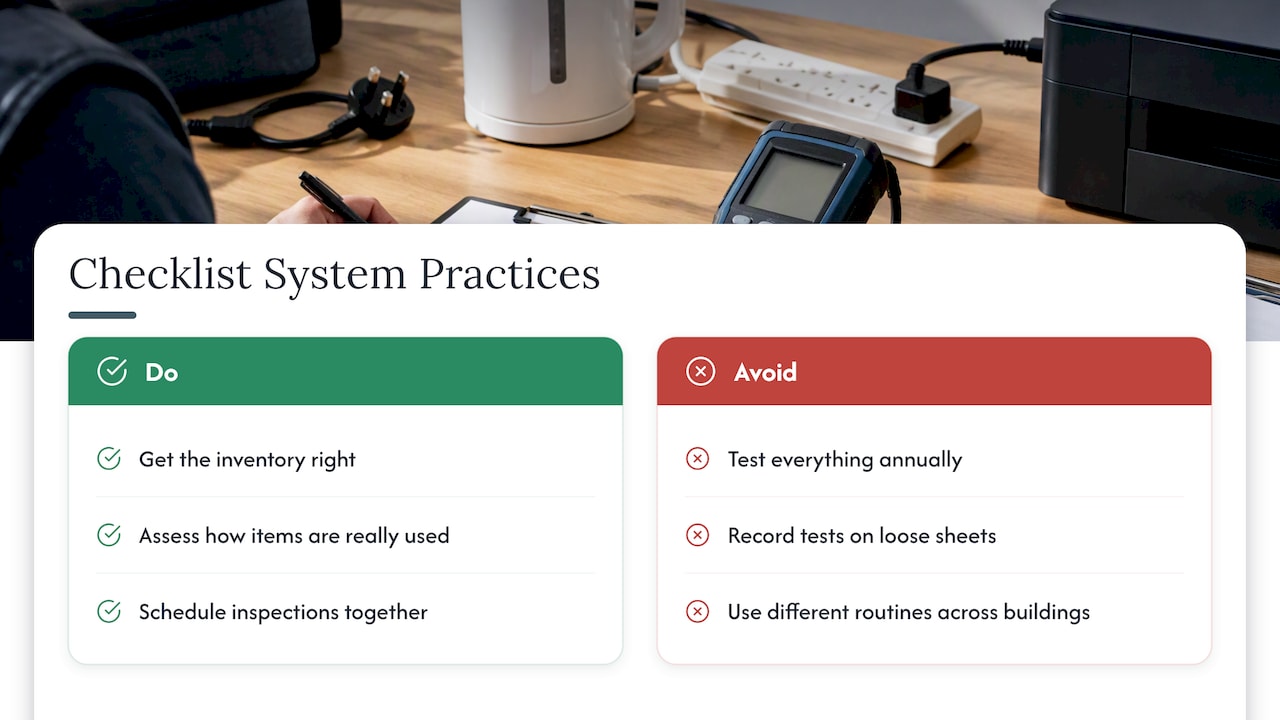
Our advice is to treat the checklist as the product and the test as one step within it. Get the inventory right and the rest becomes quick. Be honest in your risk assessment about how items are really used, not how the policy says they are used. Resist the urge to test everything annually just to feel safe: an office with a few desk items and a rented flat with a toaster need a different rhythm from a workshop.
Where we add the most value is coordination. Many of our clients also need fixed wire inspections, emergency lighting, fire alarm checks and extinguisher servicing. Having one provider schedule them together means fewer visits, one set of documents and fewer missed dates. That is what our clients tell us matters when they manage more than one site.
— Gemma
Getting the testing done
If you would rather hand over the inspection and testing stage, our engineers can visit your site, test the items on your inventory, label results and give you a clear report that sits neatly in your records. We work across the UK and can schedule single sites or several locations, aiming to keep disruption low. Start with our PAT testing service, or look at the full range of services if you want electrical and fire checks arranged together.
Send us your appliance count and site list and we can tell you what a visit would involve. If the number of items is a guess, that is fine: part of our job is helping you get that inventory right.
FAQ
Is there a legal requirement to PAT test every year?
No. The law requires electrical equipment to be maintained so far as reasonably practicable to prevent danger, but it does not set a testing frequency. The HSE says frequency is a matter of judgement based on risk assessment, and its suggested intervals are not legal requirements.
Do I have to keep PAT records or put labels on appliances?
Not by law, according to the HSE’s own answers on PAT. It does recommend both, because they let you monitor whether your maintenance scheme works and show that you have one. In practice insurers and licensing bodies often ask for them.
What qualifications does a PAT tester need?
There is no single mandatory licence, but the tester must be competent through training and experience. A Level 1 tester uses a simple pass/fail instrument, while a Level 2 tester interprets readings from more sophisticated equipment, so ask which level applies to your items.
What should I do with an appliance that fails?
Label it clearly as failed, take it out of use and tell the person who uses it. Then repair it through a competent person or dispose of it, and re-test after any repair.
Can employees do any of the checking themselves?
Yes, for user checks. Employees can look over leads, plugs and casings before use and report problems. Formal inspection and electrical testing should be done by a competent person.
Sources
- HSE: Maintaining portable electrical equipment (HSG107)
- HSE: PAT (portable appliance testing) answers to popular questions
- Inspection and testing of electrical equipment (safety guidance)
- Electrical Safety First: advice for landlords