

The minimum emergency lighting levels in England come from BS 5266 and BS EN 1838. Defined escape routes need at least 1 lux along the centre line at floor level. Open areas need at least 0.5 lux. High-risk task areas need at least 10% of the normal lighting level at that point. Those figures are only part of compliance, because the lighting must also switch on quickly, last long enough and be tested and logged. This guide covers all of that, in the order you will meet it on site.
TL;DR
- Escape routes: at least 1 lux along the centre line, measured at floor level. Open areas: at least 0.5 lux.
- High-risk task areas need at least 10% of the normal illuminance. Fire-fighting equipment and first aid points need 5 lux at the point itself.
- The current code of practice is BS 5266-1:2025, which came into effect on 31 October 2025.
- Test monthly with a short functional check and annually with a full-duration test. Keep a written log of every test, fault and repair.
- If a test fails, record it, put interim safety measures in place and have a competent person repair it.
Table of Contents
- What a lux level actually tells you
- The lux levels you need to know
- How fast the light must come on
- Which standard applies in England
- A worked example: a small office
- Testing: how often and what to record
- When a test fails or the lux level is not met
- Common reasons a system misses its lux target
- We think the lux figure is the start of the conversation
- Getting your emergency lighting tested
- FAQ
- Sources
What a lux level actually tells you
Lux measures illuminance: how much light lands on a surface. One lux is very little. A normally lit office is often several hundred lux. That is deliberate. Emergency lighting is not there to let people carry on working. It is there to let them see the way out, find exits and avoid hazards while the mains supply is down.
The Health and Safety Executive frames it as a performance question. HSG38 Lighting at work says emergency lighting must give the necessary illuminance at appropriate locations, such as exits and escape routes. A luminaire that glows when you press the test key is not enough on its own. The light has to reach the places people need it, quickly enough to be useful.
The lux levels you need to know
The figures below are the ones most often quoted from BS EN 1838, which BS 5266 relies on for performance. They are summarised in a technical guide to emergency lighting and in the standard’s own guidance.
| Area | Minimum level | Where it applies |
|---|---|---|
| Defined escape routes | 1 lux | Along the centre line, at floor level |
| Open areas (anti-panic) | 0.5 lux | At floor level, excluding a perimeter border |
| High-risk task areas | 10% of normal lighting, and not less than 15 lux | At the task itself |
| Fire-fighting equipment and first aid points | 5 lux | Vertical illuminance at the point |
The 10% figure for high-risk task areas comes from the same guide. The 5 lux requirement for first aid and fire-fighting equipment comes from BS EN 1838. Treat the 15 lux floor for high-risk areas as a figure to confirm with your designer for the specific process, because the right level depends on the hazard.
Measured at floor level
Escape route and open area readings are taken at floor level. That matters when you or an engineer check a system. A meter held at waist height will give a flattering number that does not reflect what a person stepping towards an exit sees.
Wider routes and the 2025 revision
BS EN 1838 allows a wide escape route to be treated as a series of 2 m wide strips, or as an open area. Guidance published about BS 5266-1:2025 describes lux checks that now look beyond the centre line towards the full width of the route. Ask whoever designs or certifies your system exactly how they assess width, and ask them to state it on the paperwork. Do not assume that a system designed under an earlier edition has been checked this way.
Where light is needed, whatever the lux reading
The standards expect emergency lighting near exit doors, stairs, changes of level, changes of direction, corridor intersections and fire-fighting and first aid equipment. Reaching 1 lux in a corridor does not excuse a dark stair landing or an unlit call point.
How fast the light must come on
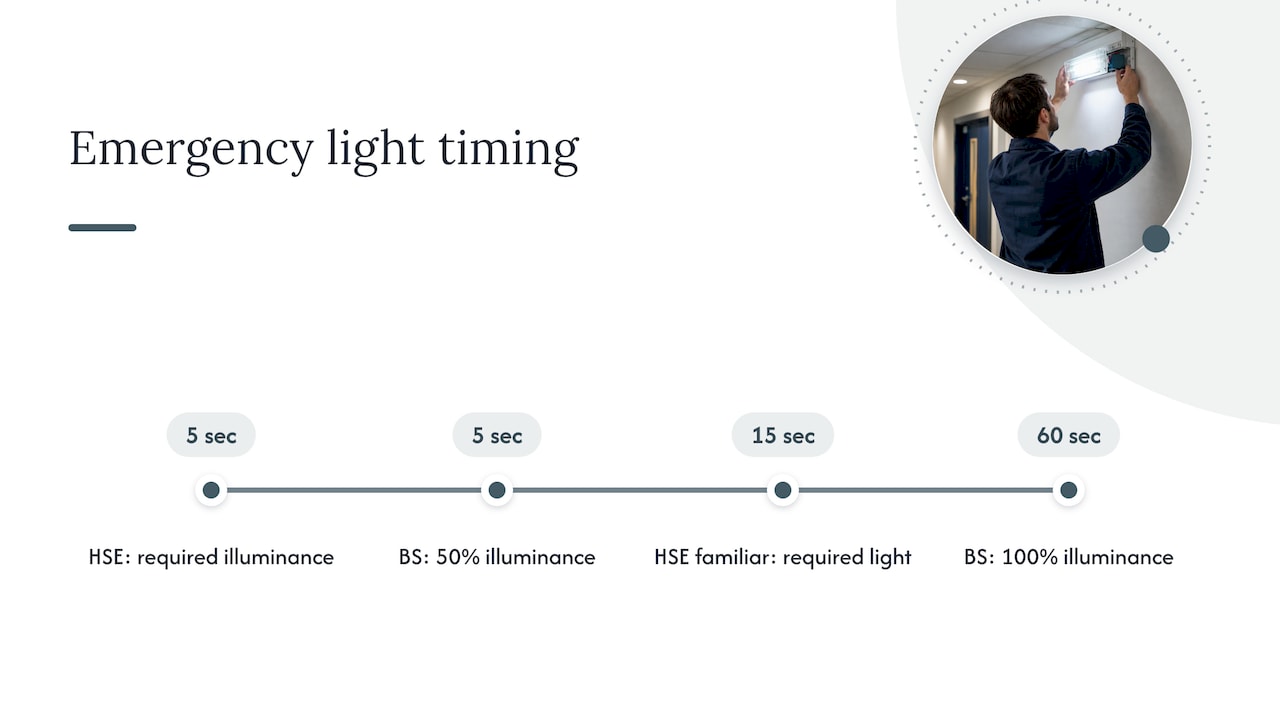
Lux is only half the specification. HSE guidance says escape lighting should reach the required illuminance within five seconds of the main lighting failing, or within fifteen seconds where employees are familiar with the workplace. BS EN 1838 guidance also sets a build-up curve: 50% of the required illuminance within 5 seconds and 100% within 60 seconds.
The same standard asks for a minimum colour rendering index (Ra) of 40, so that safety colours such as the green of exit signs and the red of fire equipment can still be told apart.
Which standard applies in England
The current code of practice for design, installation and wiring is BS 5266-1:2025, which came into effect on 31 October 2025. Its scope reflects modern building use, including keeping people safe in place and maintaining essential operations, not only getting them out.
The legal duty sits in fire safety law. In England that is the Regulatory Reform (Fire Safety) Order 2005. Scotland and Northern Ireland have their own legislation, but the principles and emergency lighting requirements are similar. The Order places the duty on the responsible person, usually the employer, owner or managing agent. BAFE guidance stresses that showing ongoing due diligence through competent, third-party certificated organisations is key to meeting those requirements.
A worked example: a small office
Take a two-storey office with a central corridor, a stair and an open-plan floor. An engineer would normally check:
- The corridor, for at least 1 lux on the centre line at floor level.
- The open-plan area, for at least 0.5 lux in the anti-panic zone.
- Each exit door, stair flight, change of direction and corridor junction, for a luminaire close by.
- The fire extinguisher points and the first aid kit, for 5 lux at the point.
- The exit signs, for visibility and a legible, correct pictogram.
If a partition has been added since the last test, the open-plan area might now be a corridor or a dead end, and the original design no longer matches. That is why layout changes should trigger a review, not just the annual test.
Testing: how often and what to record
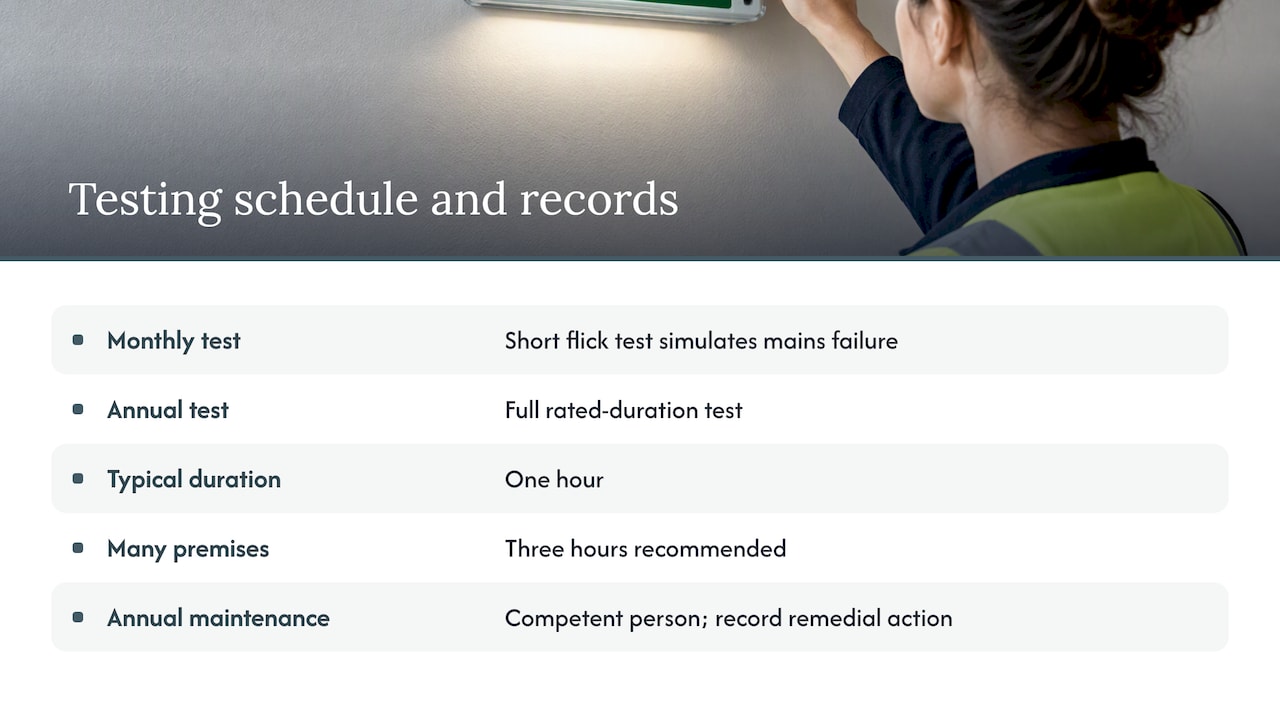
As a general guide, the Fire Protection Association advises monthly testing and an annual full-duration test. The monthly test is a short functional or “flick” test that simulates a mains failure to confirm lamps switch on and light properly. The annual test runs the system for its rated duration. Duration is typically one hour, with three hours recommended in many premises, depending on the building and its evacuation strategy.
County Durham and Darlington Fire and Rescue Service says annual tests and maintenance should be carried out by a competent person, with remedial action recorded.
The log book
Fire authorities expect a written log. Warwickshire County Council states that a log of all system tests and results must be maintained, that written declarations of compliance should be available on site for inspection and that the installer should provide a completion certificate. The Avon Fire and Rescue Service log book shows the level of detail inspectors like to see: for each test the date, duration, result, location, any fault, whether it was cleared and a responsible signature.
Our page on emergency lighting certificate types and monthly testing explains the paperwork in more detail.
Who is responsible for the installation paperwork
The installer’s certificate and the maintainer’s test records are different documents, and you need both. In managed residential buildings, ownership of the duty is a common point of confusion. If you manage a block, this explanation of communal lighting in blocks of flats sets out who is generally expected to look after shared lighting, and why records matter if something goes wrong.
When a test fails or the lux level is not met
A failed test is a normal event. What counts is what you do next. BAFE’s guidance is to:
- Log the failure.
- Put alternative safety procedures in place until repairs are done, for example a fire marshal, a closed area or a temporary change to the evacuation plan.
- Have a competent person repair the fault, as BS 5266-1 section 12 says.
- Record the testing and repair information in the log book.
Do not wait for the next monthly check. A low reading on an escape route, a dead fitting or a battery that no longer lasts the full duration all need the same response.
Common reasons a system misses its lux target
- Ageing batteries. Fittings that pass a short test can fail a full-duration one.
- Layout changes. New partitions, racking or stock stored in corridors block or shadow the light.
- Dirty or obstructed luminaires. Dust, paint or ceiling tiles moved over a fitting reduce output.
- Missing coverage at hazards. A fitting is present, but not at the stair, the change of level or the extinguisher.
- Unrecorded faults. The repair was done, but the log has no entry, so you cannot show it.
We think the lux figure is the start of the conversation
Most of the emergency lighting problems we see on site are not about the number on a meter. They are about nobody owning the process: the monthly test is missed, a fault is noted but not chased, or a refit changes the layout and the lighting is never reassessed.
That is why we pair emergency lighting testing with the other fire and electrical checks a building needs. When fire alarm tests, extinguisher servicing, fixed wire inspection and fire risk assessment sit with one provider, nothing slips between suppliers, and you get clear documentation and a schedule designed to minimise disruption and missed dates. That matters most if you run several sites, where one missed certificate is easy to overlook.
Our advice is simple. Get your lux levels checked against the current code of practice, keep the log book somewhere your team can find it, and treat a failed test as a job to close the same week.
Gemma
Getting your emergency lighting tested
We carry out emergency lighting testing for businesses, landlords, property managers and organisations across the UK, with records you can show an inspector. Our emergency lighting testing service covers the routine checks and the annual full-duration test. If you want to understand what budget to plan for, our guide to emergency lighting test costs in England explains how repairs can change the picture.
If you also manage the alarm, extinguishers and electrical safety on the same premises, we can coordinate them together. See our fire risk assessments and fire alarm testing, or start from our main page.
FAQ
What are acceptable emergency lighting lux levels?
On a defined escape route, at least 1 lux along the centre line at floor level. In open areas, at least 0.5 lux. At fire-fighting equipment and first aid points, 5 lux at the point. High-risk task areas need at least 10% of the normal illuminance.
What is the British standard for emergency lighting?
The code of practice is BS 5266-1:2025, in effect since 31 October 2025. It covers design, installation and wiring, and works alongside BS EN 1838 for the lighting performance itself.
How often should emergency lights be tested?
As a general guide, a short functional test every month and a full-duration test every year. A competent person should do the annual test, and every test and fault should go in your log book.
How long must emergency lighting last?
A minimum of one hour is common, with three hours recommended in many premises, depending on the building and how long evacuation or recovery might take. Your fire risk assessment should set the duration for your site.
Sources
- Lighting at work (HSG38), Health and Safety Executive
- A Guide to Emergency Lighting: Introduction
- SIST EN 1838:2025 emergency lighting standard
- BS 5266-1:2025 Emergency lighting, NBS
- Emergency lighting and safety services webinar questions, IET
- Emergency Lighting System Guidance, BAFE
- How often should emergency lighting be tested?, Fire Protection Association
- Maintenance and Recording, County Durham and Darlington Fire and Rescue Service
- Fire safety emergency lighting, Warwickshire County Council
- Fire Safety Log Book, Avon Fire and Rescue Service
- Who is responsible for communal light bulbs in a block of flats?