

An EICR uses four codes to tell you how urgent each problem in your electrical installation is: C1 (danger present), C2 (potentially dangerous), C3 (improvement recommended) and FI (further investigation). A C1 or C2 makes the whole report unsatisfactory. A C3 on its own does not. FI is the code people most often get wrong, and it changed in 2026. This guide explains each code, what you must do about it, and what the rules mean for landlords and businesses in England.
TL;DR
- C1 means danger is present and needs immediate action. C2 means potentially dangerous and needs urgent remedial work. Either one makes the report unsatisfactory.
- C3 means improvement is recommended. It does not stop a report being satisfactory.
- FI means the inspector could not fully assess something and further investigation is advised. Under the 2026 model form it does not by itself make a report unsatisfactory, but you should still act on it.
- In England, landlords must complete remedial or further investigative work within 28 days of the inspection, or sooner if the report says so.
- Businesses should use competent people, keep the records and stop using anything shown to be unsafe until it is fixed.
Table of Contents
- What an EICR code actually is
- The four codes at a glance
- C1: danger present
- C2: potentially dangerous
- C3: improvement recommended
- FI: further investigation
- When an EICR becomes unsatisfactory
- What landlords in England must do
- What businesses and other duty-holders should do
- How to read your report quickly
- Get your EICR coded and cleared
- FAQ
- Sources
What an EICR code actually is
An Electrical Installation Condition Report (EICR) records the condition of the fixed wiring in a building: the consumer unit, circuits, sockets, switches and fixed fittings. When the electrician finds something that falls short of the standard, they write it down as an observation and give it a code. The code tells you how serious it is and how fast you need to respond.
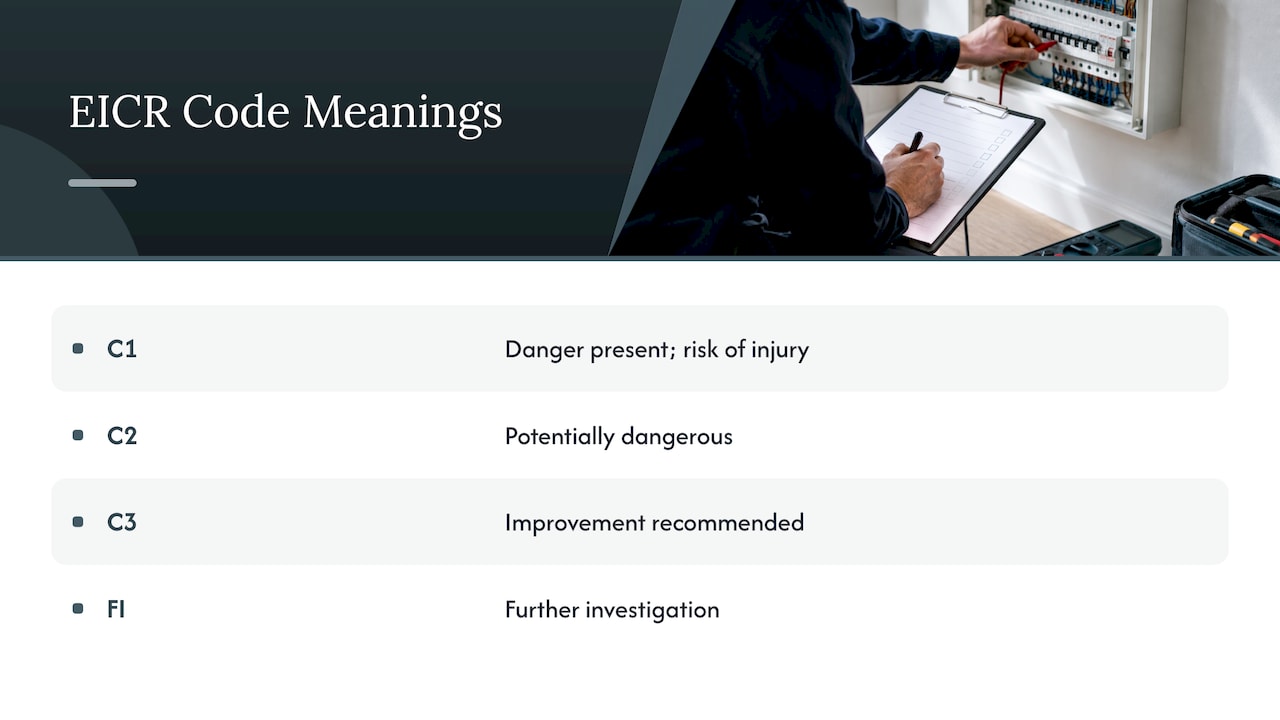
The IET, which publishes BS 7671, describes the codes in its inspection and testing FAQs: C1 is danger present with risk of injury, C2 is potentially dangerous, C3 is improvement recommended, and FI is further investigation.
Coding is a judgement, but not a free one. The ECA says an inspector should choose a code based on the observed risk and the context of the installation, and should be able to justify it against BS 7671 rather than personal preference (ECA guidance note on EICR coding). The same guidance warns that over-coding defects as C1 or C2 can cause needless disruption and expense. A good report therefore explains each coded item clearly enough that you can see why it was given.
If you want the wider picture first, our guide to what an EICR is covers what is inspected and why.
The four codes at a glance
| Code | Meaning | What you should do | Effect on the report |
|---|---|---|---|
| C1 | Danger present, risk of injury | Immediate remedial action | Unsatisfactory |
| C2 | Potentially dangerous | Urgent remedial action | Unsatisfactory |
| C3 | Improvement recommended | Consider the recommendation | Does not make it unsatisfactory |
| FI | Further investigation | Arrange the investigation | Does not by itself make it unsatisfactory under the A4 model form |
The sections below go through each code in turn.
C1: danger present
C1 is the most serious code. It means there is a danger now, with a risk of injury. Typical examples are exposed live conductors that can be touched, or burnt and overheated connections.
Because the risk is immediate, you should not wait for the final report. Electrical Safety First’s Best Practice Guide 4 says the person who ordered the report should be told without delay and that, where practicable, the dangerous item should be made safe or the affected part of the installation isolated.
In practice, that often means the electrician makes the hazard safe before leaving site, or switches off the affected circuit and tells you which parts must stay off until repaired. The official guidance for the rented sector also notes that a C1 hazard may be made safe by the inspector on the day (GOV.UK guidance).
A C1 always makes the overall report unsatisfactory.
C2: potentially dangerous
C2 means the installation is not necessarily dangerous at the moment of inspection, but a fault or a foreseeable event could make it so. Best Practice Guide 4 describes it in those terms and says urgent remedial action is required. The IET’s model-form guidance likewise describes C2 remedial work as necessary as a matter of urgency (IET model forms).
Common examples include missing or inadequate protective measures, such as no RCD protection where it is needed for socket outlets, or a lack of proper earthing and bonding. Nothing may have gone wrong yet, but the margin of safety is missing.
The responsible person should arrange the work through a competent electrical person quickly. A C2 also makes the overall report unsatisfactory, and the IET model-form guidance is clear that any C1 or C2 observation does so.
C3: improvement recommended
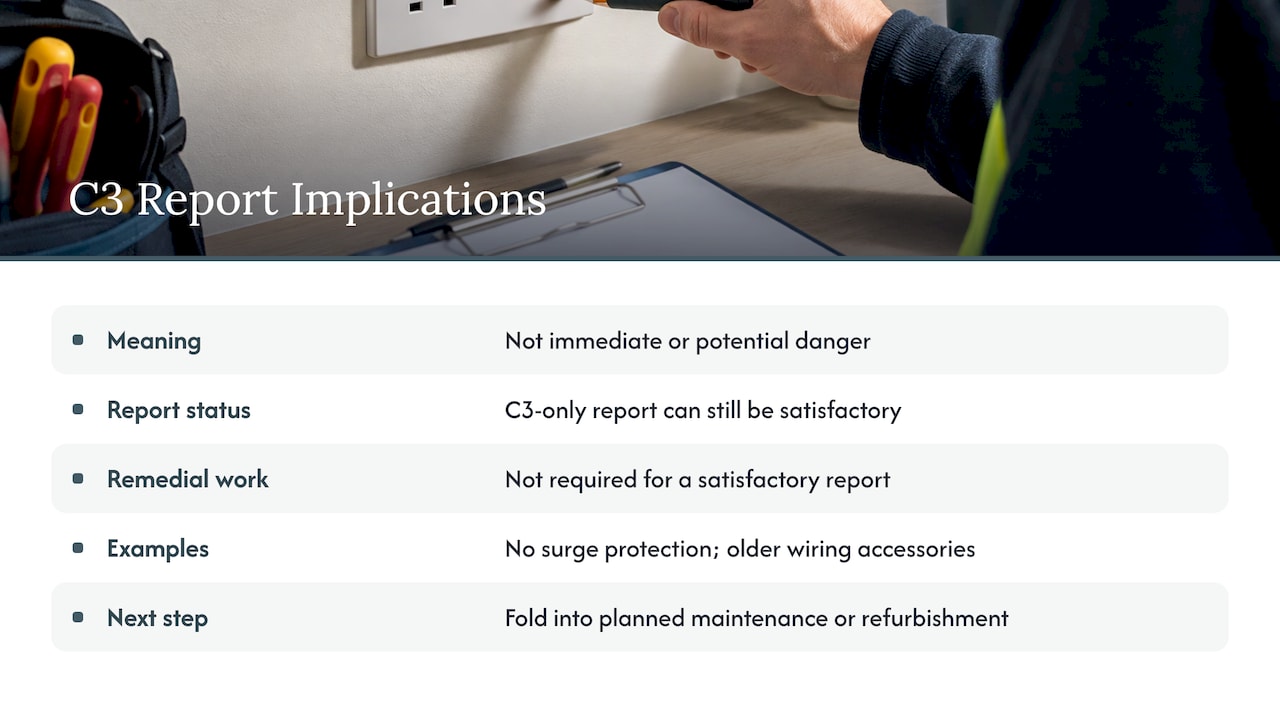
C3 means the issue is not an immediate or potential danger, but correcting it would improve electrical safety. This is the code that causes most confusion, because people see it on a report and assume it is a failure.
It is not. GOV.UK states that a C3 does not require remedial work for the report to be satisfactory. A report containing only C3 observations can therefore still be satisfactory (IET model forms).
That does not make C3 items worthless. They often reflect older installations that were compliant when installed but fall short of current practice, such as a consumer unit with no surge protection or older wiring accessories. It makes sense to read them, ask what they would cost to put right and fold them into planned maintenance or a refurbishment. Where surge protection comes up, our guide to Type 1 and Type 2 SPD placement explains the BS 7671 rules.
FI: further investigation
FI is used when the inspector sees something that looks wrong but cannot fully assess it within the agreed scope and limits of the inspection. The IET explains that the further investigation might reveal a C1 or C2 issue (IET, Implications of BS 7671:2018+A4:2026 on EICRs).
A typical case is a circuit that cannot be traced to its source, or a part of the installation that was not accessible and may hide a defect. The IET stresses that periodic inspection is meant to establish whether an installation is suitable for continued use, not to find every possible fault, so FI should be kept for a genuine unresolved safety question.
What changed with Amendment 4
This is where older guides now disagree with newer ones. The IET reports that Amendment 4 changed the FI wording from “further investigation required without delay” to “further investigation is advised”, and separated FI from the C1 and C2 classifications. Under the A4 model form, FI does not itself produce an unsatisfactory outcome.
That is a change to the form, not a licence to ignore the item. If an FI is recorded, get it investigated. The result may well turn into a C1 or C2, and in England a landlord’s legal duty still covers further investigative work, as the next sections explain.
When an EICR becomes unsatisfactory
The rule is short:
- Any C1 or any C2 makes the overall condition unsatisfactory.
- C3 observations alone do not. The report can still be satisfactory.
- FI alone does not make it unsatisfactory under the A4 model form, though it should be followed up.
So a report with ten C3s and nothing else can be satisfactory, while a report with one C2 and nothing else is unsatisfactory.
To move from unsatisfactory to satisfactory, the C1 and C2 items must be remedied, and any FI items investigated and resolved, by a competent person. The electrician then confirms in writing that the work is done, usually with an updated report or certification. Our page on EICR validity and the next inspection date explains how the next inspection date is set.
What landlords in England must do
If you let property in England, the GOV.UK guidance on electrical safety standards sets out the duties:
- Have the electrical installation inspected and tested at least every five years by a qualified person.
- Obtain a report giving the results and the date of the next inspection.
- Where the report shows that remedial or further investigative work is necessary, complete it within 28 days of the inspection, or sooner if the report specifies a shorter period.
Note the wording: remedial or further investigative work. So even where an FI does not make the report unsatisfactory on the form, an English landlord should treat the 28-day clock as running for it. In practice, C1 and C2 items usually need to be dealt with faster than 28 days, because the code itself says immediate or urgent.
These rules are for England. Northern Ireland has its own regulations, with a five-year maximum interval and a 28-day period for remedial work (Electrical Safety Standards for Private Tenancies Regulations 2024). Scotland and Wales work under separate regimes. If you hold property outside England, apply the rules of the nation where it sits.
For more on the duties and penalties, see our guide to landlord electrical safety duties in England and the page on the landlord electrical certificate.
Blocks of flats and insurance
If you manage a block, the codes matter beyond tenancy law. An unresolved C1 or C2 is the sort of thing insurers ask about after a loss. This overview of electrical safety, EICRs and block insurance shows how EICR outcomes relate to cover for residential blocks. Keeping a dated record of each coded item and the work done to clear it is the simplest way to show you acted promptly.
What businesses and other duty-holders should do
EICRs are not only for landlords. If you run a shop, office, school, hotel or warehouse, you have duties to keep electrical systems safe, and the EICR is the evidence that you have looked.
The HSE advises employers to risk-assess electrical equipment, check that equipment and its supply are safe, use competent people for necessary inspections, and stop using equipment or a supply where there is evidence of an unsafe condition until corrective work is complete (HSE guidance). That maps neatly onto the codes: a C1 or C2 on a circuit is exactly that kind of evidence.
The ECA’s guide to the employer’s legal duties adds that you should use someone with the necessary skills, knowledge and experience, keep installation documents and test records safely, and compare results with future records (ECA technical guide). Comparing reports over time is where coding is most useful: a C3 that quietly becomes a C2 five years later tells you where to spend.
A practical routine for a multi-site business:
- Keep every EICR and its observation list in one place, by site.
- Log each coded item with an owner, a target date and the evidence of completion.
- Deal with C1 and C2 items first, then FI, then C3 as part of planned works.
- Diarise the next inspection date from each report so no site lapses.
How to read your report quickly
Codes are normally listed in the observations section of the report, with a reference to the circuit or location and often the relevant BS 7671 regulation. Look for these four things:
- The summary outcome: satisfactory or unsatisfactory.
- The list of C1 and C2 items: these must be fixed.
- Any FI entries: ask what is needed to complete the investigation and what limitation prevented it.
- The next inspection date: this governs when you need to be re-tested.
If an observation looks over- or under-coded, ask the inspector to explain the reasoning against the regulations. A reputable electrician will welcome the question, since the ECA expects them to be able to justify each code.
Our view on EICR codes
Most of the worried calls we hear are not about the electrics, they are about the codes. A client sees a C2 or an FI and does not know what to do next. We think the report should read as a clear action list: what is urgent, what must be done within the legal window, what can be planned.
That is why we focus on clear documentation and scheduling. When you coordinate electrical and fire safety through one provider, an EICR, PAT testing and fire alarm checks sit in the same diary, and a coded item does not get lost between suppliers. For multi-site businesses and landlords with several properties, that matters more than any single test.
Our advice is simple: treat C1 and C2 as work to do now, treat FI as a question to close, and use C3 to plan ahead.
Gemma
Get your EICR coded and cleared
We carry out EICR and fixed wire testing for landlords, businesses and organisations across the UK, and we can coordinate it with PAT testing, fire alarm testing, emergency lighting and fire risk assessments so your compliance dates stay in step. You can see how it works on our EICR and fixed wire testing page.

If you are budgeting, our guide to EICR costs in England explains what drives the price and how repairs are itemised. When you are ready, get in touch through our website to arrange an inspection.
FAQ
Is a C3 a fail?
No. A C3 means improvement is recommended, not that anything is dangerous. A report with only C3 observations can still be satisfactory, so you do not need to carry out C3 work to pass. It is still sensible to read them and plan the improvements.
Does an FI code mean my EICR has failed?
Under the Amendment 4 model form, FI alone does not make a report unsatisfactory. However, it flags something the inspector could not fully assess, which might turn out to be a C1 or C2. In England, landlords must complete further investigative work within 28 days of the inspection, or sooner if the report says so.
How long do I have to fix a C2?
A C2 needs urgent remedial action, so do not wait for the longest permitted period. For an English rented property, the legal limit is 28 days from the inspection or any shorter period in the report. Arrange a competent electrician as soon as you have the report.
Can I dispute a code?
Yes, by asking the inspector to explain it. The ECA says codes should be chosen from the observed risk and be justifiable against BS 7671. If the explanation does not satisfy you, you can ask another qualified electrician for their view on that specific item.
What happens after the work is done?
The electrician confirms in writing that the C1, C2 and any FI items are resolved, and you keep that with the original report. Landlords in England should then supply the relevant documents as the regulations require. The report also states the date of your next inspection.
Sources
- IET: Implications of BS 7671:2018+A4:2026 on EICRs
- IET: Inspection and testing FAQs
- IET: Model forms for certification and reporting
- ECA: EICR coding guidance note
- Electrical Safety First: Best Practice Guide 4
- GOV.UK: Electrical safety standards in the private and social rented sectors
- Electrical Safety Standards for Private Tenancies Regulations (Northern Ireland) 2024
- HSE: Work using electrically powered equipment
- ECA: The Employer’s Legal Duties, Safe Electrical Installations