
For a typical small business in England, fire alarm servicing costs roughly £240 to £450 a year on a standard two-visit contract. A site of around 100 devices runs closer to £500 to £1,000 (squote.app pricing guide). Larger, addressable or monitored systems cost more. The price is driven by how many devices you have, the type of panel and what the contract covers, not by floor area.
This guide shows the published ranges by building type, explains what sits inside a service visit, sets out what pushes a quote up and gives you a way to budget when you run several sites.
TL;DR
- Expect about £240 to £450 a year for a small business and £500 to £1,000 for a 100-device site, on a standard contract of two visits a year.
- Cost follows device count, panel type and number of panels, plus how much repair, call-out and out-of-hours cover the contract includes.
- Six-monthly servicing is the BS 5839 recommendation. The legal duty is to keep the system in efficient working order.
- Compare quotes on what they include (parts, call-outs, response times), not on the headline annual figure.
- Multi-site operators save time and missed dates by putting every site on one schedule with one provider.
Table of Contents
- What fire alarm servicing costs in England
- Price per visit versus annual contract
- What affects the cost of servicing a fire alarm
- What a service visit should include
- How often it must be serviced, and what the law says
- Keeping the records that support your cost
- Budgeting for fire alarm servicing across several sites
- Why the cheapest quote is not always the lowest cost
- Get a quote for your system
- FAQ
- Sources
What fire alarm servicing costs in England
Published UK price guides agree on the shape of the market, even where the exact figures differ. A review of those guides puts typical commercial fire alarm servicing at £200 to £900 per year. The same review notes that device count and the number of panels matter more than floor area, and that remote monitoring, addressable panels or several buildings under one contract sit at the top of the range.
The table below pulls the annual contract ranges from one 2026 UK guide, split into three levels of cover: basic, standard and full. It is a starting point for budgeting, not a quote.
| Premises | Devices | Basic | Standard | Full cover |
|---|---|---|---|---|
| Small retail unit or café | 5 to 15 | £180 to £280 | £280 to £420 | £420 to £600 |
| Medium office or warehouse | 30 to 80 | £380 to £650 | £600 to £1,000 | £900 to £1,500 |
| School or academy | 100 to 300 | £900 to £1,800 | £1,500 to £2,800 | £2,200 to £4,500 |
Source for the table: Fire Alarm Answers, 2026 maintenance contract guide.
Read the table by row, not by column. A café with ten call points and a handful of detectors sits in the first row whether it is in Manchester or Maidstone. A warehouse with several zones and an addressable panel belongs in the second.
Price per visit versus annual contract
You can buy servicing one visit at a time or as a contract. Per-visit pricing usually follows a base charge plus a rate per device. One UK costing guide gives these ballparks:
- A small conventional system of up to 20 devices: £120 to £220 per visit.
- An addressable system of 50 to 100 devices: £250 to £500 per visit.
- Larger systems: £3 to £6 per device on top of a base charge of £150 to £250.
The same guide says a small conventional system takes about 1 to 1.5 hours per visit, while 50 to 100 addressable devices take 2 to 4 hours (squote.app). Since time on site is what you pay for, the device count shows up directly in the price.
Because the usual regime is two visits a year, a per-visit price multiplied by two is the fair way to compare it with a contract. A contract normally earns its keep through predictability: you know the annual figure, and the visits are booked for you.
What affects the cost of servicing a fire alarm
Six things move a quote more than anything else.
Number of devices and panels
Every call point, detector and sounder has to be checked, and the standard expects every device to be functionally tested at least once in each twelve-month period. More devices means more time. More panels means more panel checks, more logbook entries and more travel inside the building.
Conventional or addressable
Addressable systems report which device has a fault, which speeds up diagnosis, but they tend to be larger and more complex, and they price higher per visit than a small conventional system with the same number of zones.
Building layout and access
Height, long wiring routes, plant rooms and locked areas all add time. Out-of-hours access, common in shops, restaurants and care settings, can add to the price too.
Remote monitoring
If your system signals to a monitoring centre, the servicing visit includes checking that signal path. Guides place monitored systems at the upper end of the range.
What the contract covers
A basic contract might cover only the inspection visits. A full-cover contract bundles repairs, replacement parts, call-outs and round-the-clock response. Call-outs outside a contract are commonly priced at around £80 to £150 plus an hourly rate, with parts at trade price plus 25 to 40 per cent, according to the same squote.app guide.
The state of the system
A well-kept system with an up-to-date logbook is quicker to service than one with recurring faults, unlabelled zones or missing zone plans. Fixing those problems costs money once and then saves time on every later visit.
What a service visit should include
A typical six-monthly visit covers the panel and its fault history, batteries and standby power, a sample of devices, sounder levels, zone-plan accuracy and a review of the logbook. A competent engineer should report any outstanding defects and issue a service certificate. For domestic Grade A systems, BS 5839-6 sets the same expectation: inspection and servicing at periods not exceeding six months by a competent person, with defects reported and a certificate issued.
A visit is also needed after a fault, a fire or any alteration to the building. Changing a layout, adding a partition or fitting out a unit can leave detectors in the wrong place, and that is better found by an engineer than by an inspector.
When you request quotes, ask each provider to say in writing:
- How many visits a year are included and how many devices are tested at each.
- Whether repairs, parts and call-outs are included, and at what rate if not.
- The response time for a fault and whether it applies out of hours.
- What paperwork you receive after every visit.
- Whether the engineer’s firm holds third-party certification covering maintenance. Maintenance is a separate module of the BAFE SP203-1 scheme, so it is worth confirming the certificate scope. NICEIC describes the scheme as covering design, installation, commissioning and handover, and maintenance.
How often it must be serviced, and what the law says
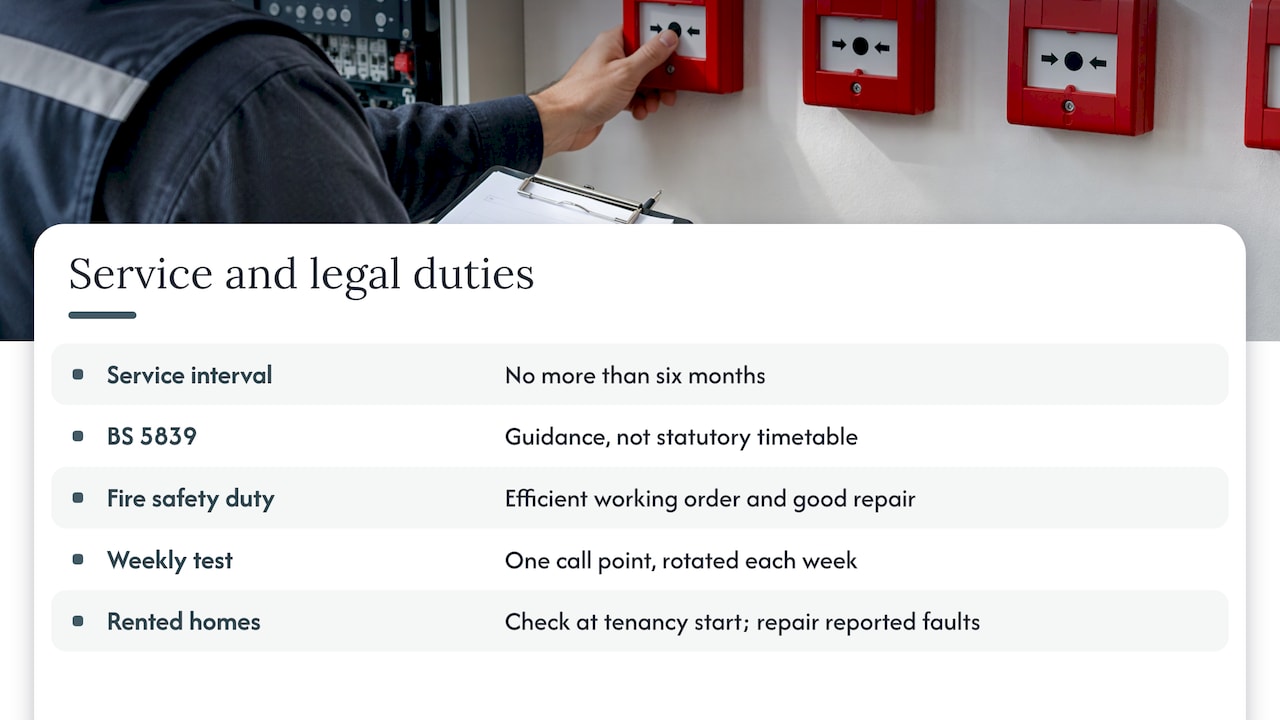
The cost figures above assume two visits a year, because the standard practice is a service at intervals of no more than six months. That interval comes from BS 5839, which is guidance and good practice, not a statutory timetable. The legal duty sits elsewhere.
For workplaces and the common parts of other non-domestic buildings in England, the Regulatory Reform (Fire Safety) Order 2005 requires the responsible person to keep fire safety equipment in efficient working order and good repair. The Home Office guidance for those with duties under the Order says fire alarm systems must be regularly tested and maintained by competent people. Six-monthly certification is the practical way to show you are meeting that duty, and it is the evidence an inspector or insurer will expect to see.
In a multi-occupancy building with one shared alarm, the building owner will normally arrange routine testing and maintenance. An employer leasing part of it must still make sure the arrangements are adequate for the people in their premises. If you are a tenant, ask your landlord for the latest service certificate.
For rented homes in England, the Smoke and Carbon Monoxide Alarm (England) Regulations 2015, amended in 2022, require alarms in prescribed places, a check on the day a new tenancy starts and repair or replacement after a tenant reports a fault. Our guide to landlord fire safety in England covers what that means in practice.
Between visits, the user test matters too. A one-call-point test each week, rotating the point, is the usual routine, and it is cheap because your own staff do it. Our page on the weekly fire alarm test explains how to run it, and our servicing requirements guide sets out the full cycle.
Keeping the records that support your cost
A service is only worth what you can prove afterwards. Every weekly test, service visit, fault and false alarm belongs in the logbook, and our guide to the fire alarm logbook shows what to record. Good records also make servicing quicker, which keeps visit time and price down. The same habit of keeping fire safety records for several years is common across UK fire rules, and an insurer or enforcing authority can ask to see them long after the visit itself.
Budgeting for fire alarm servicing across several sites
The price per site does not fall much when you add sites, because each building still needs an engineer on site for the time its devices take. What multi-site operators can control is the other cost: missed dates, repeat visits and admin.
A workable budget has four lines per site.
- Core contract: two visits a year at the standard level of cover for that site’s device count. Use the table above to set a first estimate, then replace it with a real quote.
- Repairs allowance: a set sum for parts and labour, since faults are found at servicing. If the contract does not include repairs, hold more in reserve for older systems.
- Call-out allowance: at least one out-of-contract call-out per site if you are not on full cover, using the £80 to £150 range as a planning figure.
- Change allowance: refits, extensions and new tenants can mean extra detectors or re-commissioning.
Then group the work. Put every site on one renewal date, one reporting format and one booking calendar. Fire alarm servicing sits alongside other recurring checks: emergency lighting, fire extinguishers and the fire risk assessment. Scheduling them on the same visit day, where the engineers and the site allow, cuts disruption to your staff and customers. If you manage buildings for others, see our guide to electrical and fire safety compliance for property managers.
Why the cheapest quote is not always the lowest cost

Two quotes at £300 a year can buy very different things. One may include repairs, parts and a four-hour response. The other may include two inspections and nothing else, with call-outs billed on top. The tiered figures in the table show the pattern: the gap between basic and full cover is often 50 to 100 per cent of the basic price, and that gap pays for the items most likely to cost you money later.
A quick test is to ask what happens when a detector fails on a Friday evening. If the answer is a call-out fee, hourly rate and parts at a marked-up price, price that into the quote before comparing. If the answer is that the cost is covered, the full-cover figure may be the cheaper one.
Perspective
Most of the fire alarm problems we see come down to a system that nobody owns. The panel shows a fault, the logbook has a gap and the service date slipped past because it sat with someone who left.
Our approach is to treat servicing as one schedule, not a series of separate chores. We test and service fire alarms, emergency lighting and extinguishers, carry out fire risk assessments, and also handle PAT and fixed wire inspections, all through one provider. For a small business that means one phone call. For a multi-site operator it means clear documentation and scheduling designed to minimise disruption and missed inspection dates.
When you budget, put the visit calendar first and the price second. A system serviced twice a year, with a complete logbook, is easier to insure, easier to defend to an inspector and quicker to service next time.
Gemma
Get a quote for your system
We provide fire alarm testing and servicing for businesses, landlords, property managers and organisations across the UK, on a one-off or scheduled basis. Tell us how many devices you have, what type of panel it is and how many sites you run, and we will quote for the visits you need.
If you also need a fire risk assessment or other compliance testing, we can schedule it alongside the alarm service. Start from citypat.co.uk to request your quote.
FAQ
How much does it cost to service a fire alarm in a small shop or café?
For a small retail unit or café with 5 to 15 devices, 2026 UK guide ranges for an annual two-visit contract run from about £180 to £280 for basic cover up to £420 to £600 for full cover (Fire Alarm Answers). Your price depends on device count, panel type and what the contract includes.
How often should a fire alarm be serviced?
BS 5839 recommends a service by a competent person at intervals not exceeding six months, which makes two visits a year the usual contract. A weekly user test of one call point sits between those visits. The law requires the system to be kept in efficient working order, and the six-monthly service is how most responsible persons evidence that.
Is a call-out included in my annual fire alarm contract?
Only if the contract says so. Basic contracts often cover inspection visits alone, while full cover typically includes repairs, parts and out-of-hours response. Outside a contract, call-outs are commonly priced at about £80 to £150 plus an hourly rate (squote.app). Ask for this in writing before you sign.
Who pays for fire alarm servicing in a rented building?
In a multi-occupancy building with one shared system, the building owner normally arranges routine testing and maintenance. A tenant employer must still make sure the arrangements are adequate for the people in their part of the building. For rented homes in England, landlords have separate duties under the smoke and carbon monoxide alarm regulations.
Sources
- PM Assist: BS 5839 fire alarm testing and categories
- Fire Alarm Answers: fire alarm maintenance contract cost, 2026
- squote.app: fire alarm servicing costs, labour rates and pricing
- BS 5839-6 extracts on inspection and servicing
- NICEIC: fire detection scheme certification
- Fabric fire regulations and record keeping