
A fire alarm logbook is the written record of everything done to your alarm system: weekly tests, six-monthly services, faults, false alarms and any agreed departures from the standard. In England the responsible person for the premises is expected to keep it up to date and have it ready whenever the fire and rescue service asks. The law does not prescribe a particular book, but it does expect your fire safety arrangements to be provable. This guide covers what goes in, who signs what, and how to avoid the gaps that cause trouble at inspection.
TL;DR
- The responsible person (employer, landlord, owner or occupier with control of the premises) is accountable for the logbook, even if an engineer fills in part of it.
- Record the weekly call point test (a different point each week), six-monthly servicing, faults with dates reported and cleared, false alarms and any variations from BS 5839-1.
- No single brand or layout is mandatory, but a structured logbook is the simplest way to show your records can be audited.
- Keep it in a fixed, known place, such as beside the fire alarm panel, so it can be produced at once.
- Entries must be legible, dated and signed by a named person. Initials and blanks to fill in later are red flags.
Table of Contents
- What a fire alarm logbook is, and is not
- Is a fire alarm logbook a legal requirement in England?
- Who is responsible for the fire alarm logbook?
- What to record in a fire alarm logbook
- How to make entries that stand up at inspection
- Where to keep it
- Paper or digital logbook?
- High-rise residential buildings: extra duties
- Our perspective
- How we can help
- FAQ
- Sources
What a fire alarm logbook is, and is not
Think of the logbook as the history of your alarm system. The panel tells you what is happening now. The logbook tells an inspector, an insurer or a new engineer what has happened over months and years.
It is not a certificate. A servicing certificate shows one visit. The logbook joins all the visits, tests and faults into one chronological story. One security firm describes it as an evidentiary defence rather than paperwork, and that is the right way to think about it: if the hardware works but the record is empty, you struggle to show maintenance actually happened.
Most fire and rescue services publish a free template. Avon Fire and Rescue’s non-domestic log book covers fire alarm, emergency lighting, firefighting equipment, training and people with mobility needs in one document. Derbyshire’s version opens with the address and the place the log is kept, and states its aim as helping the responsible person meet the Fire Safety Order.
Is a fire alarm logbook a legal requirement in England?
The honest answer has two parts.
The law requires records, not a specific book. Devon and Somerset Fire and Rescue states that businesses with premises, whatever their size, must have a written fire risk assessment and a record of their fire safety arrangements. Under the Regulatory Reform (Fire Safety) Order 2005, tests, maintenance and training need to be capable of being audited. A logbook is the standard way of doing that.
The British Standard expects one. BS 5839-1 is the code of practice for fire detection and alarm systems in non-domestic premises, and it recommends a system logbook. A code of practice is not law in itself, but following it is the most defensible route to meeting the Order. BSI published the 2025 edition in April 2025, updating the 2017 version.
Some sellers state that companies are not obliged to keep fire log books. Strictly, that is about the product, not the duty. You must be able to evidence your arrangements, and nobody has found a better way to do that than a logbook.
Who is responsible for the fire alarm logbook?
The responsible person. Under the Order, this is whoever has control of the premises: an employer, landlord, building owner or occupier. Devon and Somerset Fire and Rescue notes the duty extends to anyone with a degree of control over the premises or safety systems.
In practice:
- Single-occupier business: the owner or a director, who can delegate day-to-day entries to a named staff member.
- Landlord of commercial or shared premises: the landlord for common parts and shared systems, with tenants responsible for their own areas.
- Managing agents and facilities managers: often the named day-to-day contact, but the legal duty can still sit with the owner or employer, so agree who does what in writing.
- Engineers: they complete their own service entries, but they do not take on your duty.
Delegating the writing never delegates the accountability. If you appoint someone to run the weekly test, name them in the book and make sure they know how to do it.
What to record in a fire alarm logbook
A well-built logbook holds these items, whether you use a printed book or a digital system.
Weekly user test
BS 5839-1 recommends a weekly test by the user, operating a different manual call point each week. The fire service guidance from Buckinghamshire Fire & Rescue also says the responsible person should ensure the system is tested weekly. Record:
- Date and time
- The call point tested (zone and location, not just “tested”)
- Whether the panel and sounders responded as expected
- Who carried out the test, signed with a full name
- Whether you told anyone monitoring the system beforehand, if applicable
Writing “weekly test OK” with no call point reference makes the record hard to trust. Rotating through every point in turn is easy to prove only if each one is written down.
Six-monthly servicing
Professional servicing by a competent person is recommended every six months. Per BSI’s summary of the standard, there is a tolerance of one month either side of the due date. Record the date of each visit, the engineer’s name and company, what was tested, and the outcome. File the full service certificate with the book and note where it is.
Faults, defects and remedial work
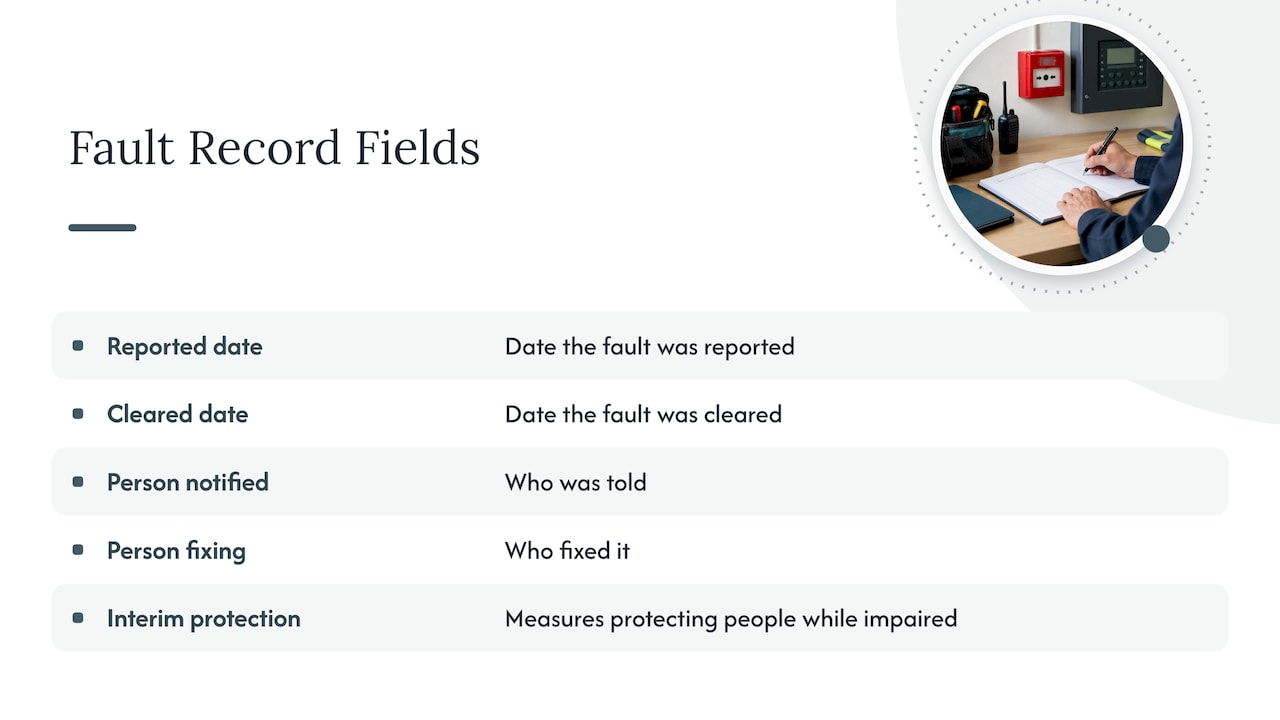
Every fault needs a line for the date it was reported and a line for the date it was cleared. A list of open issues with no closure dates is one of the commonest weaknesses, according to MAC Security Systems. Include who was told, who fixed it, and what interim measures protected people while the system was impaired.
False alarms and unwanted activations
Log date, time, zone, cause if known and action taken. Patterns, such as the same detector triggering repeatedly after cooking or dust, show up when entries are kept together, and they tell you where to act.
Changes to the system and variations
The 2025 edition made one change that matters for logbooks. According to the Fire Industry Association’s guide to the changes, all agreed variations from the standard should now be recorded in the system logbook, whereas the 2017 edition referred only to “major” variations. If a detector position was a compromise, or a risk assessor agreed an exception, write it down in the book itself. Do not rely on an email or a conversation.
Also record extensions, new devices, changes of use and re-programming, with dates and the contractor involved.
Related safety records
Most fire service templates combine the alarm with emergency lighting tests, extinguisher checks, fire drills and staff training. That is sensible: an inspector will ask for them together. If you keep emergency lighting in a separate record, cross-reference it. Our guide to emergency lighting testing costs in England explains what a test visit covers and where repair costs can appear.
How to make entries that stand up at inspection
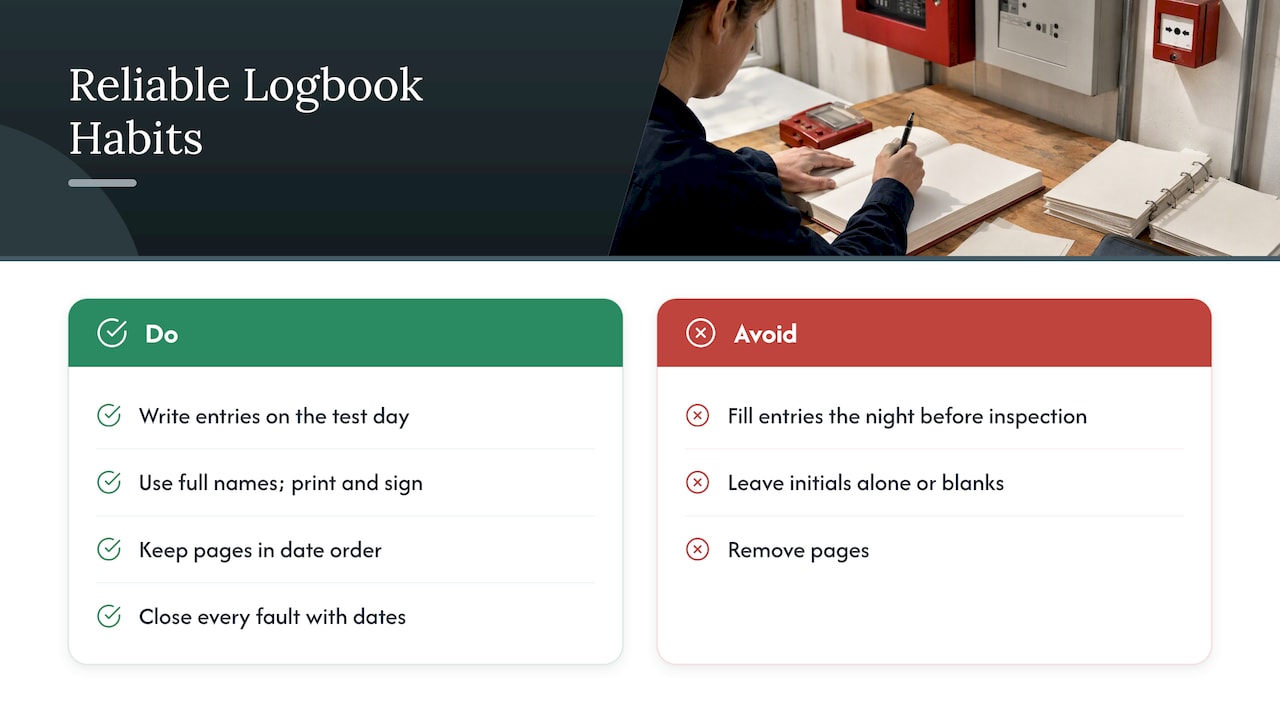
Good record keeping is mostly habit. According to MAC Security Systems, a defensible entry is legible, chronological, and signed and dated by a named competent person. Initials alone and blanks to be completed later raise doubts.
A short checklist:
- Write at the time. Entries made on the day of the test are credible. A page of identical entries filled in the night before an inspection is not.
- Use full names. Print and sign. If more than one person tests, keep a list of authorised testers at the front.
- Keep it in order. No gaps between dates, no loose sheets. If a week is missed, record that it was missed and why.
- Close every fault. Date reported, date cleared, who fixed it.
- Cross-reference documents. Note where certificates, the fire risk assessment and the as-fitted drawings are kept.
- Never remove pages. Correct errors with a single line and a dated initial, so the original can still be read.
If enforcement happens, it rarely starts with a fine. MAC Security Systems describes it as beginning with an informal conversation, escalating when paperwork gaps suggest maintenance may not have happened. A tidy logbook keeps that conversation short.
Where to keep it
Put the book in a fixed location that staff and the fire service can find without asking: typically next to the fire alarm panel or at reception. Write that location on the front cover, as the Derbyshire template does. Do not lock it in a manager’s office that is closed at weekends.
A posted plan is a good partner for the logbook. The logbook records history, while an action sheet and map on the wall tells people what to do now. For a worked example of that idea from a very different setting, see this posted fire action plan for a stable yard, which makes the same point about a visible plan versus a folder nobody opens.
Paper or digital logbook?
Both work. The standard asks for a logbook, not for paper.
| Paper logbook | Digital logbook | |
|---|---|---|
| Cost | Free templates from fire services, or low-cost printed books | Usually a subscription |
| Access | Only at the panel | Any authorised user, any device |
| Audit trail | Depends on discipline | Often time-stamped automatically |
| Risk | Lost, damaged or backfilled | Access control and login management needed |
| Best for | Single small premises | Multi-site or managed portfolios |
For one small unit, a printed book by the panel is perfectly adequate. For several sites, a digital system or a single scheduling provider makes missed weekly tests much easier to spot. Whichever you choose, the same rules apply: contemporaneous, named, signed, closed-out entries.
High-rise residential buildings: extra duties
If you are the responsible person for a high-rise residential building in England, there are specific rules beyond the logbook basics. Regulation 7 of the Fire Safety (England) Regulations 2022 requires monthly routine checks of lifts and essential firefighting equipment, and faults not fixed within 24 hours must be reported electronically to the local fire and rescue authority, with a further report once repaired. The Surrey County Council summary is a plain-English reading of these duties. Keep each check, report and repair date in your records. These regulations apply in England, so Scotland, Wales and Northern Ireland have their own rules.
Our perspective
When we visit sites, the logbook is often where a compliance problem first shows. The alarm works, the engineer has been, but the book is missing, scattered across three folders or filled with identical entries. That is rarely negligence. It is usually that nobody owns the task.
Our advice is simple. Name one person for the weekly test and one deputy. Put the date of the next six-monthly service in the front of the book. Review the book monthly for open faults. If you run several premises, make sure each has the same layout, so that anyone can pick up any site’s book and understand it.
We also see the alarm as one part of a system. The logbook should point to your fire risk assessment, emergency lighting tests and extinguisher servicing, because an inspector will move between them. Coordinating those through one provider means fewer missed dates and one set of documents to file. That is the thinking behind how we run testing across single and multi-site clients.
— Gemma
How we can help
We carry out fire alarm testing at business and landlord premises across the UK, with clear documentation you can file straight into your logbook. If you also need emergency lighting testing, fire extinguisher servicing or a fire risk assessment, we can coordinate them together so the dates line up across one or many sites. Landlords and employers with electrical equipment can also look at our guide to PAT testing records, which applies the same keep-it-auditable principle to portable appliances. To book or ask about scheduling, start at citypat.co.uk.
FAQ
Do I have to use an official fire alarm logbook?
No single brand or layout is mandated. What matters is that your tests, maintenance and training can be audited. Free templates from fire and rescue services, or a purchased book or software, all do the job if they are completed properly.
How often should a fire alarm be tested?
For non-domestic premises, BS 5839-1 recommends a weekly user test using a different call point each time, plus professional servicing every six months. Record both in the logbook. Your fire risk assessment may point to a different frequency for your premises, so follow it where it does.
Who should sign the logbook?
The person who actually carried out each test or visit, using their full name and the date. Engineers sign their own service entries. The responsible person remains accountable for the book as a whole, so review it regularly.
What happens if I do not have a fire alarm logbook?
You may struggle to show the fire and rescue service that your alarm has been tested and maintained. Enforcement usually begins with a conversation and escalates where records suggest maintenance did not happen. Starting a book now, from a fire service template, is better than waiting for an inspection.
Sources
- BSI: updated fire safety standard for fire alarm systems (BS 5839-1:2025)
- Fire Industry Association: Guide to the changes in BS 5839-1:2025
- Devon and Somerset Fire and Rescue: Fire safety law
- Buckinghamshire Fire & Rescue: Look after your business’s fire alarm system
- Derbyshire Fire & Rescue Service: Fire Safety Log Book
- Avon Fire & Rescue: Fire Safety Log Book, non-domestic premises
- The Fire Safety (England) Regulations 2022, regulation 7
- Surrey County Council: Fire Safety Regulations 2022 duties