
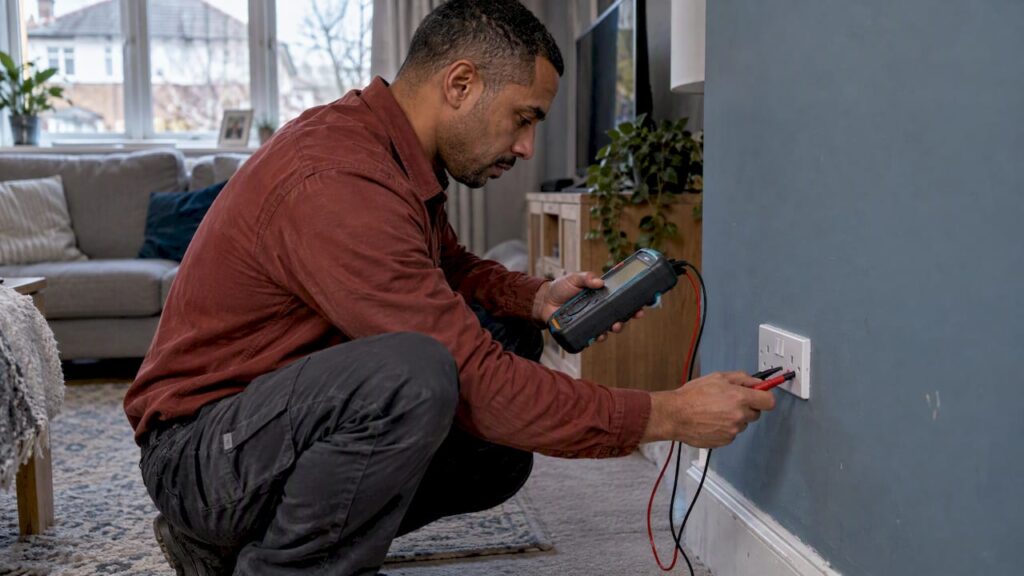
If you rent out a home in England, the electrical certificate you need is an Electrical Installation Condition Report, or EICR. It must be issued by a qualified person at least every five years, and you must give a copy to your tenants. There is no separate “landlord electrical safety certificate” with a different name: people use that phrase for the EICR. This guide covers what the report is, which tenancies it applies to, what happens on the day, how to read the result, and what to do next.
TL;DR
- Landlords in England need a valid EICR for every privately rented home, renewed at least every 5 years or sooner if the report says so.
- Give the report to existing tenants within 28 days of the inspection, and to new tenants before they move in.
- If the report finds faults that need fixing, the work must be done within 28 days or any shorter period stated, and written confirmation sent to tenants and the council.
- PAT testing of appliances you supply is not a named legal requirement for landlords in England, but you must keep those appliances safe, and testing is the usual way to show it.
- Councils can fine landlords who breach the rules, so keep the report, the confirmation of repairs and the dates in one place.
Table of Contents
- EICR, electrical safety certificate and EIC: what is the difference?
- What the law requires in England
- How often you need one, and who can do it
- What happens during a landlord electrical inspection
- What to do if the report finds faults
- Giving the report to tenants and the council
- What happens if you do not have one
- What does a landlord EICR cost?
- Do landlords need PAT testing too?
- Our view: treat the electrical certificate as a schedule, not a one-off
- Getting your landlord EICR booked with us
- FAQ
- Sources
EICR, electrical safety certificate and EIC: what is the difference?
Three names cause most of the confusion.
- EICR (Electrical Installation Condition Report): a report on the condition of the existing fixed wiring and fittings. This is the document landlords need. It is also called periodic inspection and testing, or fixed wire testing.
- Electrical safety certificate: the everyday phrase landlords and letting agents use for the EICR. When a search or a tenancy checklist says “landlord electrical certificate”, it means this report.
- EIC (Electrical Installation Certificate): issued by the electrician when new work or a major alteration is finished, to confirm it meets the standard at the time of installation. NICEIC explains the distinction: an EICR assesses what is already there, an EIC certifies something new.
So a landlord who has had a new consumer unit fitted will hold an EIC for that job, but still needs an EICR for the installation as a whole.
An EICR looks for fire and electric-shock risks. It does not guarantee that nothing will ever go wrong, and it covers the fixed installation: wiring, consumer unit, sockets, switches and light fittings. It does not test your tenants’ own kettles or your supplied washing machine. That is a different job, covered further down.
What the law requires in England
The rules sit in the Electrical Safety Standards in the Private Rented Sector (England) Regulations 2020. Council guidance records that they came into force on 1 July 2020 and applied to new tenancies from 1 April 2021 and to existing tenancies from the same date. Since then every qualifying tenancy has needed a report. Government guidance says installations must be inspected and tested by a qualified person at least every 5 years, and that the duty has been extended to the social rented sector through 2025 amendments.
In practice that means you must:
- Have the installation inspected and tested by a competent person before a new tenancy begins, and then at intervals of no more than five years.
- Obtain a report from that person showing the results and the date of the next inspection.
- Supply the report to tenants and, on request, to the local council.
- Carry out any required remedial work, and confirm it in writing.
Which tenancies are covered
Most assured shorthold and other private tenancies are. The government guidance lists exceptions, including shared accommodation where you or your family live in the property, long leases of seven years or more, student halls, hostels and refuges, care homes, hospitals, hospices and other healthcare accommodation, mobile homes, caravans and boats.
If your property is a house in multiple occupation, the same EICR rule applies, and your licence may add conditions on top. We cover how licence terms affect appliance checks in our HMO PAT testing guide.
Different rules elsewhere in the UK
This article is about England. Scotland, Wales and Northern Ireland have their own rules and timings. In Scotland, the Repairing Standard guidance asks private landlords to keep a copy of the EICR for six years and to give the latest report to prospective tenants before a tenancy starts. If you let across borders, check each nation’s official guidance rather than assuming the English rule carries over.
How often you need one, and who can do it
The baseline is every five years. The inspector may recommend a shorter interval on the report, for example where the installation is old or in poor condition, and if so that shorter date is the one you follow. A new tenancy does not restart the clock, but a new tenant must receive a copy of the current report before they move in.
The inspector must be “qualified and competent” in the words of the guidance. That is a legal test, not a brand, but you can make it easy to demonstrate:
- Ask whether the electrician is registered with a recognised competent person scheme.
- Ask for proof of qualifications in inspection and testing, not only installation work.
- Ask for confirmation of public liability insurance.
- Ask to see a sample report so you know what you will receive.
Some councils spell this out for their own tenants’ contractors: Bristol City Council’s policy, for example, expects electrical workers to hold current qualifications and belong to a competent person’s scheme. It is a sensible standard for any landlord to adopt.
What happens during a landlord electrical inspection
A typical inspection of a flat or small house takes a few hours, and larger or older properties take longer. The inspector:
- Carries out a visual check of the consumer unit, wiring, sockets, switches and fittings.
- Switches the power off at points during testing, so tenants should be told in advance.
- Tests circuits for insulation resistance, earth continuity and the performance of protective devices such as RCDs.
- Records the results circuit by circuit and gives each observation a code.
Give them access to the consumer unit and every room, including lofts and outbuildings that have fixed electrics. Tell tenants well before the day. Access problems cost landlords more repeat visits than any technical problem does.
Reading the codes
The Electrical Safety First landlords’ guide explains that observations are coded C1, C2 and FI:
| Code | Meaning | What it means for you |
|---|---|---|
| C1 | Danger present | Risk of injury. Immediate action needed. |
| C2 | Potentially dangerous | Urgent remedial work needed. |
| C3 | Improvement recommended | Not a failure on its own, but worth planning. |
| FI | Further investigation required | Something could not be confirmed and needs more checking. |
A report with a C1, a C2 or an FI is classed as unsatisfactory. A report with only C3 observations, or none, is satisfactory. Read the overall outcome on the front page, then the list of observations behind it.
What to do if the report finds faults
This is where deadlines bite. Under the government guidance, when an EICR shows that work is needed you must complete the investigative or remedial work within 28 days of the inspection, or sooner if the report sets a shorter period. You then give the tenant and the council written confirmation that the work is done, together with the report, within 28 days of completing it. Councils can serve remedial notices on landlords who do not act.
A sensible order of work:
- Ask the inspector which items are C1 or FI and need action first.
- Get quotes for the remedial work. Many inspectors can quote on the spot, but you are free to use another qualified electrician.
- Have the work done and ask for the electrician’s certificate, normally an EIC or a minor works certificate, as proof.
- If the work was FI investigation, make sure a follow-up report states the outcome.
- Send the confirmation to tenants and, where required, to the council, and keep proof of when you sent it.
If you manage several properties or need other building repairs done alongside electrical fixes, a firm that offers electrical repair services under one contract can save you coordinating multiple trades.
Giving the report to tenants and the council
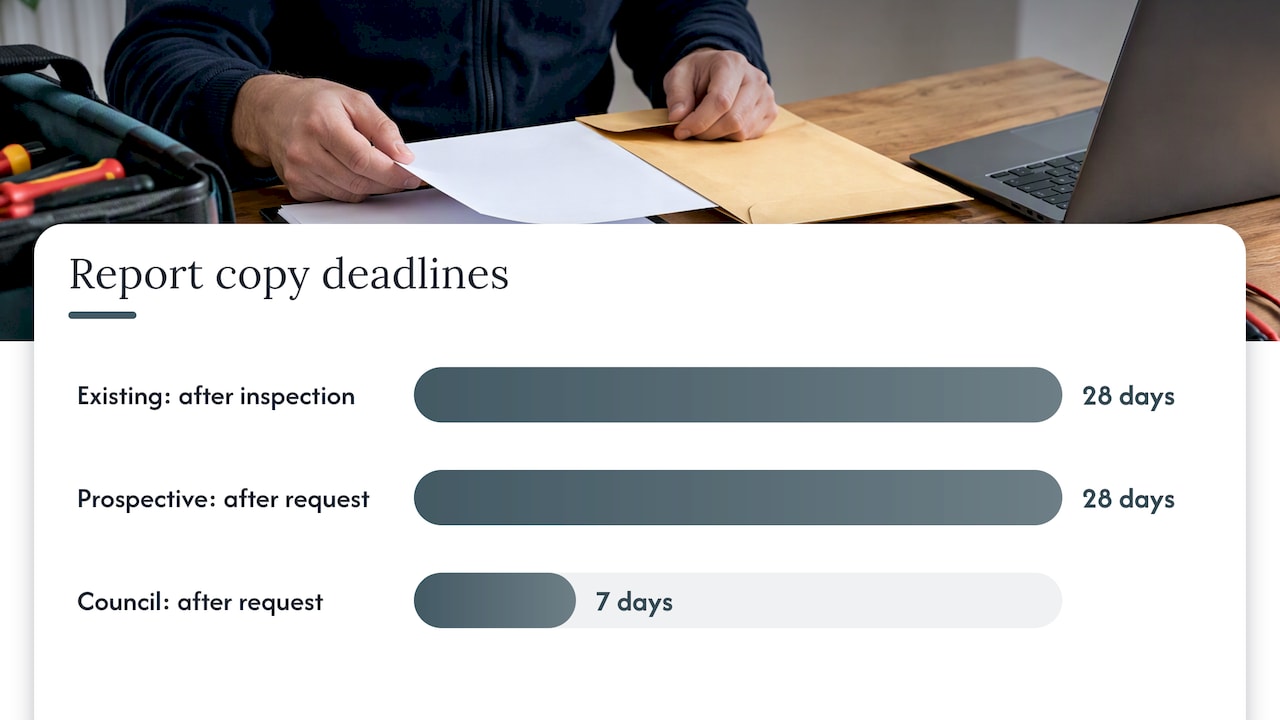
The guidance sets out the timings for England:
- Existing tenants: a copy within 28 days of the inspection.
- New tenants: a copy before they occupy the property.
- Prospective tenants: a copy within 28 days of a request.
- Local council: a copy within 7 days of a written request.
Keep a dated record of how and when you supplied it, such as an email with the PDF attached. The documentation matters beyond the tenant: a valid EICR is part of the paperwork councils look at, and some councils note that failing to provide one can affect a landlord’s ability to regain possession through a Section 21 notice, as Stratford District Council’s pre-tenancy checklist points out. Rules on possession notices have been changing, so check the current position with the government or a housing solicitor before relying on any notice.
Certificates also work in your favour. Electrical Safety First notes that certificates give documentary evidence that an installation met a satisfactory standard if someone later claims an injury or fire was caused by it. For insurers and mortgage lenders, a dated, signed report is the simplest way to show the installation was checked.
What happens if you do not have one
Local authorities enforce the regulations. Where a landlord has breached the duties, councils can impose a financial penalty of up to £30,000, according to one council’s published enforcement policy, and each council applies its own civil penalty policy to decide the level. Penalty levels and powers can be updated, so check the current maximum on GOV.UK or your council’s site.
Beyond fines, there is the practical risk. A property with an unsatisfactory installation, no record and a fire or shock incident is the position no landlord wants to explain to an insurer.
What does a landlord EICR cost?
Price depends mainly on the size of the property and number of circuits. One consumer price guide puts the average for a three-bedroom house at £200 to £250, with smaller flats lower and large houses and HMOs higher. Regional prices vary, and remedial work is always separate.
What moves the price:
- Number of circuits and consumer units.
- Age and accessibility of the installation, including hidden or cluttered boards.
- Whether the property is empty (quicker) or occupied (more coordination).
- Number of properties: portfolios usually allow a better rate per property.
- Travel and parking.
NICEIC suggests getting several quotes from registered inspectors. When you compare them, check that each includes the same scope: a full report, all circuits tested, and a copy for the tenant. A very low headline price that covers only a sample of circuits is not a like-for-like quote.
We do not publish a fixed price list for EICRs, because the cost depends on the property. Contact us for an EICR quote with the number of properties and bedrooms and we will quote for the job.
Do landlords need PAT testing too?
This is the second most common landlord question, and the answer needs care. In England, the EICR regulations cover fixed installations. They do not name portable appliance testing for rented homes. But as a landlord you remain responsible for keeping any appliances you provide, such as a cooker, kettle, washing machine or fridge in a furnished let, in safe condition. Councils such as Stratford note that landlords must maintain supplied appliances and that risk-based PAT testing is often how this is done.
A practical approach:
- Furnished lets: test the appliances and leads you supply when the tenancy begins and at intervals matched to the risk, for instance between tenancies.
- Unfurnished lets: there is little to test, because tenants own their appliances.
- HMOs and shared houses: shared kitchens and communal equipment are heavily used, so checks are usually more frequent. Your licence conditions may say how often.
- Scotland: different rules apply. The Repairing Standard asks landlords to arrange regular in-service inspection and testing of the appliances they supply.
There is no annual legal rule for PAT in England, which we explain in our guide to PAT testing regulations in England. Keep the test labels and certificate, as covered in what PAT testing records to keep.
Our view: treat the electrical certificate as a schedule, not a one-off
We test electrical and fire safety for landlords, property managers and businesses across the UK, and the problems we see are rarely technical. They are administrative. A report exists, but nobody knows where it is, the next inspection date was missed, or the tenant never received a copy.
Our advice is to run each property on a simple schedule:
- Put the next EICR date in your calendar the day the report is issued, with a reminder six months before.
- Store the report, any remedial certificates and the proof that you sent them to tenants in one folder per property.
- Book appliance checks for the same visit window where you can, so tenants are disturbed once, not twice.
- For portfolios, group properties by region and renewal date so inspections can be batched.
That is why we offer electrical and fire safety services through one provider, with clear documentation and scheduling designed to cut disruption and missed dates. A landlord with one flat gets the same paperwork discipline as an agent with fifty.
— Gemma
Getting your landlord EICR booked with us
We carry out EICR and fixed wire testing for landlords and property managers, and PAT testing for the appliances you supply. If you manage several lets, we can coordinate inspections across them and keep the documentation together. Tell us how many properties you have and where, and we will arrange a quote and a schedule.
FAQ
Do all landlords in England need an electrical certificate?
Most private landlords do. Any qualifying private tenancy needs a valid EICR, and the duty has been extended to social landlords. Exceptions include lodgers sharing with the landlord’s family, long leases of seven years or more, student halls, hostels, care homes and similar accommodation.
How long does a landlord electrical certificate last?
A satisfactory EICR lasts up to five years, or less if the inspector sets a shorter date on the report. If you change the installation significantly, ask your electrician whether an earlier re-inspection makes sense.
Is an EICR the same as a PAT test?
No. An EICR tests the fixed wiring and consumer unit. PAT testing checks portable appliances such as kettles, lamps and washing machines. A landlord needs the EICR by law in England, while PAT is the usual way to show supplied appliances are safe.
What if my tenant refuses access for the inspection?
Keep a written record of every attempt to arrange access, offering several dates with proper notice. Ask your council or a housing adviser what steps they expect before you rely on that record. Do not enter without proper notice and agreement.
Sources
- Electrical safety standards in the private and social rented sectors guidance, GOV.UK
- Electrical Installation Condition Reports, NICEIC
- Landlords’ guide to electrical safety, Electrical Safety First
- Private Sector Housing Enforcement Policy 2024, Wiltshire Council
- Landlord’s Pre-tenancy Checklist, Stratford District Council
- Electrical Safety Policy, Bristol City Council
- Repairing Standard statutory guidance, gov.scot
- EICR certificate cost, MyBuilder