
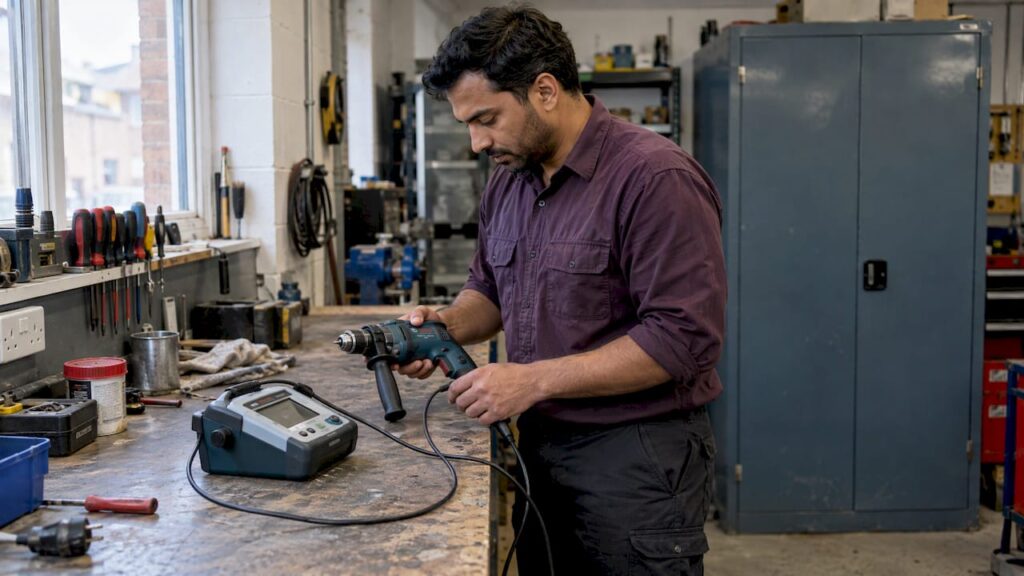
PAT stands for portable appliance testing. It is the examination of plug-in electrical equipment to make sure it is safe to use, and the Health and Safety Executive (HSE) defines it in just those terms. The law does not name PAT as a legal duty. It does require you to keep electrical equipment safe, and a recorded programme of checks and tests is the most practical way to show you have done so. If you want that programme run for you, across one site or many, our PAT testing service is built for exactly that.
TL;DR
- PAT testing is a set of checks on portable electrical items: user checks, formal visual inspections and, where needed, electrical tests with specialist equipment.
- No law says every appliance must be tested every year. The law says equipment must be maintained so it does not cause danger, and the right interval depends on the equipment and where it is used.
- Some faults, such as a broken earth connection or deteriorated insulation, cannot be seen by eye, which is why testing exists alongside visual checks.
- Landlords have separate duties: the fixed wiring report (EICR) is a different job from PAT, and social landlords in England now also have to arrange inspection and testing of the appliances they provide.
- Keep a record of what was checked, when and with what result. It is your evidence if an insurer, inspector or tenant asks.
Table of Contents
- What PAT testing means
- What PAT testing actually checks
- What happens during a PAT visit
- Do you legally need PAT testing?
- How often should PAT testing be done?
- Records, labels and the PAT certificate
- PAT testing and the rules for landlords
- Who is allowed to carry out PAT testing?
- Arranging PAT testing with City PAT
- FAQ
- Sources
What PAT testing means
A portable appliance is, broadly, anything with a plug that can be moved while it is connected to the supply or disconnected from it. The University of Essex’s guide to portable appliances lists easily moved items, larger items that are rarely moved, hand-held items wired in with a lead, mains-connected battery chargers and extension leads.
In practice that means kettles, toasters, monitors, printers, desk lamps, vacuum cleaners, hair dryers, power tools, extension leads and the like. Fixed built-in white goods, USB-powered equipment and chargers with a transformer or USB port built into the plug sit outside that definition in the same guide.

You will also see “in-service inspection and testing”, often shortened to ISIT. It is the formal name for the same activity. The government’s 2025 legislation on social housing describes ISIT as what was previously known as PAT testing.
What PAT testing actually checks
PAT is not one test. It is a layered routine. HSE’s guidance on maintaining portable electrical equipment says effective maintenance combines three things:
- User checks. The person using the item looks for obvious damage before use: a cracked plug, a frayed lead, scorch marks, a loose cable grip.
- Formal visual inspections. A competent person examines the equipment more closely and records what they find. The plug is opened where appropriate, the correct fuse is confirmed and the cable and casing are checked.
- Combined inspection and test. Where the risk justifies it, an electrically competent person uses a portable appliance tester to measure the electrical condition of the item.
The HSE’s answers to common PAT questions put it plainly: most electrical defects can be found by looking, some only by testing, and some cannot be detected by testing alone. That is why a sensible programme never relies on a meter reading by itself.
Why testing adds something that looking cannot
HSE’s guidance explains that some faults cannot be seen at all. A broken earth wire inside a plug, deteriorated insulation or internal contamination can leave an appliance looking perfect while it is unsafe. A combined inspection and test is justified when there is reason to suspect a fault, after any repair or modification, and at intervals suited to the risk.
That is the gap formal testing fills for a shop with a worn-out kettle lead, a workshop with heavily used tools or a landlord with a furnished let.
What happens during a PAT visit
NICEIC, the electrical contracting certification body, describes the process in the three stages above. At the end, you should receive an inventory of results and pass or fail labels showing the inspection date. Anything that fails should be taken out of use.
A typical visit follows this order:
- Asset list. Items are identified and counted, so nothing is missed and the record is complete.
- Visual inspection of every item, its plug and its lead.
- Electrical testing where the item and its environment call for it.
- Labelling. Passed items are labelled. HSE notes in HSG107 that a label can show an item passed and when it was tested, but should not carry a next-test-due date, because you set the interval from your risk assessment.
- Report. You receive a record of every item tested, with failures and recommended action.
The weak points in a PAT job are rarely the testing itself. They are items missed because they were in a drawer, a home-office laptop charger that was not in the list, a site that was tested last year but lost its paperwork, or a failed item that went back into use. Complete asset lists, clear documentation and scheduling are where a good provider earns their fee. Our approach at City PAT is built around clear documentation and scheduling designed to minimise disruption and missed inspection dates, whether you have one office or a chain of sites.
Do you legally need PAT testing?
This is the question behind most searches, and the honest answer has two halves.
PAT testing by name is not a legal requirement. HSE’s guidance on low-risk environments calls it a myth that every portable appliance in a place such as an office needs a PAT test every year. The law requires employers to make sure electrical equipment is maintained to prevent danger. It does not set out what must be done or how often.
A duty to keep equipment safe is a legal requirement. The Electricity at Work Regulations 1989 and the Provision and Use of Work Equipment Regulations 1998 both require workplace equipment to be maintained. The BBC’s electrical safety guidance sets this out and notes that the frequency of inspection and testing varies by equipment type.
Put those together and the practical position is this. You need a maintenance system that fits your risks, and you need to be able to show it. For most employers that means regular checks plus periodic formal inspection and testing, with records. Our own page on PAT testing regulations in England goes through the no-annual-rule position for employers and landlords in more detail.
It also matters for insurance. An insurer, after an electrical fire or injury, will want to see that you maintained your equipment. A dated, itemised record is far easier to produce than an explanation.
What about new equipment?
HSE says new equipment should be supplied in a safe condition and does not need a formal PAT inspection or test, though a simple visual check to confirm it is undamaged is recommended. The test then comes into play after repairs, damage or when items move into a harsher environment.
Battery-powered and low-voltage items
HSE’s table for low-risk workplaces shows that battery-operated equipment below 40 volts needs no user check, formal visual inspection or combined inspection and test in those environments. The BBC’s guidance, by contrast, makes clear the duty to maintain applies whether equipment is battery operated or mains-powered. In practice, the mains charger for a battery tool is the item that comes into scope. Where site tools run at 110V, see our guide to 110V PAT testing in England.
How often should PAT testing be done?
There is no single answer, and that is by design. HSE says the right frequency depends on the equipment and its environment: a power tool on a construction site needs examining more often than a lamp in a hotel bedroom.
HSG107 includes a table of suggested starting frequencies for user checks, formal visual inspections and combined inspection and testing. These are not legal requirements. You can lengthen intervals if few faults turn up and shorten them if faults are common. HSE describes the approach as proactive: the plan should prevent incidents rather than respond to them.
Here is how that plays out for different workplaces, as an illustration of the reasoning rather than a rule:
| Setting | Typical risk profile | How the interval tends to be set |
|---|---|---|
| Office | Low: desk equipment, little movement | Longer intervals for testing, with regular user checks and visual inspections |
| Retail | Mixed: tills, displays, staff-room appliances, public contact | Shorter for items handled often or moved around |
| Hotel | Mixed: guest-room lamps and hairdryers, back-of-house kitchen equipment | Different intervals for guest-room items and heavy-use items |
| School | Many users, classroom equipment moved regularly | Risk-based, with more attention for heavily used and portable items |
| Construction site | High: tools, extension leads, rough handling | Much more frequent checks |
If you want the detail behind setting those intervals, PAT testing frequency in the UK is covered in a dedicated guide, and our own page on setting PAT testing frequency works through the 3 to 60 month range used in England.
We tailor the plan to your sector. We have pages for offices, retail businesses, schools, hotels and construction sites.
Records, labels and the PAT certificate
People often ask what a PAT certificate is. It is the report that lists each item tested, the result and the date. HSE says there is no legal requirement to keep maintenance logs, but a suitable log is useful. It shows what you have done, helps you decide whether intervals are right and gives you something to hand an insurer or enforcing officer.
A good record contains:
- a unique ID or description for every item
- its location
- the type of check carried out (visual only, or visual and electrical)
- the result and date
- any repair, retest or removal from use
For a single site, a spreadsheet can hold this. For several sites, the problem is keeping it consistent and making sure nothing drops off the schedule. We coordinate multiple electrical and fire safety services through one provider and manage testing across single and multi-site locations, so your records and dates sit in one place.
PAT testing and the rules for landlords
Landlords tend to mix up three different things, so it helps to separate them.
- PAT covers plug-in appliances.
- EICR (Electrical Installation Condition Report) covers the fixed electrical system: wiring, sockets and the consumer unit. NICEIC stresses the two should not be confused. Our guide explains what an EICR is.
- Social landlord appliance testing is a recent change.
The 2025 amendments to the Electrical Safety Standards in the Private Rented Sector (England) Regulations 2020 extend five-yearly electrical installation checks to social landlords. They also require social landlords to make sure electrical equipment they provide under a tenancy is safe and that it is inspected and tested at least every five years. A copy of the report goes to tenants on request, and remedial work has to be completed within 28 days.
The government’s June 2025 response explained that evidence of testing is provided with the EICR, so the visit confirms testing is up to date, and that the inspector recommends frequency by appliance type and use. NICEIC reports that the rules apply from November 2025 for new tenancies and May 2026 for existing ones, so both dates have now passed.
If you are a landlord who supplies kettles, microwaves, lamps or other appliances with a let, bringing the PAT and EICR together in a single visit is the tidy route. See our pages on PAT testing for landlords and EICR and fixed wire testing. Social landlords should check their own obligations under the 2025 Regulations, and any landlord unsure of their position should take advice from their local authority or a solicitor.
Who is allowed to carry out PAT testing?

HSG107 describes two levels of competence. At the simpler level, a person without electrical skills uses a basic pass/fail tester where no interpretation is needed. At the higher level, a person with electrical skills uses a more sophisticated instrument whose readings need interpreting. The employer’s duty is to make sure whoever tests is competent.
For most businesses, the sensible answer is a provider whose engineers do this every day, who use calibrated equipment and who hand over a full report. That protects the person signing the risk assessment as much as it protects staff and customers.
Our view
Most business owners we talk to are not worried about the electrics. They are worried about the paperwork, the missed date and the question an insurer might ask after an incident.
PAT testing is a good example. The law does not hand you a fixed schedule, which sounds like freedom but really means you carry the judgement. Somebody has to decide which items are in scope, how often each needs a visual check or a test, and how to prove it was done. If that decision lives in one person’s head, or in a different spreadsheet at each site, it tends to fail at the worst moment.
That is why we coordinate electrical and fire safety work through one provider: PAT, EICR, fire alarm testing, emergency lighting, extinguisher servicing and fire risk assessments. One set of documents, one schedule, nationwide support, and testing planned to minimise disruption to your working day.
The best PAT programme is the one that runs without you having to think about it, and still stands up when someone asks to see it.
Gemma
Arranging PAT testing with City PAT
If you have worked out what you own and roughly how risky its use is, the next step is getting it done and documented. City PAT carries out portable appliance testing on site for businesses, landlords and organisations across the UK, for single sites or several. Our PAT testing page explains how to book, and our PAT testing checklist shows what to prepare before and after the visit.
Because we also handle EICRs, fire alarm and emergency lighting testing, extinguisher servicing and fire risk assessments, you can put all of your recurring compliance dates with one provider rather than several. Start at citypat.co.uk.
FAQ
Is PAT testing a legal requirement?
Not by name. HSE says the law requires employers to maintain electrical equipment so it does not cause danger, but it does not set a frequency or insist on PAT. A planned programme of checks, testing where justified and records is the usual way to meet that duty.
Do extension leads need PAT testing?
Yes, they come within the definition of portable equipment, and they are often among the most knocked about items in a workplace. Your risk assessment sets how often they are checked and tested, with heavy-use settings such as building sites needing far more frequent attention.
What is a PAT testing certificate?
It is the report issued after testing, listing each item, its result and the date, usually with pass or fail labels on the equipment. HSE says there is no legal requirement to keep a maintenance log, but a suitable record is useful evidence of what you have done.
Do new appliances need testing?
HSE says new equipment should arrive in a safe condition and does not need a formal inspection and test, though a simple visual check for damage is recommended. Testing becomes relevant once the item has been in use, repaired or moved to a harsher environment.
Sources
- HSE: PAT (portable appliance testing) answers to popular questions
- HSE: Maintaining portable electric equipment in low-risk environments (INDG236)
- HSE: INDG236 leaflet (PDF)
- HSE: Maintaining portable electrical equipment (HSG107)
- University of Essex: Portable appliance testing overview
- BBC: Safety of electrical equipment and appliances
- NICEIC: Portable appliance testing guide
- NICEIC: EICRs in the rented sector
- legislation.gov.uk: SI 2025/1043 Explanatory Memorandum
- GOV.UK: Government response on electrical safety in the social rented sector
- PAT testing frequency in the UK