
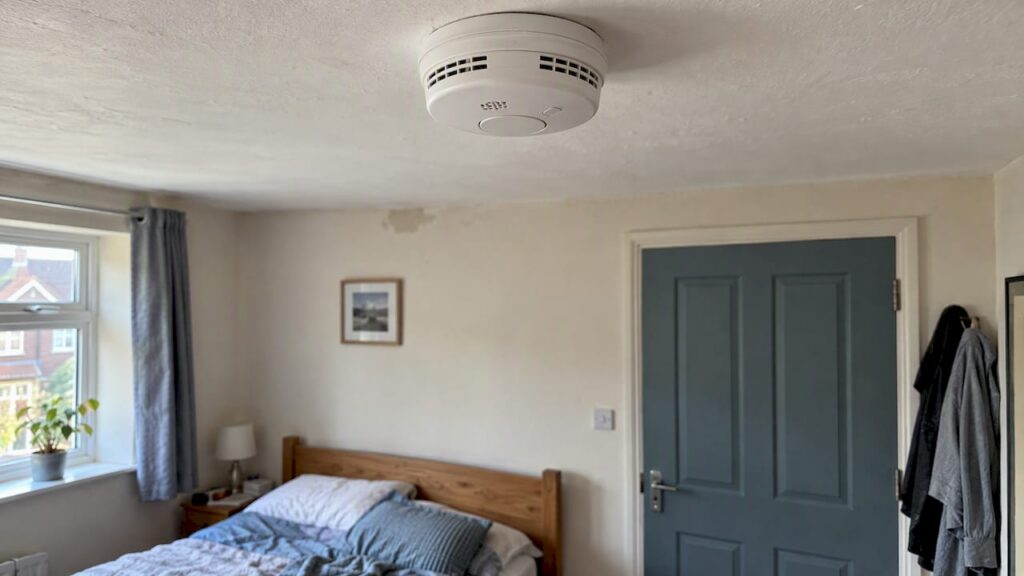
If you let a home in England, you must fit working smoke alarms, keep escape routes clear, supply fire-safe furniture and make sure the electrics and any gas appliances are checked. Shared buildings and houses in multiple occupation (HMOs) add a written fire risk assessment and, often, more equipment. This guide sets out what applies to which type of property, what to keep as evidence, and what happens if you fall short.
TL;DR
- Every storey used as living accommodation needs at least one smoke alarm, and any room with a solid-fuel appliance needs a carbon monoxide alarm, according to GOV.UK’s landlord safety guidance.
- Escape routes must be accessible to tenants at all times, and furniture you supply must be fire-safe.
- An EICR (electrical installation condition report) is expected at least every five years, and gas appliances need an annual Gas Safety Certificate.
- HMOs and shared buildings fall under the Fire Safety Order: the responsible person needs a written fire risk assessment and should review it regularly.
- Wales, Scotland and Northern Ireland have different rules, so check which nation your property is in.
Table of Contents
- Who is responsible for fire safety in a rented property?
- Smoke and carbon monoxide alarms
- Escape routes, fire doors and furnishings
- Electrical and gas safety checks
- Fire risk assessments: when you need one
- HMOs and larger properties
- Do the rules differ across the UK?
- What about changes in 2026?
- What happens if you get it wrong?
- A landlord’s fire safety schedule
- Our view on landlord fire safety
- Getting your checks done in one visit
- FAQ
- Sources
Who is responsible for fire safety in a rented property?
The landlord. The government’s guidance says you must keep the property safe and free from health hazards, meet gas and electrical safety duties, follow fire safety regulations, fit alarms and keep escape routes accessible (GOV.UK). Using a letting agent does not move the duty. An agent may manage the property day to day, but if the paperwork is missing, it is your name on the tenancy.
Which rules bite hardest depends on the kind of property. Fire services point out that the measures needed depend on the property type, the number of storeys and when it was built or converted (Devon and Somerset Fire and Rescue Service). A two-bed terrace let to one family is treated very differently from a converted house let to five sharers, or a block of flats with shared stairs.
Three broad groups are worth separating:
| Type of let | Main fire safety regime | What it means in practice |
|---|---|---|
| Single household house or flat | Smoke and carbon monoxide alarm rules, electrical safety rules, gas safety, furniture rules | Alarms, tested at the start of each tenancy, EICR, gas certificate, compliant furnishings |
| HMO | Fire Safety Order plus licence conditions where a licence applies | Written fire risk assessment, fire doors on escape routes, often fire alarm and extinguishers |
| Flat in a multi-occupied building | Fire Safety Order for common parts, plus the above for each flat | Assessment covering external walls, flat entrance doors and management arrangements |
Smoke and carbon monoxide alarms
This is the part every landlord must get right, and it is the easiest to prove.
In England you must provide a smoke alarm on each storey of the property where there is living accommodation, and a carbon monoxide alarm in any room with a solid-fuel appliance such as a wood burner or coal fire (GOV.UK). The rules were extended from 1 October 2022, so that social landlords are covered as well as private ones, and the carbon monoxide duty widened to rooms with fixed combustion appliances other than gas cookers, according to a summary of the amendment regulations.
The working rules are simple:
- Fit at least one smoke alarm on every floor.
- Fit a CO alarm wherever there is a solid-fuel appliance, and consider one beside gas boilers and other combustion appliances even where the law does not require it.
- Test every alarm on the first day of each new tenancy and record it.
- Repair or replace any alarm reported as faulty promptly.
Tenants are responsible for testing alarms during the tenancy, but only if they have been told how and the alarm is working to begin with. A short handover sheet and a dated photo of each alarm at move-in solves most disputes before they begin.
Mains-wired or battery?
For a standard single-household let, English law does not demand mains-wired, interlinked alarms. That is different in Scotland, where the Tolerable Standard requires interlinked fire and smoke alarms (Scottish Government), and Wales, where landlords must ensure mains-wired smoke alarms (Welsh Government). Many English landlords choose interlinked alarms anyway, because one alarm sounding throughout the house gives tenants earlier warning. If you are weighing the options, our note on why wireless beats wired for most UK homes covers fitting time and disruption.

Escape routes, fire doors and furnishings
You must check that tenants can reach escape routes at all times (GOV.UK). In practice that means:
- No bikes, bins, pushchairs or stored furniture in hallways and stairwells you control.
- Front and internal exit doors that open easily from inside without a key where a lock is fitted.
- Clear, lit stairs, particularly in converted buildings with shared access.
Where a licence is required, or the property is an HMO, doors leading onto escape routes must be fire doors (Devon and Somerset Fire and Rescue Service). A fire door only works if it closes fully, so check the closer, the seals and the gaps, and do not wedge it open.
Any furniture you supply, from sofas to mattresses, must be fire-safe under the government’s list of landlord duties. Look for the permanent label on upholstered items and keep receipts for furniture you buy.
Electrical and gas safety checks
Fire and electrical safety overlap, since faulty wiring and appliances are a common cause of house fires. Hampshire and Isle of Wight Fire and Rescue Service advises landlords to provide a valid Gas Safety Certificate annually for gas appliances and to ensure an EICR is carried out every five years (Hampshire and Isle of Wight FRS). Keep the certificates and give copies to tenants. Any urgent remedial work flagged by the inspector (coded as a danger present or potentially dangerous) should be fixed and signed off, not filed away.
We carry out EICR and fixed wire testing for landlords and property managers, with reports written so you can pass them to a tenant, an agent or a licensing officer without further explanation.
What about PAT testing?
There is no blanket annual legal requirement to PAT test appliances in a let property, but if you supply appliances such as kettles, washing machines or lamps, you are responsible for their safety. The right interval comes from risk, the type of appliance and, for HMOs, licence conditions. Our guides on PAT testing rules in England, HMO PAT testing and licence terms and what PAT records to keep go into the detail.
Fire risk assessments: when you need one
A single household let does not normally need a formal written assessment under the Fire Safety Order, though thinking through the risks is still sensible. Shared spaces change that. Under the Order, the responsible person for an HMO may be the landlord or the managing agent, and must carry out a written, recorded fire safety assessment (Luton Borough Council HMO fire guide).
For HMOs, that assessment must consider fire spread via external walls, the performance of flat entrance doors, and the management arrangements for maintaining fire safety measures, following the Fire Safety Act 2021 and the Fire Safety (England) Regulations 2022 (Luton Borough Council). The 2022 Regulations introduced additional duties for responsible persons under the Order (GOV.UK fire safety legislation guidance).
A good assessment records:
- The people at risk, including anyone who sleeps on the premises or is less mobile.
- Ignition sources, fuel and ways a fire could spread.
- The detection, warning, lighting and firefighting equipment in place.
- Escape routes and how long they take to use.
- Actions with owners and dates, plus the date of the next review.
Devon and Somerset Fire and Rescue Service recommends reviewing assessments regularly, at least once a year (Devon and Somerset FRS). Review sooner after any change: new occupants, a conversion, a loft room, a new kitchen layout or a failed inspection.
HMOs and larger properties
Large HMOs are expected to have fire alarms and extinguishers, and the government’s landlord guidance lists this explicitly (GOV.UK). Your council’s licence conditions can go further, specifying alarm grades, emergency lighting, fire door standards or extinguisher placement. Read the licence as a checklist and ask your council if anything is unclear.
For a licensed HMO, a typical compliance set includes:
- A current fire risk assessment.
- Fire alarm servicing, with a fire alarm logbook recording weekly tests, faults and service visits.
- Emergency lighting testing where escape routes need lighting if the power fails. If you are budgeting, see what emergency lighting tests cost and why repairs matter.
- Annual extinguisher checks and fire blankets where specified.
- EICR and Gas Safety Certificates.
Do the rules differ across the UK?
Yes, and it matters if you hold properties in more than one nation.
- Wales: landlords must ensure dwellings are fit for human habitation at the start of and during an occupation contract (Welsh Government).
- Scotland: fire and carbon monoxide safety sit within the Tolerable Standard. Private landlords must provide a smoke alarm in the main daytime living room, one in each circulation space on every storey, and a heat alarm in every kitchen (Scottish Government).
- Northern Ireland: the Smoke, Heat and Carbon Monoxide Alarms for Private Tenancies Regulations 2024 require interlinked smoke and heat alarms, with heat alarms in every kitchen (legislation.gov.uk).
None of this applies in England unless the English rules say so. If a competitor’s guide quotes a heat alarm in every kitchen as a universal requirement, it is describing Scotland or Northern Ireland.
What about changes in 2026?
The Renters’ Rights Act 2025 is reshaping tenancies in England, but it is primarily about tenancy terms rather than fire equipment. Your fire duties still come from the alarm regulations, the Fire Safety Order and its 2022 amendments, electrical safety rules and your licence conditions. Because dates and commencement stages move, check the GOV.UK landlord safety page before each new tenancy rather than relying on any guide, ours included.
What happens if you get it wrong?
The practical consequences arrive in a sequence. If a private landlord will not fix or fit alarms, a tenant can complain to the council, which can order the landlord to fit and test them within 28 days (Shelter England). Beyond that, missing safety records can complicate an insurance claim after a fire, put an HMO licence at risk and, where someone is hurt, expose you to far more serious action. Insurers commonly ask for evidence that checks were carried out, and proof that you did them is the thing that protects you.
A landlord’s fire safety schedule
Use this as a starting calendar and adjust it to your licence and property.
| When | What to do | What to keep |
|---|---|---|
| Before every new tenancy | Test all smoke and CO alarms, check escape routes, check furniture labels | Dated checklist and photos |
| Annually | Gas safety check, review fire risk assessment (HMOs and shared buildings), extinguisher service | Gas certificate, assessment, service tags |
| At least every five years | EICR, or sooner if the report says so | EICR and proof that remedial work was done |
| Weekly, in shared buildings with a fire alarm | Alarm test | Logbook entry |
| Quarterly and annually | Emergency lighting flick and full-duration tests where fitted | Test record |
| After any change | Update the assessment, tell tenants | New dated version |
Our view on landlord fire safety
Most landlords we meet are not careless. They are busy, own a handful of properties and are unsure which of five different certificates matters this month. The biggest risk we see is not an absence of effort but a patchwork: an EICR from one contractor, extinguisher tags from another, an alarm check with no record at all, and nothing that ties the dates together.

So our advice is to treat fire safety as one schedule, not six jobs. Put every due date for a property in one place, book related visits together so tenants are disturbed once, and keep every report where an agent, insurer or council officer can find it in minutes. Where a property has shared areas, get the fire risk assessment done first, because it tells you what else the building needs and stops you buying equipment you do not need.
And where you are unsure whether a rule applies to you, ask the council or your fire and rescue service. They would rather answer a question than attend an incident.
— Gemma
Getting your checks done in one visit
We coordinate electrical and fire safety services through one provider across the UK, so a landlord or property manager can handle several properties with clear documentation and scheduling designed to minimise disruption and missed dates. A fire risk assessment is the usual starting point for an HMO or block, and we can add fire alarm testing, extinguisher servicing and EICRs to the same plan. You can also start from our main site to request a quote.
FAQ
How many smoke alarms does a landlord need in England?
At least one on every storey of the property used as living accommodation. A carbon monoxide alarm is also required in any room with a solid-fuel appliance. Many landlords fit more, such as a heat alarm in the kitchen, but that goes beyond the minimum for English single-household lets.
Does a landlord need a fire risk assessment for a normal rented house?
Not usually a formal written one for a single household let, but HMOs and the shared parts of multi-occupied buildings fall under the Fire Safety Order, where a written assessment is required. If you are unsure which category you fall into, ask your local council or fire and rescue service.
How often should alarms be tested?
Test them at the start of every new tenancy, then make sure tenants know how to test them and report faults. For shared-area fire alarm systems in HMOs and blocks, keep a logbook of regular tests and service visits.
What can a tenant do if the landlord has not fitted alarms?
They can complain to the council, which can order the landlord to fit and test alarms within 28 days. Shelter England sets out the process in its fire safety advice.
Sources
- Private renting: your landlord’s safety responsibilities (GOV.UK)
- Fire safety for landlords (Hampshire and Isle of Wight Fire and Rescue Service)
- Landlords, letting agents and property managers (Devon and Somerset Fire and Rescue Service)
- Guide to fire safety in houses in multiple occupation (Luton Borough Council)
- Fire safety: guidance for those with legal duties (GOV.UK)
- Fire safety in rented homes (Shelter England)
- Smoke and carbon monoxide alarm regulations: a guide for UK landlords
- Fitness of homes for human habitation: guidance for landlords (Welsh Government)
- Renting Homes: checklist for landlords and tenants (Welsh Government)
- Repairing standard: Annex A, meeting the Tolerable Standard (Scottish Government)
- Repairs and maintenance obligations (Scottish Government)
- Smoke, Heat and Carbon Monoxide Alarms for Private Tenancies Regulations 2024 (legislation.gov.uk)